Joint forensic investigation launched at Hanwha Aerospace's Daejeon plant; dedicated police and prosecution teams formed to determine cause; explosion at cleaning room follows deadly blasts in 2018 and 2019; concerns mount over impact on exports and arms deliveries
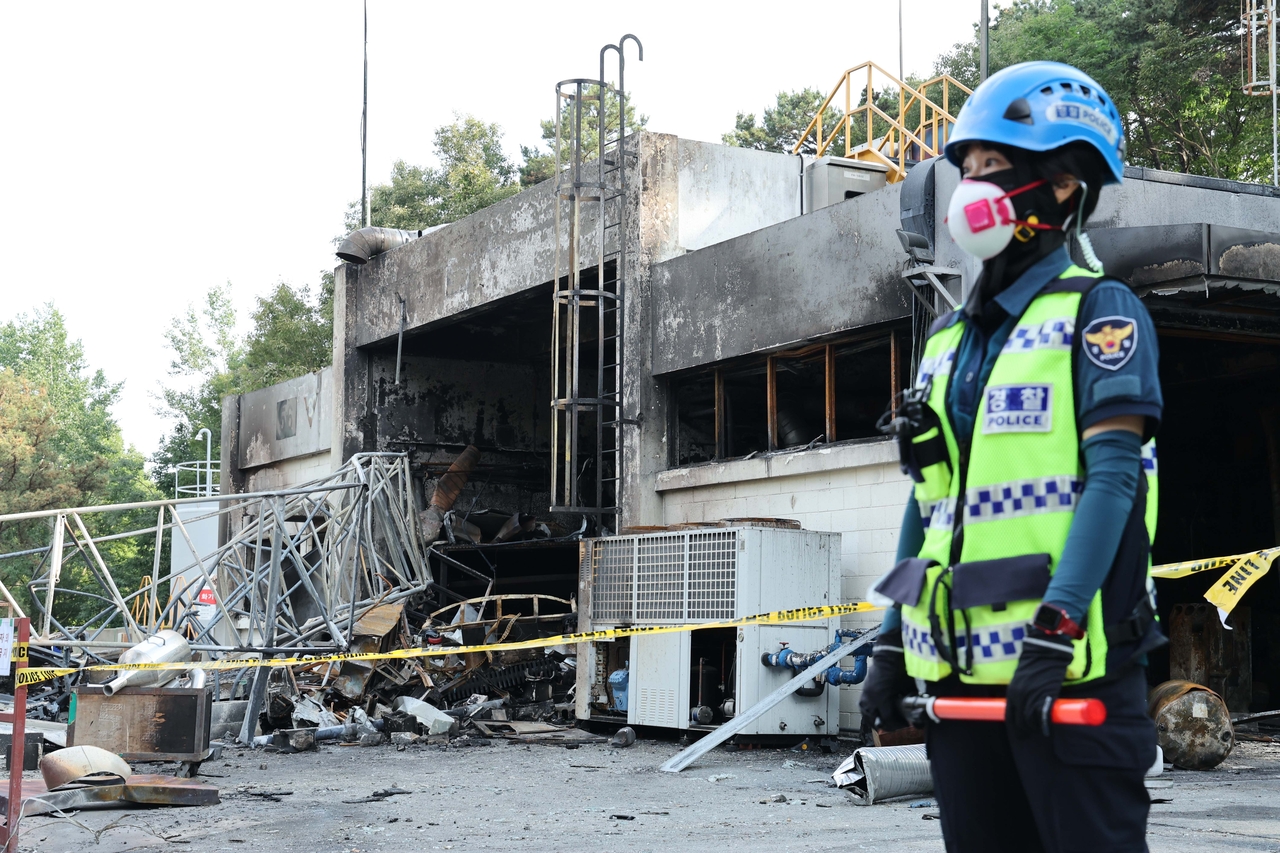
Police and fire authorities launched a joint forensic investigation Monday into the explosion at Hanwha Aerospace's Daejeon factory that left seven workers dead or injured. The same facility was struck by deadly blasts in 2018 and 2019, killing five and three workers respectively, prompting calls for a thorough examination of root causes and fundamental safety reforms. Concerns have also emerged that the investigation's findings could affect the safety certification of the company's export products.
Police, fire officials, the National Forensic Service and the Korea Occupational Safety and Health Agency began a detailed joint inspection of the scene at 10 a.m. Monday, with the goal of establishing what triggered the explosion.
According to police and fire authorities, the blast and subsequent fire broke out at around 10:59 a.m. Sunday in the cleaning room of Building 56 at the Hanwha Aerospace Daejeon factory in Oesamdong, Yuseong-gu, Daejeon. Hanwha said seven workers had been cleaning tools contaminated with propellant — an explosive compound — at the time of the accident.
About 20 minutes after the explosion, at around 11:17 a.m., fire authorities declared a Level 1 emergency response and deployed 33 vehicles and 101 personnel to fight the blaze, which was brought under control roughly two hours later. Five workers died in the accident and two sustained serious injuries; one of the injured suffered severe burns across the body.
Eom Hyo-sik, head of the defense and security division at the Korea Defense and Security Forum who worked at Hanwha during the 2018 and 2019 accidents, said propellant is a sensitive material that can ignite even from static electricity. He added, however, that investigators should keep multiple possibilities open — including whether the explosion actually originated in the cleaning room or in an adjacent workspace.
The Daejeon Metropolitan Police Agency and the Daejeon District Prosecutors' Office each formed dedicated investigation teams to determine the cause of the blast and examine whether the company bears any negligence. The Ministry of Employment and Labor issued an immediate work-suspension order at the Hanwha Aerospace site and opened a probe into possible violations of the Occupational Safety and Health Act and the Serious Accidents Punishment Act.
The Daejeon factory has now been the site of three major explosions, with the two earlier incidents claiming eight lives in total. In May 2018, two workers died at the scene and three others who sustained burns died while receiving treatment. In February 2019, an explosion and fire in the propellant demolding room of Building 70 killed three more workers.
Both previous accidents were attributed to inadequate safety management. In the 2018 incident, investigators found that workers had struck the valve of a propellant container with a rubber mallet after the filling equipment malfunctioned. The 2019 blast occurred when residual static electricity inside a rocket propellant body reacted with the explosive material — it later emerged that a grounding device to discharge static electricity had never been installed.
The Ministry of Employment and Labor conducted special labor inspections and safety audits after those accidents, but the recurrence of a fatal disaster seven years later means the factory's safety practices are now squarely back under scrutiny.
At a briefing Sunday, Hanwha said the cleaning room where the accident occurred had been classified as a low-risk area. The company said flame-retardant suits and blast barriers were installed in certain zones and that some spaces were partially isolated, but added that the precise point of the explosion still needed to be confirmed.
Shin Jong-woo, secretary-general of the Korea Defense and Security Forum, said investigators must examine whether safety protocols were strictly followed, and expressed puzzlement that a fire could break out in a room used routinely for cleaning. "This isn't a place that started cleaning yesterday," he said.
Kong Ha-seong, a professor in the fire and disaster prevention department at Woosuk University, said static electricity management is the cornerstone of safety in high-risk propellant processes, and that even a minute charge can trigger a large explosion. He added that static electricity can build up in unexpected ways — during high-pressure water use or from friction against work clothing.
Concerns have also been raised that the investigation's outcome could disrupt future exports and deliveries. The Daejeon facility is understood to produce the Korea Tactical Surface-to-Surface Missile (KTSSM), the Chunmoo multiple rocket launcher, the long-range surface-to-air missile L-SAM and the air defense system Cheongung-II.
Eom said the safety record of exported weapons systems could take a hit depending on which products the affected propellant was destined for, and stressed that a thorough investigation was needed to dispel anxiety among importing countries.
Both major union federations issued statements condemning the accident as a systemic failure of safety management and demanding severe punishment for those responsible and the introduction of concrete preventive measures.
The Korean Confederation of Trade Unions said officials indicted over the 2018 and 2019 explosions received suspended sentences and Hanwha was fined only 50 million won (about $33,100), calling the lenient penalties a direct cause of the latest deaths. "Perfunctory, slap-on-the-wrist punishment has once again led to a serious industrial disaster and cost workers their lives," the federation said.
The Federation of Korean Trade Unions also issued a statement saying that the recurrence of similar accidents at the same facility made a comprehensive review of the safety management system and disaster-prevention framework unavoidable, and called on the government and the company to clearly establish the cause and fix responsibility.
Employment and Labor Minister Kim Young-hoon pledged a thorough investigation, saying, "There is no such thing as a low-risk workplace where weapons are made."
President Lee Jae Myung said it was "a serious problem" that the same type of accident had recurred repeatedly at the same facility. Speaking at a Cabinet meeting Monday, he directed the Ministry of Employment and Labor to compile a list of workplaces with repeated accidents of the same type and report back, and urged relevant authorities to investigate the cause thoroughly, establish measures to prevent recurrence and conduct safety inspections at similar facilities without delay.
arin@heraldcorp.com
20ki@heraldcorp.com
youknow@heraldcorp.com