
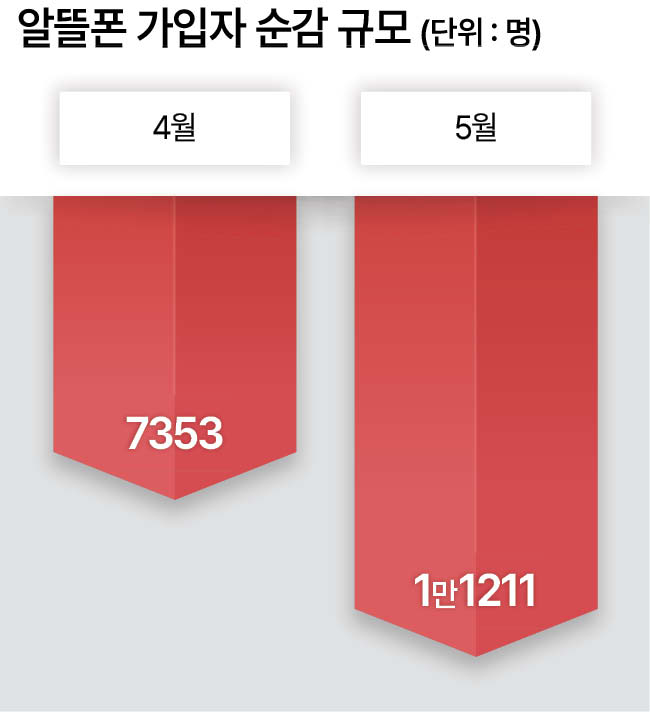
7,353 subscribers left in April, 11,211 in May
Big three telecom marketing spending hits record levels
Bundled plans starting at 20,000 won launch this month
Industry calls on government to end 'reverse discrimination' against MVNOs

South Korea's three major telecom carriers have dealt a heavy blow to the mobile virtual network operator industry by pouring record sums into subscriber acquisition, with nearly 20,000 MVNO customers switching to the big three over the past two months.
The pressure on MVNO operators is set to intensify as LG Uplus leads the big three in rolling out bundled plans priced in the 20,000-won ($14) range starting this month.
According to the Korea Telecommunications Operators Association, MVNO net subscribers fell by 11,211 in May. Of those, 77,111 subscribers moved to one of the three major carriers while 65,900 new subscribers joined MVNO services.
The net loss in April stood at 7,353, bringing the combined two-month total to 18,564 MVNO departures.
Industry insiders attribute the exodus to a bruising subscriber war among the big three, arguing that record-level marketing spending has pulled in even budget-carrier customers.
The battle intensified following SK Telecom's personal data breach last year, which triggered a suspension of new sign-ups from May 5 to June 23 last year — 51 days — and penalty-free contract cancellations from April 19 to July 14 last year, a span of 86 days. KT also offered penalty-free cancellations from Dec. 31 last year to Jan. 13 this year, a 14-day window. The fallout from that cutthroat competition spilled over into the MVNO sector.
SK Telecom spent 725 billion won ($524 million) on marketing in the second quarter of last year, 719 billion won ($520 million) in the third quarter, 763.5 billion won ($552 million) in the fourth quarter, and 740.8 billion won ($536 million) in the first quarter of this year — the highest average marketing spend among the three carriers. The outlays came after SK Telecom's mobile network operator market share fell below 40 percent last year.
KT spent approximately 655.8 billion won ($474 million) in the second quarter of last year — when SK Telecom was offering penalty-free cancellations — up from 625.5 billion won ($452 million) in the first quarter, and about 669.8 billion won ($484 million) in the third quarter. Spending jumped to roughly 883.8 billion won ($639 million) in the fourth quarter, coinciding with KT's femtocell mismanagement and a resulting data breach affecting approximately 20,000 customers. In the first quarter of this year, KT spent about 687.3 billion won ($497 million).
LG Uplus posted marketing expenditure of 549.8 billion won ($397 million) in the first quarter of last year and 531.9 billion won ($384 million) in the second quarter, before rising to 580.2 billion won ($419 million) in the third quarter, then dipping slightly to 547.5 billion won ($396 million) in the fourth quarter. The carrier then spent 614.2 billion won ($444 million) in the first quarter of this year.
Adding to the pressure, LG Uplus, SK Telecom and KT have all announced plans to launch bundled plans priced in the 20,000-won range in succession this month.
LG Uplus launched its DataPlan 300MB offering at 28,000 won ($20) per month on Tuesday, the first of an 18-plan lineup offering unlimited data use with speed caps. SK Telecom is set to follow on July 2 with 26 unlimited plans — also subject to speed limits — including its existing T-Together Customized plan at 27,830 won ($20) per month.
"When the government pushes the big three, the MVNO industry inevitably gets caught in the crossfire," an industry official said. "If the president's campaign pledges are to be implemented, they must apply equally to MVNOs. Simply rolling out plans that resemble MVNO offerings without extending the same terms leaves MVNOs unable to compete with the big three — it amounts to reverse discrimination that the MVNO industry is being forced to absorb."
ko@heraldcorp.com





