EV-dedicated production line backed by 2 trillion won investment
Processes and equipment built from the ground up for electric vehicles
GV90 nears mass production after quality refinements
First major overhaul of Ulsan plant in 60 years gets underway
![The Genesis 'Neolun Concept,' believed to be the concept model for the GV90. [Hyundai Motor]](https://wimg.heraldcorp.com/news/cms/2026/06/02/news-p.v1.20260602.ab936ba9237e4e278378db93cebc6a0a_P1.png)

Hyundai Motor Group Chairman Euisun Chung recently visited Hyundai Motor's dedicated electric vehicle factory in Ulsan to review production readiness, industry sources confirmed. The visit amounts to a final inspection ahead of the new plant's full launch, with observers noting that mass production of the Genesis GV90 — a large electric SUV — is now imminent.
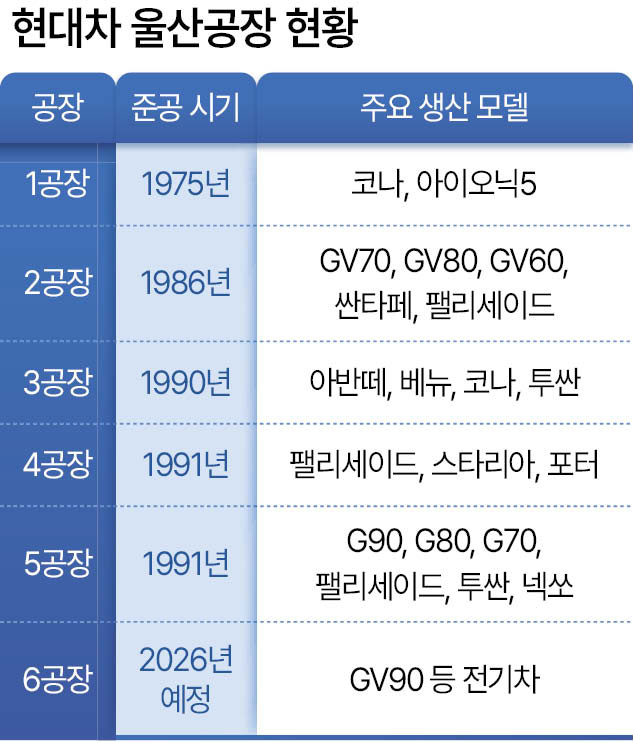
Chung visited the Ulsan EV-dedicated factory, known as Plant 6, in late May to assess equipment installation and mass production preparations, according to industry sources. The factory, completed at the end of last year, is on the verge of beginning operation. With the GV90 — Genesis's first flagship electric vehicle — expected to enter full mass production around September, the visit is widely read as a final on-site check.
The Ulsan EV-dedicated factory is the first new domestic passenger vehicle plant Hyundai Motor has built in about 29 years, since the Asan factory opened in 1996. Located within the existing Ulsan plant complex, the all-electric production facility is regarded as a key hub symbolizing South Korea's shift to electrified manufacturing. Hyundai Motor invested approximately 2 trillion won ($1.45 billion) in the plant, securing annual production capacity of around 200,000 electric vehicles on a site spanning 548,000 square meters.
The factory goes well beyond simply adding a production line — its processes and equipment were configured for electric vehicle manufacturing from the design stage, setting it apart from the existing Ulsan facilities. It incorporates an AI-based intelligent control system, automated parts logistics and a flexible mixed-model production setup, along with a body assembly process tailored to battery installation and a high-voltage component-centered production system. The plant extends the smart manufacturing platform Hyundai Motor validated at its Hyundai Motor Group Innovation Center Singapore, and is expected to serve as the benchmark for stable, large-scale production of future EV-platform vehicles.
The GV90 is the leading candidate to be the first model produced at the new factory. Genesis's first full-size electric SUV, the GV90 is being developed along the design direction of the concept car "Neolun." It is widely cited as the first model to adopt Hyundai Motor Group's next-generation EV platform, the eM, and was developed with a target range of more than 600 kilometers on a single charge. The possible inclusion of Level 3 autonomous driving support and other advanced technologies has also been discussed.
Coach doors, which generated considerable buzz, are likely to be excluded from the initial production model. The GV90 is nonetheless positioned as a flagship concentrating Genesis's electrification technology and premium strategy, intended to compete with global premium electric SUVs such as the Mercedes-Benz EQS SUV and BMW iX. Hyundai Motor is also reportedly considering producing extended-range electric vehicles alongside the battery-only variant at the same facility.
The launch of the Ulsan EV-dedicated factory also marks the starting point of a broader restructuring of the aging Ulsan complex. After the new plant begins operation, Hyundai Motor plans to start reconstruction of all of Plant 1 and Line 2 of Plant 4 from September next year. Once construction begins, production of the Ioniq 5, Kona and other models currently built at Plant 1 — along with the Porter from Plant 4's Line 2 — is expected to transfer to other facilities.
Plants 2 through 5 are also expected to undergo reconstruction in sequence. Some in the industry believe Plant 2 could be next in line. Ulsan Plant 2 currently handles production of mid- to large-size SUVs for both Genesis and Hyundai Motor, including high-demand models such as the Palisade, GV70 and GV80, which carry substantial order backlogs. Reconstruction of Plant 2 is therefore seen as more likely to be considered after Plants 1 and 4 are addressed and the EV-dedicated factory reaches stable operation, rather than being launched immediately.
Hyundai Motor Group has announced plans to invest 125.2 trillion won domestically from this year through 2030 and to expand electrified vehicle exports from 690,000 units in 2024 to 1.76 million units by 2030, making the upgrading of production lines an unavoidable priority.
Recent production disruptions at the Ulsan plant have further underscored the urgency of launching the new factory and restructuring existing lines. Following a supplier safety accident in late March, the plant struggled with parts procurement for roughly two months, causing a sharp drop in operating rates. Production of key models including the Sonata, Santa Fe, Palisade and Genesis vehicles was significantly affected.
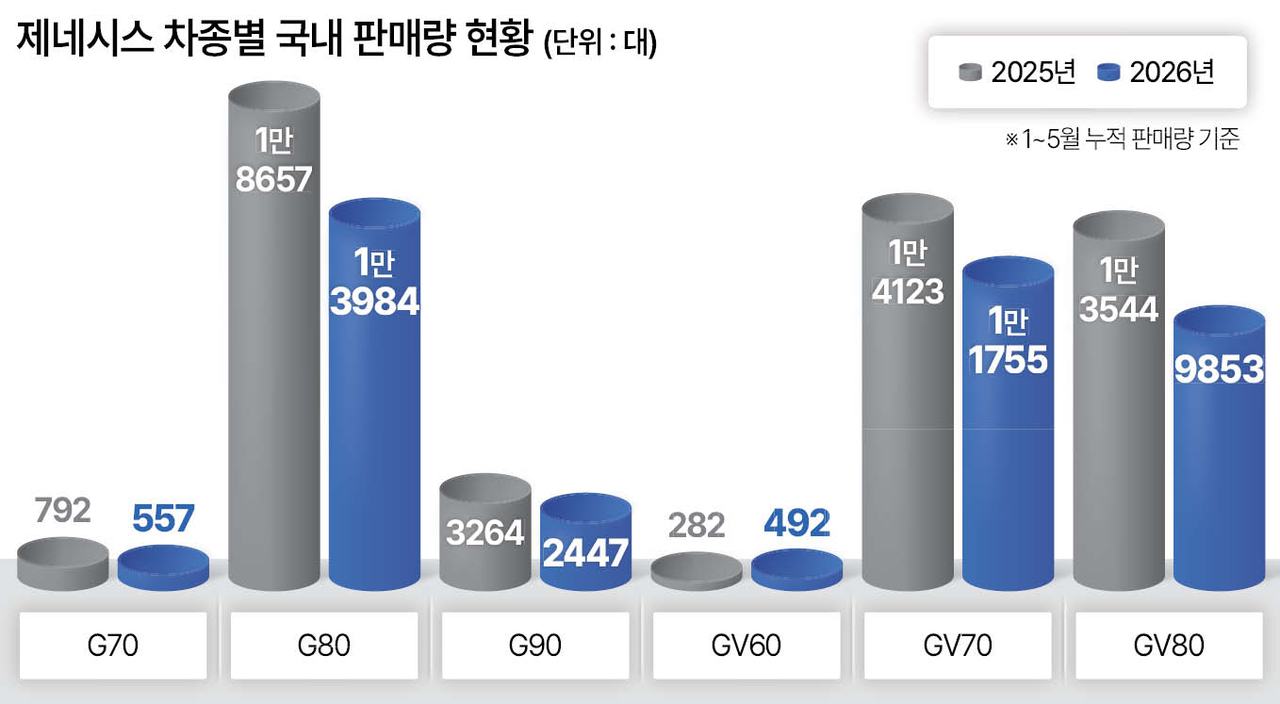
The GV90 is expected to be the pivotal new model that reverses a slump in Genesis sales. Supply disruptions weighed heavily on production, holding Genesis's domestic sales to around 39,000 units in the January–May period this year — a 22.8 percent decline from the same period last year. Sales of core models including the G80, GV80 and GV70 all posted double-digit percentage drops, and the industry widely expects the GV90 to be the key new vehicle that turns the brand's fortunes around.
Most of the production disruptions have been resolved this month, however, and the plant appears to have returned to normal operation. Some lines have extended weekend overtime to as many as five sessions to work through the order backlog. With a substantial backlog already at the Ulsan plant, bringing the EV-dedicated factory to full capacity would move Hyundai Motor's domestic production system another step toward an electrification-centered structure.
"The Ulsan EV-dedicated factory is not simply a plant that produces one electric vehicle model — it will be the benchmark for transforming Hyundai Motor's entire domestic production system," an industry official said. "Once GV90 mass production gets off to a stable start, reconstruction of aging lines and the introduction of next-generation electrified models should also gain momentum."
kwater@heraldcorp.com