Special inspection of vulnerable rail-crossing bridges also ordered
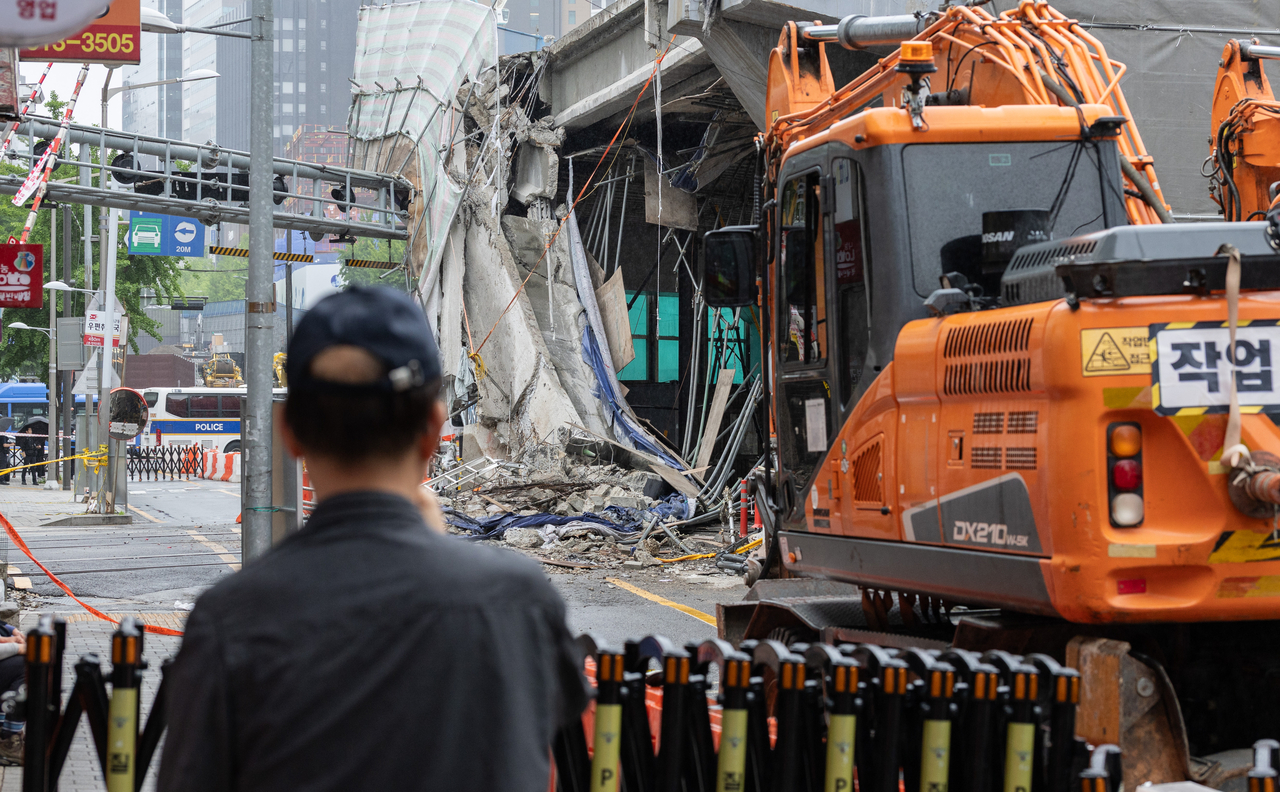
The Ministry of Land, Infrastructure and Transport said Thursday it will conduct an unscheduled inspection of the railway safety management system in connection with the demolition work at the Seosomun overpass, where a collapse occurred, and investigate any legal violations. The ministry also said it will carry out a joint special inspection of vulnerable rail-crossing bridges to prevent similar accidents.
The ministry said it and the Korea Transportation Safety Authority will begin the unscheduled inspection Thursday and continue through June 12.
Inspectors will first examine whether the Seoul Metropolitan Government — the registered work notifier for the project — implemented safety management in accordance with the conditions attached when it received approval from the National Railway Network Authority to carry out the demolition.
Seoul had been granted approval for the demolition work on the condition that it immediately halt construction and consult with the National Railway Network Authority and Korea Railroad Corporation (Korail) if deformation of railway facilities was anticipated before work began. It was also required to stop work and notify both agencies if an emergency arose during construction that could endanger train operations.
A roughly 2.9-centimeter step displacement detected in the upper structure of the bridge during demolition work in the early hours of May 26 constitutes a situation that clearly required those conditions to be met. The inspection will therefore focus on the course of consultations between Korail and the National Railway Network Authority on one side and the Seoul Metropolitan Government and the project operator on the other, as well as any legal violations during the work process.
Inspectors will also examine whether the contractor followed proper procedures in the consultations and approvals it conducted with Korail to carry out work at the time of the accident. The contractor had proceeded with Korail's agreement to perform routine work while trains were running, despite the risk that the overpass could collapse and debris could fall onto the tracks.
The work in question was primarily intended for safety inspection and accident-prevention measures. The contractor, however, sought Korail's approval describing the purpose only as "preventing slab overturning," with no mention of those safety objectives.
Those consultation and approval arrangements could have restricted a timely response — such as halting train operations — to prevent a railway accident caused by falling debris. The inspection will therefore focus on the circumstances of the approvals and any procedural violations.
If legal violations are identified during the inspection, the ministry plans to take necessary measures, including referring the matter to police for investigation and requesting or cooperating with audits.
Based on the inspection results, the ministry also plans to review regulatory improvements aimed at preventing recurrence. Those include strengthening on-site supervision and safety management by Korail and the National Railway Network Authority for work within railway protection zones, and reinforcing contractors' reporting procedures.
The ministry will form a joint special inspection team — comprising Korail, the National Railway Network Authority, the Korea Infrastructure Safety Corporation and the relevant facility managers — to inspect four vulnerable bridges, including those rated D or below, among rail-crossing bridges. The inspection will run from Thursday through June 17, covering safety conditions and maintenance practices.
Bridges found to require immediate action will be referred to their managing authorities with recommendations for repair, reinforcement, monitoring and detailed safety inspections.
Kim Tae-byeong, director general of the ministry's Railway Bureau, said the ministry would "conduct an unscheduled inspection covering the entire consultation and approval process for work within railway protection zones and investigate any legal violations." He added that the ministry would "carry out thorough special inspections of vulnerable sites to prevent recurrence of similar accidents and establish measures to strengthen work safety management within railway protection zones."
The Seosomun overpass demolition began in April last year and had reached 88.49 percent completion as of Wednesday. The May 26 accident was triggered around 2:30 a.m. when a girder — the upper structural component of the bridge — sagged approximately 29 millimeters while workers were cutting slab No. 9, the last of the two remaining slabs, Nos. 8 and 9.
Work was halted at the scene and steel plates were installed to prevent further sagging. The following afternoon, at around 1:40 p.m., a joint safety assessment began with nine participants — including Seoul Metropolitan Government officials, a safety diagnosis specialist and outside experts. The collapse occurred at 2:33 p.m. during that assessment. Three people were killed — the chief construction supervisor, the site manager and one of the outside experts — and three others suffered serious injuries, including the project manager, a project officer and an employee of Seodaemun-gu.
hss@heraldcorp.com