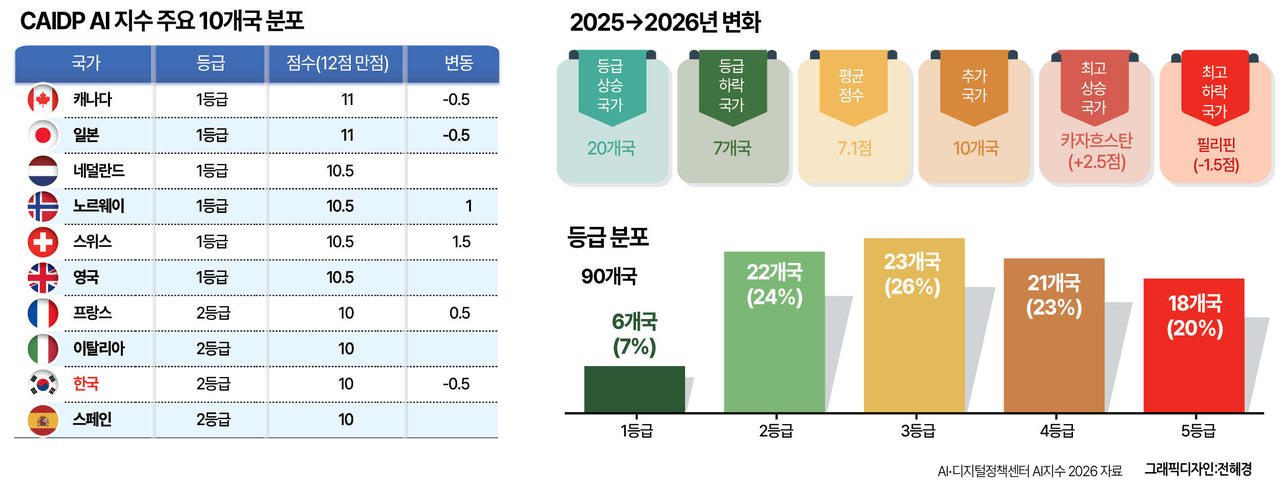

Since 2020, the Center for AI and Digital Policy (CAIDP) has published the CAIDP AI Index, the most comprehensive assessment of national AI policy and practices, grounded in democratic values and fundamental rights. From the outset, two East Asian nations have consistently ranked at the very top of the global standings: Japan and South Korea. That two neighboring countries have charted meaningfully different paths toward the same destination — AI governance — carries significant implications for how the world responds to the challenge.
In 2021, then-Minister of Science and ICT Lim Hye-sook announced that South Korea had been rated a Tier 1 country in the CAIDP AI Index. By the time CAIDP released its 2026 edition, however, Japan had retained its Tier 1 status while South Korea dropped to Tier 2 for the first time. One significant factor in Japan's continued standing was its signing of the Council of Europe's AI convention — the first international AI treaty addressing human rights, democracy and the rule of law.
This shift should not be read as a negative verdict on South Korea's AI governance record. The country has, after all, passed landmark AI legislation — a critical achievement. The change is better understood as a signal that AI policy is a highly dynamic field and that countries must move beyond declaratory commitments to actual implementation. More important is the question of why both nations have held top positions in the CAIDP AI Index for so long, and what lessons the rest of the world can draw from them.
What CAIDP Measures and Why It Matters
The CAIDP AI Index does not measure AI model performance, investment volume or the number of semiconductor chips a country produces. It is original research analyzing the policies and commitments of 90 countries against a methodology grounded in democratic values — alignment with the UNESCO Recommendation on the Ethics of AI, commitment to human rights, algorithmic transparency, meaningful human oversight, public participation in policymaking, and engagement in international governance.
In short, CAIDP asks: does a country treat AI governance as a matter of public responsibility, or merely as a question of industrial strategy?
Japan: Consistency as Strategy
Japan's standing is the result of deliberate, multi-year positioning at the intersection of innovation and governance. When Japan held the G7 presidency in 2016, it became the first country to bring AI governance onto the global stage. Current Prime Minister Takaichi Sanae, then a minister, introduced the AI governance agenda at G7 meetings — a discussion that ultimately led to the OECD AI Principles, adopted in 2019.
Japan also led the Hiroshima AI Process during its 2023 G7 presidency, an international framework for governing advanced AI systems that CAIDP has explicitly cited as a meaningful contribution to global governance architecture.
Japan enacted the AI Promotion Act in 2025. The legislation deliberately preserves a light-touch regulatory framework, requiring developers and service providers to adopt AI governance frameworks and ensure their systems are fair and safe, but without mandating specific compliance methods or imposing strong sanctions for violations.
This soft-law-first approach can leave gaps in individual protection and carries less enforcement weight than the EU AI Act — particularly for foreign companies operating in Japan. At the same time, it aligns well with Japanese corporate culture's emphasis on safety and compliance. The CAIDP AI Index recognizes Japan's consistent engagement with international norm-setting bodies — G7, OECD, UNESCO and the Council of Europe — and its demonstrated role in building multilateral AI governance.
![Vehicles drive across the Golden Gate Bridge in Sausalito, California. The words "AI Governance" visible on the road were composited using ChatGPT. [Getty Images]](https://wimg.heraldcorp.com/news/cms/2026/06/04/news-p.v1.20260529.56fa2cc48319420bbc7100dcbb77ae23_P1.png)
Korea: Landmark Legislation
South Korea's story in this period is more instructive. In December 2024, the National Assembly passed the AI Basic Act with broad bipartisan support — a remarkable achievement. The law took effect in January 2026, making South Korea the second jurisdiction in the world, alongside the EU, to enforce a comprehensive AI regulatory framework. The act is architecturally ambitious, folding three distinct policy levers — national strategy, industrial promotion and risk regulation — into a single framework. It establishes a National AI Strategy Committee and an AI Safety Institute, mandates human rights impact assessments for high-risk AI systems, and imposes transparency obligations on generative AI outputs.
The CAIDP AI Index values such policy vision while continuing to assess whether algorithmic transparency, contestability and independent oversight mechanisms to enforce AI-related rules are present in practice. CAIDP also urges the South Korean government to sign and ratify the Council of Europe's AI convention.
The Shared Foundation
Japan and South Korea share a quietly remarkable common ambition: both have declared aspirations to lead global AI. Japan aims to become the world's most AI-friendly nation, while South Korea has set its sights on joining the United States and China as one of the world's top three AI powers.
What separates them is method. Japan is betting on leadership in international rulemaking, broader AI adoption across its economy, and autonomy in decision-making, operational capability and negotiating power — what Japanese policymakers call "AI sovereignty." South Korea, by contrast, is investing heavily in owning the full AI stack end-to-end, a model it calls "Sovereign AI."
Despite this difference in approach, the two countries share a governance DNA. Both treat fairness, safety and trustworthy AI as core legal values. Both have established AI safety institutes that engage with global counterparts on evaluation standards and risk assessment, and both are investing in long-term institutional capacity rather than short-term regulatory performance — precisely what CAIDP rewards. Both have engaged substantively with the UNESCO Recommendation on the Ethics of AI and participate actively in multilateral AI governance.
Most importantly, both governments understand that the benefits and prosperity AI promises are not automatic, and that trust lies at the heart of social acceptance. Neither has fallen into the Big Tech narrative that AI regulation is at odds with innovation. They recognize that AI cannot diffuse deeply into an economy if citizens and consumers remain uneasy or concerned about its impact.
A Lesson for Other Countries
The trajectory of Japan and South Korea through the CAIDP AI Index offers a clear lesson for policymakers and researchers: governance credibility is earned through real action, not simple announcements. We live in an era when public concern about AI's impact on daily life is growing steadily — when college graduates boo commencement speakers who tell them to simply embrace AI, and when CEOs insist that AI's supremacy is inevitable. People want agency. They want to understand AI better, to see its benefits distributed fairly, to hold companies accountable, and to trust that governments will put guardrails in place to protect their rights, opportunities and livelihoods.
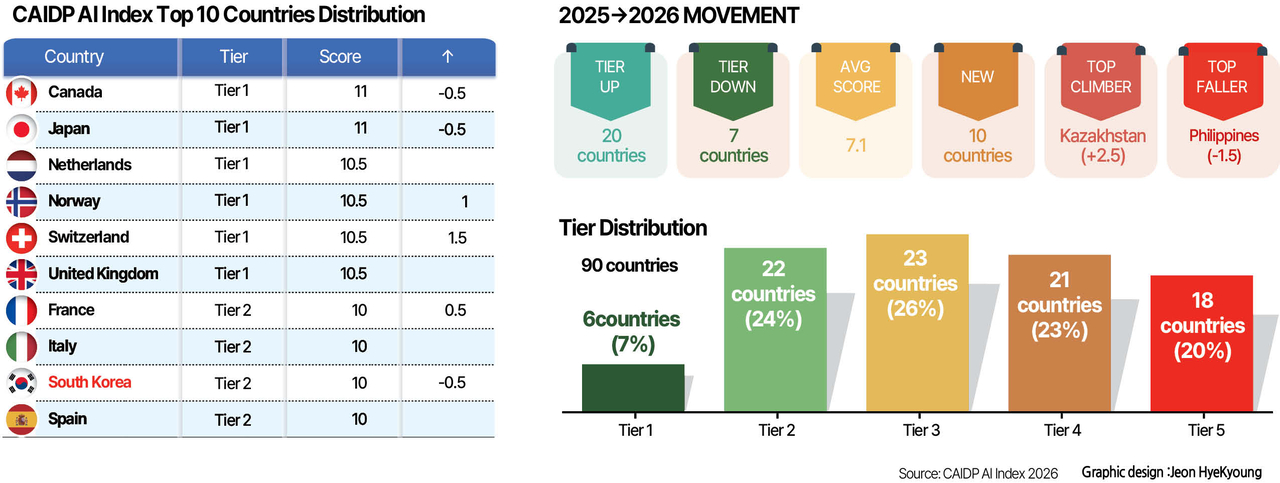

Two Roads to the Top: South Korea and Japan's AI Governance Trajectories in the CAIDP AI Index
Since 2020, the Center for AI and Digital Policy (CAIDP) has published the CAIDP AI Index — the most comprehensive analysis of national AI policy and practices, with a particular focus on democratic values and fundamental rights. From the outset, two East Asian nations have occupied the very top of the global rankings: Japan and South Korea. That two neighboring countries chart meaningfully different paths to the same destination is a striking signal about the global response to AI governance. In 2021, then-Minister of Science and ICT Lim Hye-sook announced that the CAIDP Index had ranked South Korea as a Tier 1 country. By the time CAIDP released its 2026 edition, Japan had retained its Tier 1 status while South Korea moved to Tier 2 for the first time. One significant factor in Japan's continued ranking was its signing of the Council of Europe's AI treaty — the first international AI convention addressing human rights, democracy and the rule of law.
This difference is by no means a negative assessment of South Korea's AI governance achievements. The country has, after all, passed landmark AI legislation — a critical achievement. The change should be read more as a signal that AI policy is highly dynamic and that countries need to move from commitments to implementation. What matters more is why these two countries have remained at the top of the CAIDP AI Index for so many years, and what lessons the rest of the world can draw from them.
What CAIDP Measures and Why It Matters
The CAIDP AI Index is not a measure of AI models, investment volume or the number of chips a country produces. It is original research analyzing the commitments and policies of 90 countries. The index evaluates national AI policies and practices against a methodology grounded in democratic values: alignment with the UNESCO Recommendation on the Ethics of AI, commitment to human rights, algorithmic transparency, meaningful human oversight, public participation in policymaking, and engagement in international governance.
In short, CAIDP asks: does a country treat AI governance as a matter of public responsibility, or merely of industrial strategy?
Japan: Consistency as Strategy
Japan's position is the result of deliberate, multi-year positioning at the intersection of innovation and governance. In 2016, when Japan held the G7 presidency, it became the first country to bring AI governance to the global stage. Current Prime Minister Takaichi Sanae, then a minister, introduced the AI governance agenda at G7 meetings — an initiative that ultimately led to the OECD AI Principles, adopted in 2019. During its 2023 G7 presidency, Japan led the effort to establish the Hiroshima AI Process, a landmark international framework for governing advanced AI systems that CAIDP has explicitly cited as a meaningful contribution to global governance architecture.
Japan enacted the AI Promotion Act in 2025. The legislation deliberately preserves a light-touch framework, requiring developers and deployers to adopt AI governance frameworks and ensure their systems are fair and safe, but without prescribing specific compliance methods or imposing hard sanctions for non-compliance. This soft-law-first stance can leave gaps in protecting individuals and provides fewer enforceable obligations than the EU AI Act — particularly for foreign companies operating in Japan. Yet it also aligns with the safety- and compliance-oriented culture of Japanese business. The CAIDP AI Index recognizes Japan's consistent engagement with international norm-setting bodies — G7, OECD, UNESCO and the Council of Europe — and its demonstrated role in building multilateral AI governance.
![Vehicles drive across the Golden Gate Bridge in Sausalito, California. The words "AI Governance" visible on the road were composited using ChatGPT. [Getty Images]](https://wimg.heraldcorp.com/news/cms/2026/06/04/news-p.v1.20260604.e7b6bf68921a4a1994db3b29cef0d580_P1.png)
Korea: Landmark Legislation
South Korea's story in this period is more instructive. In December 2024, the National Assembly passed the AI Basic Act with overwhelming bipartisan support — a remarkable achievement. The law took effect in January 2026, making South Korea the second jurisdiction in the world, alongside the EU, to enforce a comprehensive AI regulatory framework.
The act is architecturally ambitious, folding three distinct policy levers — national strategy, industrial promotion and risk regulation — into a single framework. It establishes a National AI Strategy Committee and an AI Safety Institute, mandates human rights impact assessments for high-impact AI systems, and imposes transparency obligations on generative AI outputs.
The CAIDP AI Index values such policy vision while continuing to assess whether algorithmic transparency, contestability and independent oversight mechanisms to enforce AI-related rules are present in practice. CAIDP also urges the South Korean government to sign and ratify the Council of Europe's AI convention.
The Shared Foundation
Japan and South Korea share a quietly remarkable common ambition: both have declared aspirations to lead global AI. Japan aims to become the world's most AI-friendly nation, while South Korea's goal is to rank among the top three AI powers alongside the United States and China. What separates them is method. Japan is betting on leadership in international rulemaking, deeper AI adoption across its economy, and autonomy in decision-making, operational capability and negotiating power — what Japanese policymakers call "AI sovereignty." South Korea, by contrast, is investing heavily in owning the full AI stack end-to-end, a model it calls "Sovereign AI."
Despite this difference in approach, Japan and South Korea share a governance DNA. Both treat fairness, safety and trustworthy AI as core legal values. Both have established AI safety institutes that engage with global counterparts on evaluation standards and risk assessment, building institutional capacity that CAIDP rewards because it reflects long-term commitment rather than regulatory theater. Both have engaged substantively with the UNESCO Recommendation on the Ethics of AI and participate actively in multilateral AI governance.
Most importantly, both governments understand that the promise of AI benefits and prosperity is not automatic, and that trust lies at the heart of social acceptance. Neither has fallen into the Big Tech narrative that AI regulation is at odds with innovation. They understand that AI cannot diffuse deeply into an economy if citizens and consumers remain uneasy or concerned about its impact.
A Lesson for Other Countries
The trajectory of Japan and South Korea through the CAIDP AI Index offers a lesson for policymakers and researchers: governance credibility is earned through real action, not simple announcements. We live at a time when survey after survey shows growing public concern about AI's impact on daily life — when college graduates boo commencement speakers who tell them to simply embrace AI, and when CEOs insist that AI's supremacy is inevitable. People want agency. They want to understand AI better, to see its benefits distributed fairly, to hold companies accountable, and to trust that governments will put guardrails in place to protect their rights, opportunities and livelihoods.
hongi@heraldcorp.com