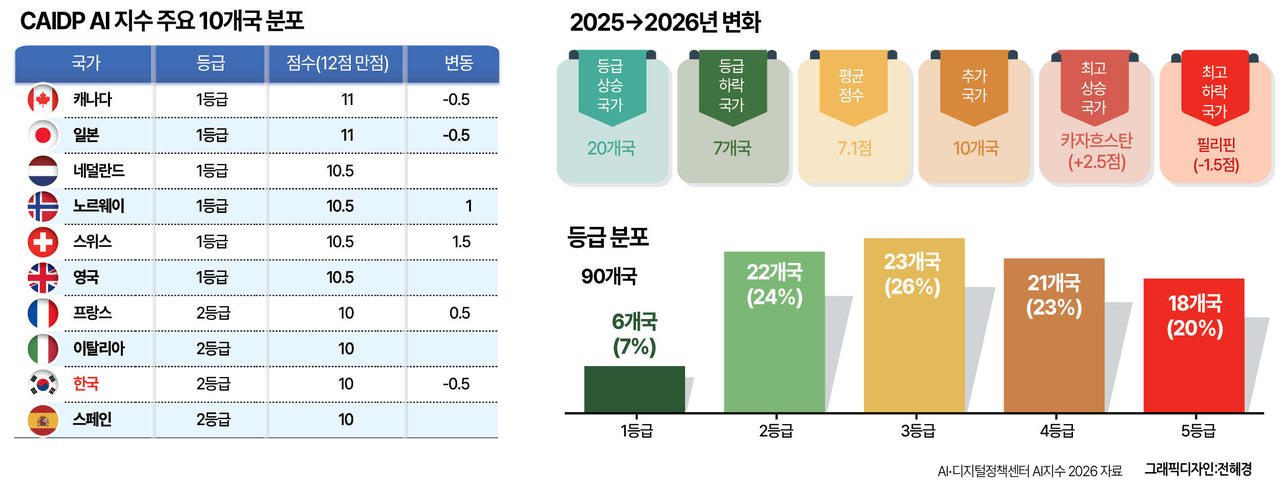

2020년부터 AI·디지털정책센터(CAIDP·Center for AI and Digital Policy)는 민주주의 가치와 기본권을 중심으로 각국의 AI 정책과 관행을 분석한 가장 포괄적인 평가인 ‘CAIDP AI 지수(CAIDP AI Index)’를 발표해왔다. 이 지수가 처음 발표된 이후 줄곧 세계 최상위권에는 두 동아시아 국가가 자리해왔다. 바로 일본과 대한민국이다. 서로 이웃한 두 나라가 AI 거버넌스라는 동일한 목적지를 향해 의미 있게 다른 경로를 선택했다는 점은, 세계의 AI 거버넌스 대응 방식에 시사하는 바가 크다.
2021년 당시 임혜숙 과학기술정보통신부 장관은 CAIDP AI 지수에서 한국이 티어(Tier) 1 국가로 평가받았다고 발표했다. 그러나 CAIDP가 2026년판 지수를 발표했을 때 일본은 Tier 1 지위를 유지한 반면, 한국은 처음으로 Tier 2로 내려갔다. 일본이 순위를 유지할 수 있었던 중요한 이유 가운데 하나는 유럽평의회(Council of Europe)의 AI 협약에 서명했기 때문이다. 이 협약은 인권·민주주의·법치주의를 다루는 최초의 국제 AI 조약이다.
그렇다고 해서 이를 한국의 AI 거버넌스 성과에 대한 부정적 평가로 해석해서는 안 된다. 한국은 무엇보다 획기적인 AI 입법을 통과시킨 국가다. 이는 매우 중요한 성취다. 오히려 이번 변화는 AI 정책이 매우 역동적인 영역이며, 각국이 선언적 약속을 넘어 실제 이행 단계로 나아가야 한다는 신호로 읽는 편이 적절하다. 더 중요한 것은 왜 이 두 나라가 오랜 기간 CAIDP AI 지수 최상위권에 머물러왔는지, 그리고 세계 각국이 여기서 어떤 교훈을 얻을 수 있는지다.
CAIDP는 무엇을 측정하며 왜 중요한가
CAIDP AI 지수는 AI 모델 성능이나 투자 규모, 혹은 한 국가가 생산하는 반도체 칩 수를 측정하지 않는다. 이 지수는 90개국의 정책과 약속을 분석한 독자적 연구다. 평가 기준은 민주주의 가치에 기반한다. 유네스코 AI 윤리 권고안(UNESCO Recommendation on the Ethics of AI)과의 정합성, 인권 보호 의지, 알고리즘 투명성, 실질적 인간 감독, 정책 결정 과정에서의 시민 참여, 국제 거버넌스 참여 여부 등이 핵심 요소다.
한마디로 CAIDP는 이렇게 묻는다. 한 국가는 AI 거버넌스를 공적 책임의 문제로 다루고 있는가, 아니면 단순한 산업 전략의 문제로만 보고 있는가.
일본: 전략으로서의 일관성
일본의 위치는 혁신과 거버넌스의 교차점에서 수년간 의도적으로 구축해온 전략의 결과다. 2016년 일본이 주요 7개국(G7) 의장국을 맡았을 때, 일본은 AI 거버넌스를 국제 무대에 처음으로 올린 국가였다. 당시 장관이었던 다카이치 사나에 현 총리는 G7 회의에서 AI 거버넌스 의제를 제기했다. 이 논의는 결국 2019년 채택된 OECD AI 원칙(OECD AI Principles)으로 이어졌다.
또한 일본은 2023년 G7 의장국 시절 ‘히로시마 AI 프로세스(Hiroshima AI Process)’를 주도했다. 이는 고도화된 AI 시스템을 규율하기 위한 국제적 프레임워크로, CAIDP 역시 이를 글로벌 거버넌스 구조에 대한 의미 있는 기여라고 명시적으로 평가했다.
일본은 2025년 AI 추진법(AI Promotion Act)을 제정했다. 일본의 입법 모델은 의도적으로 ‘가벼운 규제(light-touch)’ 체계를 유지한다. 이 법은 개발자와 서비스 제공자에게 AI 거버넌스 프레임워크를 채택하고 시스템의 공정성과 안전성을 확보하도록 요구한다. 그러나 특정한 준수 방식을 강제하지 않으며, 위반 시 강한 제재 조항도 두지 않았다.
이 같은 ‘연성법(soft-law) 우선’ 접근은 개인 보호 측면에서 공백을 남길 수 있고, 일본 내에서 활동하는 해외 기업에 대해 EU AI법(EU AI Act)보다 강제력이 약하다는 한계도 있다. 하지만 동시에 안전성과 규범 준수를 중시하는 일본 기업 문화와도 잘 맞아떨어진다. CAIDP AI 지수는 일본이 G7·OECD·유네스코·유럽평의회 등 국제 규범 형성 과정에 꾸준히 참여해왔고, 다자간 AI 거버넌스 구축에서 실질적 역할을 수행해온 점을 높이 평가하고 있다.
![미국 캘리포니아주 소살리토에서 차량들이 금문교 위를 달리는 모습이다. 도로 위에 보이는 AI거버넌스라는 글자는 챗GPT를 활용해 합성한 것이다. [게티이미지]](https://wimg.heraldcorp.com/news/cms/2026/06/04/news-p.v1.20260529.56fa2cc48319420bbc7100dcbb77ae23_P1.png)
한국: 기념비적 입법
반면 한국의 사례는 보다 많은 시사점을 제공한다. 2024년 12월 한국 국회는 초당적 지지를 바탕으로 AI 기본법(AI Basic Act)을 통과시켰다. 이는 매우 의미 있는 성과였다. 이 법은 2026년 1월 시행됐으며, 한국은 유럽연합(EU)과 함께 세계에서 두 번째로 포괄적 AI 규제 체계를 시행하는 지역이 됐다. 이 법의 구조는 매우 야심차다. 국가 전략, 산업 진흥, 위험 규제라는 세 가지 정책 수단을 하나의 체계 안에 통합했다. 국가 AI 전략위원회와 AI 안전연구소를 설치하고, 고위험 AI 시스템에 대해 인권 영향평가를 의무화했다. 생성형 AI 결과물에는 투명성 의무도 적용된다.
CAIDP AI 지수는 이러한 정책적 비전을 높이 평가하면서도, 실제로 알고리즘 투명성이나 이의제기 가능성(contestability), AI 규범을 집행할 독립적 감독 메커니즘이 존재하는지를 계속 점검한다. 또한 CAIDP는 한국 정부가 유럽평의회 AI 협약에 서명하고 비준할 것을 촉구하고 있다.
공통된 기반
일본과 한국은 조용하지만 놀라운 공통된 야망을 공유한다. 두 나라 모두 글로벌 AI 선도국이 되겠다는 목표를 선언했다. 일본은 세계에서 가장 AI 친화적인 국가가 되기를 원하고, 한국은 미국·중국과 함께 세계 3대 AI 강국에 진입하겠다는 목표를 내세운다.
두 나라를 가르는 것은 방법론이다. 일본은 국제 규범 형성에서의 리더십, 경제 전반의 AI 활용 확산, 정책 결정·운영 역량·협상력 측면에서의 자율성, 즉 일본 정책 담당자들이 말하는 ‘AI 주권’에 무게를 둔다. 반면 한국은 AI 스택 전반을 자체적으로 보유하는 ‘소버린 AI(Sovereign AI)’에 대규모 투자를 하고 있다.
접근 방식은 다르지만, 일본과 한국은 공통된 거버넌스 DNA를 공유한다. 두 나라 모두 공정성·안전성·신뢰 가능한 AI를 법적 접근의 핵심 가치로 삼고 있다. 또한 AI 안전연구소를 설립해 글로벌 기관들과 평가 기준·위험 분석 분야에서 협력하고 있으며, 단기적 규제 퍼포먼스가 아니라 장기적 제도 역량 구축에 투자하고 있다. CAIDP가 이를 높게 평가하는 이유도 여기에 있다. 두 나라 모두 유네스코 AI 윤리 권고안에 실질적으로 참여했고, 다자간 AI 거버넌스에도 적극적으로 관여하고 있다.
무엇보다 중요한 것은, 양국 모두 AI의 혜택과 번영이 자동적으로 보장되는 것이 아니며 사회적 수용성의 핵심에는 신뢰가 있다는 점을 이해하고 있다는 사실이다. 이들 정부는 AI 규제가 혁신과 상충된다는 빅테크의 서사에 빠져들지 않았다. 시민과 소비자들이 AI의 영향에 대해 불안과 우려를 느낀다면, AI는 경제 전반으로 깊게 확산될 수 없다는 점을 알고 있는 것이다.
다른 국가들을 위한 교훈
CAIDP AI 지수를 통해 본 일본과 한국의 궤적은 정책 입안자와 연구자들에게 중요한 교훈을 준다. 거버넌스의 신뢰는 단순한 선언이 아니라 실제 행동을 통해 얻어진다는 점이다.
우리는 지금 AI가 삶에 미칠 영향에 대한 대중의 우려가 계속 커지고 있는 시대에 살고 있다. 대학 졸업식에서는 “그냥 AI를 받아들이라”고 말하는 연사들에게 야유가 쏟아지고, 기업 최고경영자들은 AI의 우월성이 불가피하다고 주장한다. 그러나 사람들은 통제력을 원한다. AI를 더 잘 이해하고 싶어 하며, 그 혜택이 공정하게 분배되기를 바란다. 또한 기업이 책임을 지고, 정부가 시민의 권리·기회·생계를 보호할 안전장치를 마련하기를 기대한다.
Two Roads to the Top: South Korea and Japan‘s AI Governance Trajectories in the CAIDP AI Index
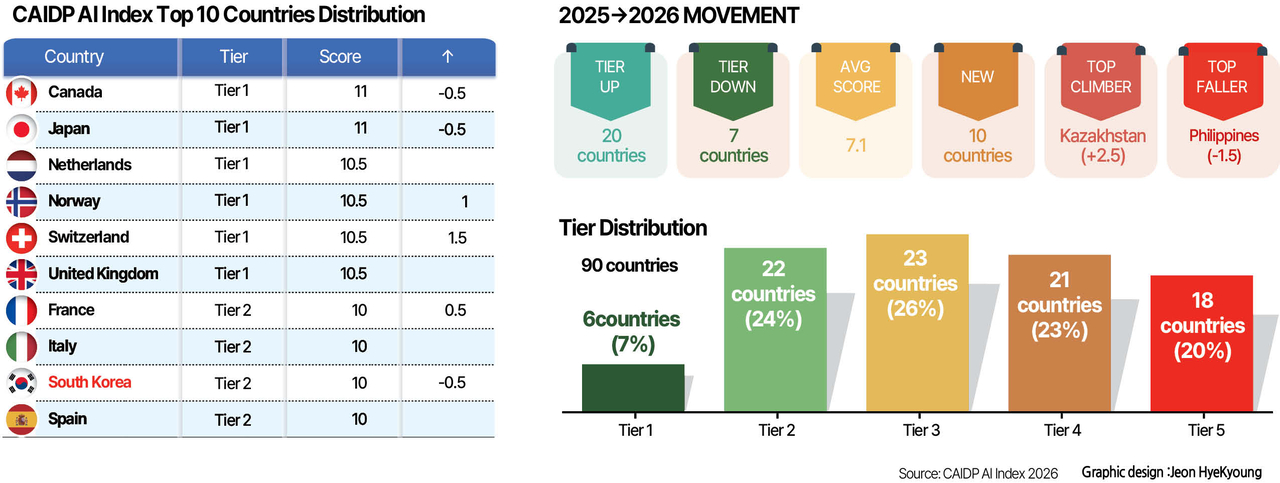
Since 2020, the Center for AI and Digital Policy (CAIDP) publishes the CAIDP AI Index - the most comprehensive analysis of national AI policy and practices, with a particular focus on democratic values and fundamental rights. Since the beginning, two East Asian nations occupied the very top of the global rankings: Japan and Republic of Korea. It is a striking signal on global response to AI governance, when two neighboring countries chart meaningfully different paths to the same destination. In 2021, then Minister Lim Hyesook (The Ministry of Science and ICT (MSIT) announced that in the CAIDP Index 2021 had ranked Korea as a Tier 1 country. By the time the CAIDP released its 2026 edition, Japan had retained its place in Tier 1, while Korea moved to Tier 2 for the first time. One significant way Japan kept its ranking is by signing the Council of Europe AI treaty - the first international AI convention on human rights, democracy and rule of law.
The difference is by no means a negative assessment of Korea’s AI governance achievements. The country after all has passed a landmark AI legislation, a critical achievement. We should read the change more as a signal that AI policy is very dynamic and that countries need to move from commitments to implementation. What is more important here is why these two countries have been at the top of CAIDP AI Index all these years, and what lessons the rest of the world can learn from them.
What CAIDP Measures and Why It Matters
The CAIDP AI Index is not a measure of AI models, investment volume, or the number of chips a country produces. It is original research, analyzing the commitments and policies of 90 countries. CAIDP AI Index evaluates national AI policies and practices against a methodology grounded in democratic values: alignment with the UNESCO Recommendation on the Ethics of AI, commitment to human rights, algorithmic transparency, meaningful human oversight, public participation in policymaking, and engaging in international governance.
In short, the CAIDP asks: does a country treat AI governance as a matter of public responsibility, or merely of industrial strategy?
Japan: Consistency as Strategy
Japan‘s position is the result of deliberate, multi-year positioning at the intersection of innovation and governance. In 2016, when Japan held the G7 presidency, it was the first country to bring AI governance to the global stage. The current prime minister Takaichi, then a minister, introduced the topic of AI governance in G7 meetings. That initiative eventually led to OECD AI Principles, adopted in 2019. During its G7 presidency in 2023 Japan led the effort for the Hiroshima AI Process, a landmark international framework for governing advanced AI systems, which CAIDP has explicitly cited as a meaningful contribution to global governance architecture.
Japan enacted the AI Promotion Act in 2025. Japan‘s legislative model deliberately preserves a light-touch framework. The AI Promotion Act requires developers and deployers to adopt AI governance frameworks, and ensure their systems are fair and safe. However, it does not prescribe a certain method, nor does it have hard sanctions for non-compliance. This soft-law first stance can leave gaps in protecting the individuals and provides fewer enforceable obligations than the EU AI Act - especially when engaging with foreign companies operating in Japan. Yet it also aligns with the safety and compliance-oriented Japanese business culture. AI Index recognizes Japan’s consistent engagement with international norm-setting (G7, OECD, UNESCO, Council of Europe), and its demonstrated role in building multilateral AI governance.
![Vehicles drive across the Golden Gate Bridge in Sausalito, California, USA. The words “AI Governance” visible on the road were composited using ChatGPT. [Getty Images]](https://wimg.heraldcorp.com/news/cms/2026/06/04/news-p.v1.20260604.e7b6bf68921a4a1994db3b29cef0d580_P1.png)
Korea: Landmark Legislation
Korea‘s story in this period is more instructive. In December 2024, the National Assembly passed the AI Basic Act with overwhelming bipartisan support, a remarkable achievement. The law took effect in January 2026, making it the second jurisdiction in the world, along with the European Union, to enforce a comprehensive AI regulatory framework.
The Act is architecturally ambitious. It folds three distinct policy levers, namely national strategy, industrial promotion, and risk regulation. It establishes a National AI Strategy Committee, an AI Safety institute, and mandates human rights impact assessments for high-impact AI systems. Transparency obligations apply to generative AI outputs.
The CAIDP AI Index values such policy vision, while still assessing if, in practice, algorithmic transparency, contestability, or independent oversight mechanism to enforce AI relevant rules are present. CAIDP also urges the Korean government to sign and ratify Council of Europe convention on AI.
The Shared Foundation
Japan and Korea share a common ambition that is quietly remarkable: both have declared aspirations to lead global AI. Japan aims to be the world‘s most AI-friendly nation, while Korea’s ambition is to be one of the top three AI powers alongside the United States and China. What separates them is the method. Japan is betting on leadership in international rulemaking, deeper adoption rates for its economy, and sovereignty in its decision-making, operational capabilities and negotiating power (what Japanese policymakers call AI Sovereignty). In comparison, Korea is investing heavily and betting on owning AI stack end-to-end and (Sovereign AI).
Despite this difference in approach, Japan and South Korea share a governance DNA. Their legal approach prioritizes fairness, safety and trustworthy AI. They both established AI safety institutes, engaging with global counterparts on evaluation standards and risk assessment, and building institutional capacity that CAIDP rewards because it reflects long-term commitment rather than regulatory theater. Both engaged substantively with UNESCO Recommendation on Ethics of AI and participate in multilateral AI governance.
Most importantly, both countries understand that the promise of AI benefits and prosperity are not automatic, and that trust lies at the heart of social acceptance. These governments are not falling into the Big Tech narrative that AI regulation is at odds with innovation. They understand that AI does not diffuse deeply into the economy if citizens and consumers are uneasy or concerned about impact.
A Lesson for other countries
The trajectory of Japan and Korea through the CAIDP AI Index offers a lesson for policymakers and researchers: governance credibility is earned through real action, not simple announcements. We are living at a time when one survey after another shows increasing public concerns about AI’s impact on their lives; when college graduates boo speakers who tell them that they should simply adopt AI, or when CEOs tell public that AI’s superiority is inevitable. People want agency and to understand AI better, the benefits to be distributed justly, the companies to be held accountable, and the governments to ensure there are guardrails to protect their rights, opportunities and livelihoods.
hongi@heraldcorp.com


![장기금리와 그린스펀의 수수께끼…이번엔 뒤집혔다 [지안루카 베니그노]](https://wimg.heraldcorp.com/news/cms/2026/10/14/news-p.v1.20261012.37af49395c5e42388798ef9d8de6e08b_T1.jpg?type=h&h=640)
![‘미국 망하지 않으면 안전?’ 美국채 투자 인기인데…원금 지키는 투자법이 있다 [Deep Spot]](https://wimg.heraldcorp.com/news/cms/2026/10/13/news-p.v1.20260904.5dadfb5404fb467f906a01b3a4ba1592_T1.jpg?type=h&h=240)
![수술 후 변해버린 아버지, ‘마약류’ 맞고 결국 아들 곁 떠났다 [메디컬 생존 게임]](https://wimg.heraldcorp.com/news/cms/2026/10/13/news-p.v1.20261013.41bea7ca77d8444ea752a291f899dc38_T1.jpg?type=h&h=240)
![정산 [‘오늘’에 대한 우리 이야기]](https://wimg.heraldcorp.com/news/cms/2026/10/12/news-p.v1.20261012.baa426e364ad488a8af2050d291e60f9_T1.png?type=h&h=240)