Oh overtakes rival 12 hours into vote count in 'golden cross' reversal
Housing supply policy, checks-and-balances message win over Han River Belt voters
Distance from party leadership seen as key to personal victory
Fifth-term title cements Oh as leading conservative presidential contender
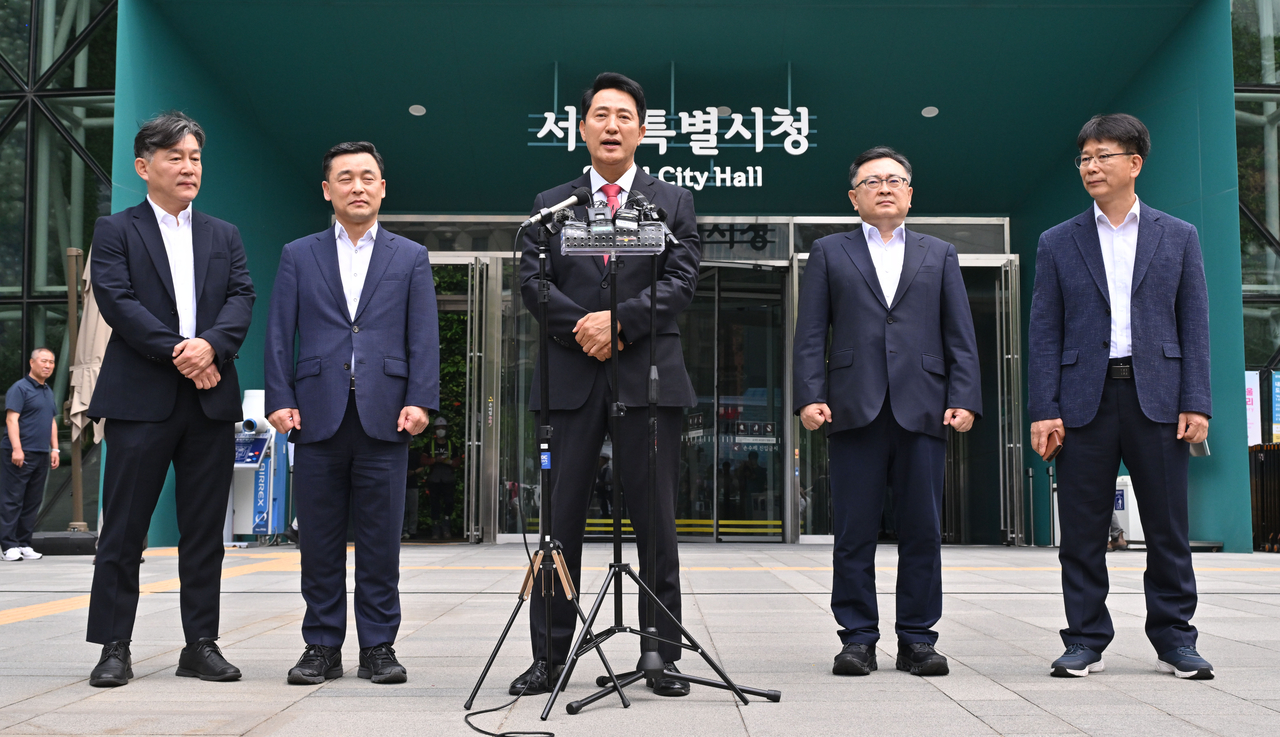
People Power Party candidate Oh Se-hoon secured a fifth term as Seoul mayor in a stunning reversal, with analysts crediting voter opposition to the Lee Jae Myung administration's real estate policies and a desire for political checks and balances. Anxiety that the privately led redevelopment and reconstruction projects Oh had been pushing forward could stall under a new mayor also appears to have shaped the result. The victory is also notable for having been won almost entirely on Oh's personal appeal, with the candidate keeping the party leadership at arm's length throughout the campaign.
When exit polls were released at 6 p.m. Wednesday, silence fell across the eighth floor of Daewang Building in Jongno-gu, where Oh's campaign was headquartered. Campaign staff faces tightened; supporters audibly sighed. The numbers were grim — JTBC had Jeong Won-oh at 53.5 percent and Oh at 42.9 percent, while a consortium of three broadcasters put Jeong at 51.4 percent and Oh at 46.0 percent. About 10 minutes after the exit polls were announced, most senior campaign staff in the front rows had left their seats. A senior campaign official said at the time that the count was still under way and that how things would unfold "remains to be seen."
Oh had trailed Jeong in most polls up until the final week of campaigning before the blackout period took effect. In the early stages of counting, Jeong led Oh by more than 30 percentage points. Even after more than half the ballots had been tallied, the gap between the two candidates remained above 20 points. The deficit was not reversed until the count passed 70 percent. As Thursday approached 5 a.m., the margin kept narrowing. At around 7:20 a.m., Oh crossed ahead — 48.66 percent to Jeong's 48.62 percent — in what campaign watchers called a "golden cross."
The road to victory was far from smooth. Oh trailed Jeong in most polls conducted right up to election day. Early in the campaign, Oh went on the offensive over allegations surrounding a past assault incident involving Jeong. He then found himself on the defensive after it emerged that steel reinforcement bars had been omitted from a section of the GTX-A rail line. A construction collapse at the Seosomun overpass demolition site that killed three people proved an even bigger blow. Oh, who said he "felt a sense of responsibility," suspended campaigning for two days in response.
Oh outperformed Jeong not only in the traditionally conservative strongholds of Gangnam, Seocho, Songpa and Yongsan, but also in Gangdong, Yeongdeungpo and Dongjak — districts that largely fall within the Han River Belt and are particularly sensitive to redevelopment and construction projects. These areas have also benefited from Oh's signature Han River Renaissance policy. Oh had pledged to deliver 310,000 new housing units by 2031, with 270,000 of them concentrated in the Han River Belt. Jeong countered with his own "steady development" platform, but it was not enough to win over Han River Belt voters. Oh's campaign pledges centered on privately led development, while Jeong's emphasized a mix of private and public-led approaches.
The checks-and-balances argument also resonated. At a press conference outside Hyochang Park station in Yongsan on Tuesday — the final day of campaigning — Oh said, "A country where both sides keep each other in check is safer than one where a single side takes everything," and urged voters to "leave one last safety valve so that South Korea does not tilt entirely to one side — leave us at least Seoul, the last line of defense." On election day Wednesday, Oh also shared on his social media a post by President Lee Jae Myung quoting Plato on the dangers of being ruled by the worst, adding: "This is exactly why your vote matters, fellow citizens."
Distancing himself from pro-Yoon forces from the outset of the campaign is also seen as a factor in his win. Oh twice delayed filing his candidacy application for the regional governorship nomination, demanding personnel changes within the party leadership as a condition. In the process, he secured a resolution signed by all 107 People Power Party lawmakers opposing a political comeback by former President Yoon Suk Yeol. That Oh did not hold a single joint campaign rally with PPP leader Jang Dong-hyeok during the entire election period reflects the same calculation. When asked about the party leadership, Oh said only that "each of us has our own role."
Many observers have drawn parallels between this Seoul mayoral race and the 2010 election. In that contest, Oh edged out Democratic Party candidate Han Myeong-sook in a similarly nail-biting finish. Oh had led in the early count, but Han took the lead roughly two hours in, after 9 p.m. on election night. Han extended her margin and in effect declared victory, while Oh canceled scheduled appearances as defeat appeared imminent. Then, as ballots from the three Gangnam districts began to be counted, the situation shifted dramatically. Past 4 a.m., Oh overtook Han and the gap widened steadily. Oh ultimately won by 0.6 percentage points — 26,412 votes.
With his fifth-term win, Oh has in effect emerged as an icon of the conservative camp. In past interviews, he had been cautious about speaking on the party's direction, saying it was "not easy to comment on party affairs as mayor." He is now widely expected to become a leading voice for conservative renewal.
Also drawing attention is Oh's repeated pledge to attend Cabinet meetings and speak frankly to President Lee. At a press conference on May 31, Oh said: "If you grant me one more term as Seoul mayor, I will attend the first Cabinet meeting after the launch of the ninth directly elected administration and present — and push through — the 'five mandates of Seoul citizens' directly before the president." The five mandates, which he called "3Bu2Min," comprise three urgent real estate policy reforms and two proposals on livelihoods and democratic values: normalizing redevelopment and reconstruction projects, expanding private rental housing supply to ease the jeonse and monthly rent crisis, establishing safeguards against real estate tax hikes, easing Greater Seoul regulations to boost the city's economy, and blocking the withdrawal of indictments to uphold democratic values.
On real estate in particular, Oh stressed that "the tax burden on a single home priced below Seoul's median should be capped at the rate of inflation, and the property tax base brackets should be rationally adjusted to reflect current housing price levels," adding that he would "work with the government to find solutions on all of these." Should Oh attend Cabinet meetings and take a confrontational stance toward President Lee, the political landscape could increasingly be defined by an Oh Se-hoon versus Lee Jae Myung dynamic.
cook@heraldcorp.com