213. Mary Shelley,
and Frankenstein
A being stitched together from the dead
An abandoned creature becomes a monster
A woman steeped in loss wrote it all down
An indictment of God and human irresponsibility
The most frightening question she ever asked
![Richard Rothwell, Mary Shelley (detail), c. 1840, oil on canvas, 73.7x61cm, National Portrait Gallery, London [Scan of a print, Public Domain, commons.wikimedia.org]](https://wimg.heraldcorp.com/news/cms/2026/06/06/news-p.v1.20260605.b93499d4684d4dd1a41988643bb2e9d6_P1.png)
Editor's note
Huam-dong Art Museum is the original home of long-form cultural and arts storytelling suited to the boundless digital space. Click ■Subscribe to reporter■ to enjoy a new art story every weekend. Articles are written as storytelling grounded in historical fact, with some imaginative embellishment.
He created a creature —
stitched together from the dead
![Theodore von Holst, Frankenstein Fleeing from the Monster, 1831, Tate Britain [Tate Britain. Private collection, Bath., Public Domain, wikimedia.org]](https://wimg.heraldcorp.com/news/cms/2026/06/06/news-p.v1.20260605.8e456f86cdd54680a29c03a92e9604e2_P1.jpg)
[The Herald Business = Reporter Lee Won-yul]
Creator.
Did I request thee, Maker, from my clay
to mould me Man? Did I solicit thee
from darkness to promote me?
John Milton, excerpt from Paradise Lost
"The time: the 18th century. The protagonist's name — yes. Victor. Young master of the Frankenstein family, Swiss Genevan aristocracy. Victor Frankenstein! From childhood, he was consumed by scientific experiment. He took pleasure in handling fire and ice, mercury and electricity. Then one day — as every legend in the world begins — he realized something. That he might, perhaps, be capable of creating a living being that had never existed before. He could not sit still. He went first to a musty graveyard. The graves there. He took up a shovel and dug them open one by one. Pried off the coffin lids. Shook them out, spilling everything onto the ground — and yes, opened the mouth of the sack he had brought. He filled it with only the finest, most carefully chosen pieces. Then he returned to his workshop. Quickly he lowered the windows and drew the curtains. Only then did he take the pieces from the sack one by one. He laid them out on a spread cloth and stitched them together like a puzzle — chilling already, isn't it? He poured himself into the work. Sweat poured off him even though everything he touched was cold and stiff. Just as he reached to wipe away the last drop of sweat, Victor stopped what he was doing. No — he had no choice but to stop. The thing he had made. The creature. The thing he had barely dared to hope for suddenly twitched. It was alive. It opened its eyes, let out a metallic groan and bent its joints like a newborn animal. Terror washed over him at once. He had gathered only the most beautiful parts and joined them together — yet assembled as one, the result was somehow more repulsive than any of them alone. What did Victor do? He fled without even managing a proper scream. But Victor should not have done that. He should never have committed such an irresponsible act. Because … "
The summer of 1816 that vanished:
the night a ghost-story contest began
![Richard Rothwell, Mary Shelley, c. 1840, oil on canvas, 73.7x61cm, National Portrait Gallery, London [Scan of a print, Public Domain, commons.wikimedia.org]](https://wimg.heraldcorp.com/news/cms/2026/06/06/news-p.v1.20260605.685835bace0a4ab798e0be289ae7e1f5_P1.jpg)
"Miss Mary."
"Yes?"
"This story. Did you come up with it yourself?"
"I did. I could hardly go on listening to everyone else's stories forever."
One day in the summer of 1816.
The air was cold and the atmosphere eerie. Smoke and ash had been drifting for months — the aftermath of the massive eruption of Mount Tambora the previous year. People had taken to calling the period "the year without a summer." Romantic poet Percy Bysshe Shelley, George Gordon Byron, aspiring writer John Polidori, and stepsisters Mary Godwin and Claire Clairmont. The five young men and women had gathered at a villa in Geneva, Switzerland. With sparks of passion flying between Percy and Mary, and between Byron and Claire, the mood was strange and charged. Outside, lightning flashed again and again. "Shall we tell ghost stories to match this gloomy atmosphere?" It was Byron's suggestion — a way to ease the quiet tension. "Why not." "It would be a fine way to pass the time." Everyone agreed. Percy went first, drawing them all into a circle with a story from his childhood. Byron told a tale of vampires. Polidori seemed spellbound by it, then, when his turn came, spun a yarn about a skull-headed woman — though some accounts hold that Polidori had first raised the subject of vampires but left it unfinished. Now it was Mary's turn. But nothing came to her. She would later recall that whenever asked "Do you have a story?" she had been forced to give "(each time) the humiliating answer of no." Percy and Byron took back the floor. Their conversation ranged from literature to philosophy, science, religion and mysticism. The central topic was galvanism — and in particular the observation that a dead frog had twitched as if alive when touched with electricity, prompting speculation that "it might be possible to reanimate a corpse using this method."
The birth of an extraordinary novel:
how a nightmare became a story
![Mary Shelley's manuscript of Frankenstein, 1816, Bodleian Library [bodley.ox.ac.uk, Public Domain, commons.wikimedia.org]](https://wimg.heraldcorp.com/news/cms/2026/06/06/news-p.v1.20260605.be423c2cadd04d439aaa64386cd6b2d8_P1.png)
Mary was still stewing in the humiliation of not having produced a single frightening tale.
It was why she had stayed silent through the discussion, merely listening in as the conversation flowed around her.
The night deepened.
The bedroom candles went out one by one. Then, somewhere between two and three in the morning, Mary saw a vision on the border between fantasy and reality. A grim dread stalked her like a wild animal. "( … ) I saw the pale student of unhallowed arts kneeling beside the thing he had put together." She would later describe the apparition she witnessed that night in those words. Not long after, when the ghost-story contest convened once more, Mary described the scene from her "waking dream" — Victor Frankenstein's twisted curiosity, the creature it summoned, the brutal events that followed. She had finally managed to make everyone's blood run cold. It was the moment Frankenstein was born — the nightmare that would later be called the founding work of English-language science fiction. But was this captivating novel merely the accidental product of a competitive woman winning a bet? No. The truth is somewhat more complicated, and the background far more profound and certainly more devastating. The playful wager was only the trigger; the story had been ripening for a long time. Mary herself had not yet realized it.
The creature raged
against an irresponsible world
![Theodore von Holst, detail of the creature from Frankenstein Fleeing from the Monster, 1831, Tate Britain [Public Domain, commons.wikimedia.org]](https://wimg.heraldcorp.com/news/cms/2026/06/06/news-p.v1.20260605.296fdcab24234dbc992519e3bc76fee1_P1.png)
It was a frightful thing.
For a mere human to attempt to imitate the tremendous mechanism wrought by the Creator of the world. Whatever effort a human being might pour into fashioning a result, it would give rise to consequences of extreme terror.
Mary Shelley, excerpt from the preface to Frankenstein
Frankenstein's creation — creature. The moment it opens its eyes, it walks out of the laboratory.
The creature hides in a shed near a family's home. Gradually it learns language and observes the habits of humans and society. It feels a powerful desire to be part of that world. It summons its courage and reaches out to humans — once, then again and again. Standing 245 centimeters tall, with long black hair covering its face, yellow eyes and violet skin through which every vein is visible, the creature finds a world that will not embrace it. People edge away, then beat it savagely, and some even shoot at it. The creature had originally been gentle and naive, with a depth of feeling and a certain intelligence. Having been born, did it not also deserve love, and happiness? Yet why did everyone… The creature is bewildered. Its creator, Frankenstein, had fled in irresponsible abandon. The age that bore it turns its back with all its might. And from that moment, anger begins to rise from the very bottom of its heart.
'Bold, ambitious and arrogant':
her extraordinary journey
![William Godwin, diary entry recording the birth of Mary Shelley (Mary Godwin), 1797, Bodleian Library [bodley.ox.ac.uk, Public Domain, commons.wikimedia.org]](https://wimg.heraldcorp.com/news/cms/2026/06/06/news-p.v1.20260605.fd46184461444f08856966ae3dd59128_P1.png)
Frankenstein was written by Mary.
Her parents alone were anything but ordinary. Her father, William Godwin, was a political philosopher with a devoted following. Her mother, Mary Wollstonecraft, was a prominent thinker, educator and writer. Both were radicals — people with an open disposition toward forging new concepts and taming the untamed. Mary was born in London in 1797. Her mother died shortly after childbirth from puerperal fever. Her father remarried in 1801, to Mary Jane Clairmont — a passionate woman in her own right, though possessed of a certain refinement and learning. Mary developed an interest in politics, revolution, literature and science from an early age. It was only natural. Her father's guests filled the drawing room day and night. Among them were figures of considerable stature — former US Vice President Aaron Burr, English Romantic poet Samuel Taylor Coleridge and others. Simply eavesdropping on their exchanges was enough to accumulate knowledge. Alone, she read the Greek and Roman classics. Even then she would sometimes pick up a pen and write. "Bold, ambitious and slightly arrogant. Her passion was immense, and in patience especially, no one seemed able to keep up with her." This, it is said, was her father's assessment of Mary at fifteen.
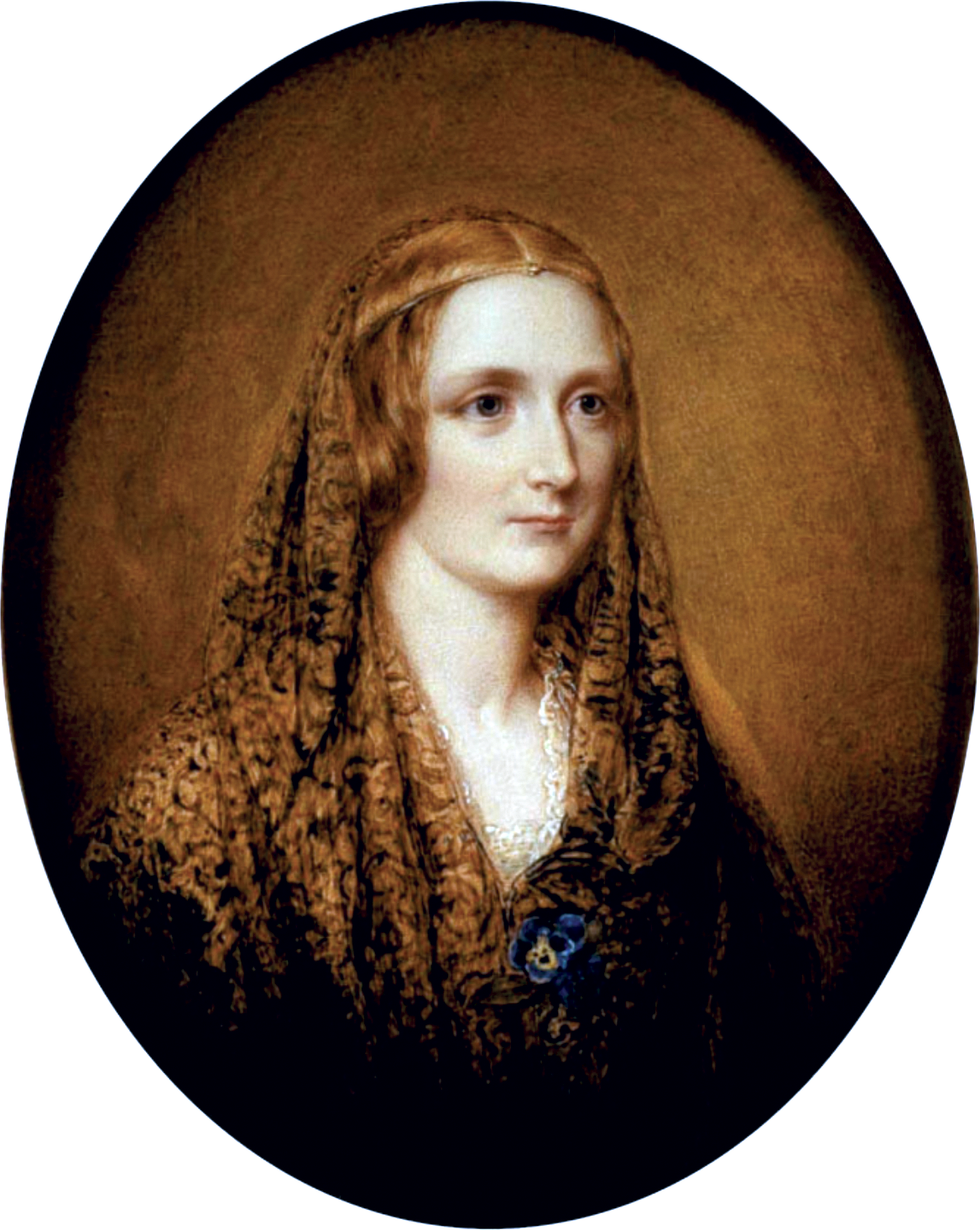
In November 1812, Mary met Percy for the first time. Mary was fifteen; Percy was twenty.
They met at her home, where Percy was a guest. He had been captivated by the freethinking her father William espoused. Two years later they met again, exchanged glances once more and kindled something in each other through talk of literature and prose. They connected. Before long they were exchanging words like "I cannot conceal my passion" and "a sublime and rapturous moment." Like April petals drifting down, their hands found each other. According to what has been passed down almost as legend, the two confirmed their love in a graveyard. Mary threw herself at him, unconcerned that Percy was a married man — so much so that they eloped together that very summer. The truth was that Mary had always been starved of love. Her father was brilliant — and equally strict and stubborn. Her stepmother quietly but unmistakably put her own children before Mary. Mary wanted to be noticed too. Just once, she wanted to be able to say: I am full to bursting, satisfied beyond measure. If God would not give her that, she was prepared to seize it herself. And before long, she realized she was pregnant.
The creature killed
those who had ruined its life
![Theodore von Holst (sketch), William Chevalier (engraving), It Was on a Dreary Night of November (illustration from the 1831 revised edition of Frankenstein), the scene in which Victor Frankenstein takes his first step into his tragic experiment [Internet Archive and HathiTrust, Public Domain, commons.wikimedia.org]](https://wimg.heraldcorp.com/news/cms/2026/06/06/news-p.v1.20260605.f62f255b6aab4b55a922157d53e86ec6_P1.jpg)
Remember that I am thy creature.
I ought to be thy Adam, but I am rather the fallen angel, whom thou drivest from joy for no misdeed. ( … ) I was benevolent and good; misery made me a fiend.
Mary Shelley, the creature's words in Frankenstein
The creature goes to find its creator, Frankenstein.
It makes a demand: create for it a bride who can understand it. Do that, and the two of them will leave for the wilderness and live alone. Frankenstein looks into the creature's passionate eyes. He sees the hands stained with the blood of the humans it has killed. He agrees. He sets to work again, the same way as before — assembling pieces, joining them, stitching them together. Time passes. The creature's bride is nearly complete. But Frankenstein destroys his second creation just before it opens its eyes, overwhelmed by unpredictable terror and uncontrollable dread. The creature's hope collapses into absolute despair. It bows its head and cries out. Then it raises its head and makes a vow: my god, my creator Frankenstein — as my life has been torn apart, so shall I trample yours.
The creature begins to kill Frankenstein's loved ones, one by one.
Fracture and death:
a personal curse, a literary blessing
![Unknown artist, Percy Shelley, c. 19th century [Wikipedia, Public Domain, commons.wikimedia.org]](https://wimg.heraldcorp.com/news/cms/2026/06/06/news-p.v1.20260605.b14ef57a8e37473fa443a298dc566d9f_P1.png)
In February 1815, Mary gave birth to her first child, a daughter, at eighteen.
But the infant soon slipped away as if falling asleep. "My baby is dead. ( … ) I am no longer a mother." So reads her journal entry.
Then came the following summer.
Mary took part in the ghost-story contest at the villa in Geneva. After several humiliations, she fashioned the tale of Victor Frankenstein and the creature — Frankenstein. She had originally intended it as a short piece no longer than a pamphlet, but Percy urged her on the spot, saying he wanted to hear more, and so the story grew many times longer. Mary had given birth to her second child, William, in January of that year. Caring for him, she did not finish the first draft until the early summer of 1817. She did not write in the exhilaration of creative fire. She wrote instead in grief and depression, chewing on them, moving her hand in desperation. The words she most often murmured to herself were cries of "it hurts" and "I am in pain." It was an unwanted personal curse and, in the end, a literary blessing. What misfortunes had befallen her in the meantime? Mary had grown estranged from her father. He seemed to regard his daughter's love-struck transgression as nothing but a stain and a disgrace. Mary was devastated — her father was an unconventional thinker, and she had believed he, of all people, would understand her. Then her half-sister died. Then Percy's wife also died. The estrangement from her father and the death of her half-sister brought another wave of loneliness; Percy's wife's death brought a deep-rooted guilt. And through it all, her surviving second child, William, did not seem to be growing up in the best of health.
Can an irresponsible human
blame an irresponsible God?
![William Powell Frith, The Lovers' Seat (Percy Shelley and Mary Shelley), 1877, oil on canvas, 64x50.5cm [sothebys.com, Public Domain, commons.wikimedia.org]](https://wimg.heraldcorp.com/news/cms/2026/06/06/news-p.v1.20260605.a309152ff1f34ae78f8a1a1f33d80e55_P1.png)
Mary must have blamed God.
It was inevitable. For human beings, resentment and rationalization are as instinctive as the will to survive.
God, from on high, had fashioned me.
And then, without a second thought, had pushed me out into the world. That was all. Whatever care had gone into the making, it seemed that once done, God had washed his hands of me entirely. The first words I heard after opening my eyes were that I was a child who had devoured its mother in being born. The father I had trusted drove me away. My stepmother had kept her distance from my very existence. The love I had thrown myself into recklessly had produced one wrong outcome after another. Looking back, all that remained beside me was the ash of self-loathing. It was sorrowful. Everywhere I turned was ruin. It seemed I did nothing but break completely, and be broken completely, over and over again. If this was the life I was given, why did God make me at all? If God cared so little, why had this creature been tossed into the world? Utterly, mercilessly irresponsible.
And yet — does a human being have the right to blame God?
At some point, Mary may have begun to think along these lines. Are you and I not also guilty of tossing things aside and pretending not to know? Even the most ostensibly rational, the most self-proclaimed enlightened among humans were no different. Petty love quarrels and senseless crimes, unfinished wars, half-hearted revolutions and ideologies, uncertain scientific theories — all of these, too, were the products of human reason and enlightenment.
The life of Frankenstein as Mary wrote it. This man who imitates the Creator is helplessly destroyed by the creature he made and abandoned. She surely shaped the story with an eye to dramatic terror and narrative pleasure. She surely also reflected the currents of her era — the Industrial Revolution, the tide of Enlightenment, the Romantic backlash.
Meanwhile, Frankenstein was also a warning and a reckoning she leveled at an irresponsible God. In addition, above all, it was a mirror and an indictment she held up to a humanity that had no standing to reproach such a God in the first place.
The creature wept
before its dead creator
![Nathaniel Whittock, Thomas Charles Wageman, T.P. Cooke of the Royal Covent Garden Theatre in the monster makeup from Frankenstein, c. 1823, from the stage production "The Fate of Frankenstein," 37x29.5cm, lithograph, New York Public Library [New York Public Library's Digital Library, Public Domain, commons.wikimedia.org]](https://wimg.heraldcorp.com/news/cms/2026/06/06/news-p.v1.20260605.7674150287a64895a40a73f10209e6f1_P1.jpg)
A question.
Are we all right? Are we not also making things, wounding them as we please, and then discarding them at will?
Another question.
Is the creature a single being? No. It could be a crowd, perhaps a generation, or at times an entire nation.
Now the creator Frankenstein pursues the creature he made. All that remains in Frankenstein is rage and the thirst for revenge. The creature, having taken everything from him, flees as if mocking his pursuit. Its feet carry it at last to a frozen continent. Frankenstein wanders the permafrost. Drops of blood bead on cracked ice. He is on the verge of dying before he can kill the creature. He might have survived — but ultimately he takes the path of paying the price. When the creature learns of Frankenstein's end, it is deeply, genuinely… grief-stricken. It even laments that Frankenstein was "the only one who truly knew me." Then the creature departs — over the ship's rail, onto the glacier, and into the void. Whether it died soon after or lived on, no one can say.
She punished God and the human world,
but the world would not yield
![Mary Shelley, Christie's auction scan of the title page from an edition of Frankenstein, 1818 [Cropped and slightly rotated from christies.com, Public Domain, commons.wikimedia.org]](https://wimg.heraldcorp.com/news/cms/2026/06/06/news-p.v1.20260605.48c45bdfdc2940a5a487e01fc002f9eb_P1.jpg)
In 1818, Mary published Frankenstein.
"A very bold novel." — La Belle Assemblée
"It has power in its composition and language ( … ) but it is a horrible, disgusting and absurd work." — Quarterly Review
Frankenstein drew mixed reactions from critics but achieved popular success almost from the moment of its release.
Yet Mary had to weep until she was hollowed out and burned through. In June 1819, her second child, William, died. Nine months earlier, in September 1818, she had buried her third child, Clara, who had barely reached one year of age. All three children she had carried in her womb were gone — and she was only twenty-two. She would soon give birth to a fourth child, who became in effect her first surviving son, but the void that had been torn open could not be filled by anything. "You have fled. Down the dark and dreary road that leads to the deepest place of grief. For your sake I cannot follow; for my sake, please return." Percy wrote these words for her, now his lawful wife. Then came 1822. Percy himself left the world. A boating accident — a sudden death as bleak and hollow an ending as anything the creature had once wrought in the frozen wastes. The writing that had punished God and the human world had won an extraordinary response, but she herself was being punished by that same world, again and again.
If you were 'the last man,'
what would you rebuild first?
![Louis Édouard Fournier, The Funeral of Shelley, 1889, oil on canvas, 129.5x213.4cm, Walker Art Gallery [uwFW5-eMuEhgAA at Google Cultural Institute, Public Domain, commons.wikimedia.org]](https://wimg.heraldcorp.com/news/cms/2026/06/06/news-p.v1.20260605.79b2f2d80d744576b906a2b7b76b09f0_P1.jpg)
This knowledge led us away from paradise.
And the hundred thousand years of history that followed left behind, in the end, nothing but the suffering and misery that exist in the world today.
Mary Shelley, excerpt from The Last Man
The late 21st century, a distant future. While humans play at relationships and scramble for power, a plague begins to sweep the globe. Neither knowledge that can pierce through anything nor weapons that can cut down everything can stop it. Humanity suffers an overwhelming defeat before the natural order. Lionel and a handful of others barely survive. But even that is short-lived. They board a ship to flee, only to find a storm waiting before them. The ship breaks apart. It sinks. And then, a single survivor — Lionel alone becomes "the last man" and escapes with his life … .
Mary's other novel, The Last Man, has this plot.
In it, she holds up once more the irresponsibility of a humanity that falls short even of God, and digs all the way to the bottom of a helplessness worse still. So what is Mary's conclusion? There is none — or none that appears. Instead, she poses a question. If humanity's accumulated negligence brings everything back to zero, what would the last "you" rebuild first?
A manuscript addressed to God —
though no answer will ever come
![Richard Rothwell, Mary Shelley, 1840–1843, oil on canvas, 29.5x24cm, Bodleian Library [Art UK, Public Domain, commons.wikimedia.org]](https://wimg.heraldcorp.com/news/cms/2026/06/06/news-p.v1.20260605.84b748d173b44a26ad49514639b54c57_P1.png)
Mary's life bloomed early.
She had long since produced works that, by themselves, could make a life feel meaningful. Afterward she lived busily as a writer and editor, publishing novels in succession — "The Fortunes of Perkin Warbeck," "Lodore" and "Falkner." She traveled with her son. In between she contributed short stories, engaged in modest social causes of her own and lived out her remaining years with vigor, experiencing romance more than once.
Of course, as was Mary's way, no moment came easily.
She was periodically tormented by threats — blackmail over letters containing intimate details of her private life, threats to expose the late Percy's old eccentricities (a form of fraud, as it turned out), threats to publicize the scandal of her elopement with Percy and more. Mary grew worn out. Even she could not help being ground down, little by little. From 1839 she suffered severe headaches and episodes of partial paralysis. She reached a point where she could no longer write at all. She faded slowly. In February 1851, Mary closed her eyes for the last time. The cause of death is believed to have been a brain tumor. She was fifty-four. In the drawer of Mary's desk lay notebooks she and Percy had exchanged. And beside them, bundles of hair from her dead children, kept just as they were. Mary must have ascended at last to where she could finally make her case. She may have seized God by the collar and demanded answers for his irresponsibility. And then, surely, she held it up with pride — the draft of Frankenstein, proof of how she had transformed that irresponsibility into something transcendent. God may have said nothing in the end. But perhaps, turning away just slightly, he allowed himself a quiet smile — and murmured: my creature. Well done. You endured. And you left something behind for humanity, a guide for the ages.
References
Frankenstein, Mary Shelley, Munhakdongne
Frankenstein, Mary Shelley, Hyundai Jiseong
The Last Man, Mary Shelley, Agora
The Journals of Mary Shelley, Shelley, Mary., Johns Hopkins University Press
Mary Shelley's Literary Lives and Other Writings, Shelley, Mary., London: Pickering & Chatto
Finding Mary Shelley in her Letters, Bennett, Betty T., Cambridge: Cambridge University Press
yul@heraldcorp.com