Bukahyeon District 3 multi-unit asking price climbs from 1 billion to 1.19 billion won; Han River belt properties also rise
![A multi-unit residential neighborhood in Seoul. This photo is unrelated to the article. [Yonhap]](https://wimg.heraldcorp.com/news/cms/2026/06/06/news-p.v1.20260402.2208f144f0fc4eaaacdd7f0753a6b2d1_P1.png)
The market is already pricing in expectations of faster private reconstruction and redevelopment after Oh Se-hoon of the People Power Party won a fifth term as Seoul mayor in the June 3 local elections. Analysts say redevelopment-eligible villa properties — which face fewer lending and tax restrictions than apartments — are likely to attract even stronger demand as a result.
According to industry sources, a multi-unit property in the <style ref="s0">Bukahyeon District 3 Housing Redevelopment Zone</style> in Seodaemun-gu has come to market with an initial investment cost of 1.19 billion won (about $778,000). The listing entitles the buyer to an 84-square-meter move-in right upon completion of the redevelopment. With an appraised value in the mid-200 million won range and a premium of 1.096 billion won, the total asking price stands at roughly 1.33 billion won.
That represents a nearly 200 million won increase in just three months: a comparable listing in the same zone was on the market in March with an initial investment cost of 1 billion won.
In Yongsan-gu, a listing in the <style ref="s0">Hannam District 4 Housing Redevelopment Zone</style> has come to market at 8 billion won — a "1+1" deal entitling the buyer to both an apartment of around 165 square meters (1 pyeong equals 3.3 square meters) and a move-in right for an 82-square-meter unit. The initial investment cost is approximately 4.9 billion won. As recently as early May, an equivalent "1+1" listing of the same size was offered as a distressed sale at 6 billion won, with an initial investment cost of 3.435 billion won. Even accounting for the distressed-sale discount, the initial investment cost alone has risen by nearly 1.5 billion won.
Properties are also moving quickly. In Eunpyeong-gu, <style ref="s0">Galhyeon District 1</style> — which has completed relocation and demolition and is awaiting ground-breaking — currently carries a premium of about 550 million won for a 59-square-meter unit, bringing the total purchase price to 1.032 billion won. A local real estate agent said properties "are selling fast."
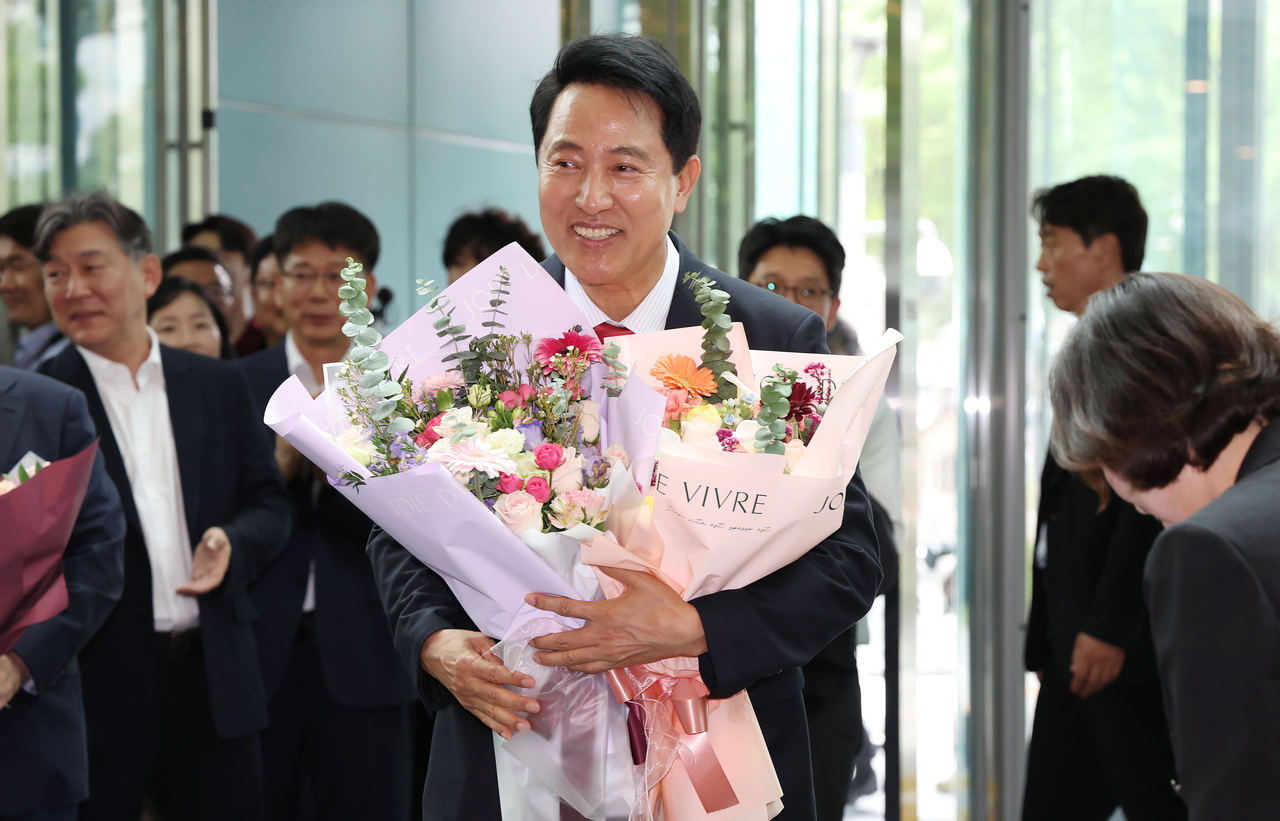
Market watchers say the price moves are directly tied to Oh's victory, which he built in part on real estate sentiment. Throughout the campaign, Oh pledged to overhaul the city's Fast-Track Integrated Planning program — known in Korean as "sintong gihoek" — to improve the financial viability of redevelopment and reconstruction projects and push them through to ground-breaking.
Oh's housing campaign pledges center on expanding supply through private urban renewal projects. He campaigned on a platform of "overwhelming supply," promising ground-breaking on 310,000 units by 2031. The Fast-Track Integrated Planning program has already delivered strong results in the early stages of urban renewal — designating zones and drawing up improvement plans — and his fifth term is expected to show results at the ground-breaking stage.
Expectations of an accelerated pace are set to grow further, particularly at major reconstruction complexes in the Gangnam area and along the Han River belt pursuing high-density, high-rise redevelopment, as well as at redevelopment sites in northern Seoul, where new apartment supply is becoming increasingly scarce. According to Real Estate 114, the number of new apartments scheduled for move-in in Seoul is expected to fall 41.7 percent this year, dropping from 32,370 units last year to 18,880 units — a decline of 13,490 units.
"There appears to be a learned-behavior effect at work — people remember how villa prices followed apartment prices higher during the Moon Jae-in administration, and that seems to be driving renewed demand for villas," said one official in the pre-sale industry. "Demand for move-in rights will be even stronger in Seoul, where new apartments are so hard to come by."
hss@heraldcorp.com