
First-half book sales analysis
Novels top general book sales with 3.96 million copies sold from January to May
'Project Hail Mary' surges on film tie-in; classics draw younger readers
Investment books jump as Kospi hits all-time highs
![Books related to the Joseon royal annals are displayed at Kyobo Bookstore's Gwanghwamun branch in Jongno-gu, Seoul, amid the box-office success of "The King's Warden." [Yonhap]](https://wimg.heraldcorp.com/news/cms/2026/06/05/rcv.YNA.20260308.PYH2026030806960001300_P1.jpg)
Fiction dominated South Korea's bookstore scene in the first half of this year, with so-called "screencellers" — novels adapted into films or drama series — leading the charge alongside growing reader interest in both Korean and international literature.
In business and economics, investment books also found a wide audience as the domestic stock market enjoyed an unprecedented rally.
Novels reclaim the spotlight, sweep bestseller lists
Fiction staged a full comeback in the publishing market during the first half of the year.
According to data released Friday by the Korea Publishing Industry Promotion Agency's integrated book distribution network, novels and related products sold 3,969,575 copies in the first five months of this year — the highest volume among the 19 general book categories, excluding children's, young adult and study titles. Sales revenue reached 61.6 billion won (about $44.8 million), second only to the social sciences category, which posted 82.97 billion won despite carrying a higher average price.
When poetry and essays are included, literature's dominance becomes even clearer. The biography, literature and literary studies category — which covers poetry, prose and drama — recorded 3,487,565 copies sold and 57.23 billion won in revenue, ranking third among the 19 categories. Combined, fiction, poetry and essays accounted for 16.4 percent of all book sales. At online retailer Yes24, sales in the novels, poetry and drama category rose 9.0 percent from the same period last year.
Bestseller lists told the same story. Nineteen novels appeared in the distribution network's top 100 titles by sales from January through May. Among general books excluding study titles, seven of the top 10 were novels.
At Yes24, 22 novels made the overall top 100 bestseller list — roughly four times the five that appeared in the first half of 2024, and 37.5 percent more than the 16 that charted in the first half of 2025, when Han Kang's Nobel Prize in Literature win had already fueled a surge in fiction sales.
Media tie-ins power 'screenceller' wave
The most striking trend of the first half was the resurgence of source novels riding renewed attention from films, streaming services and YouTube — a phenomenon the industry calls "screencellers." These titles became a major engine for the broader publishing market.
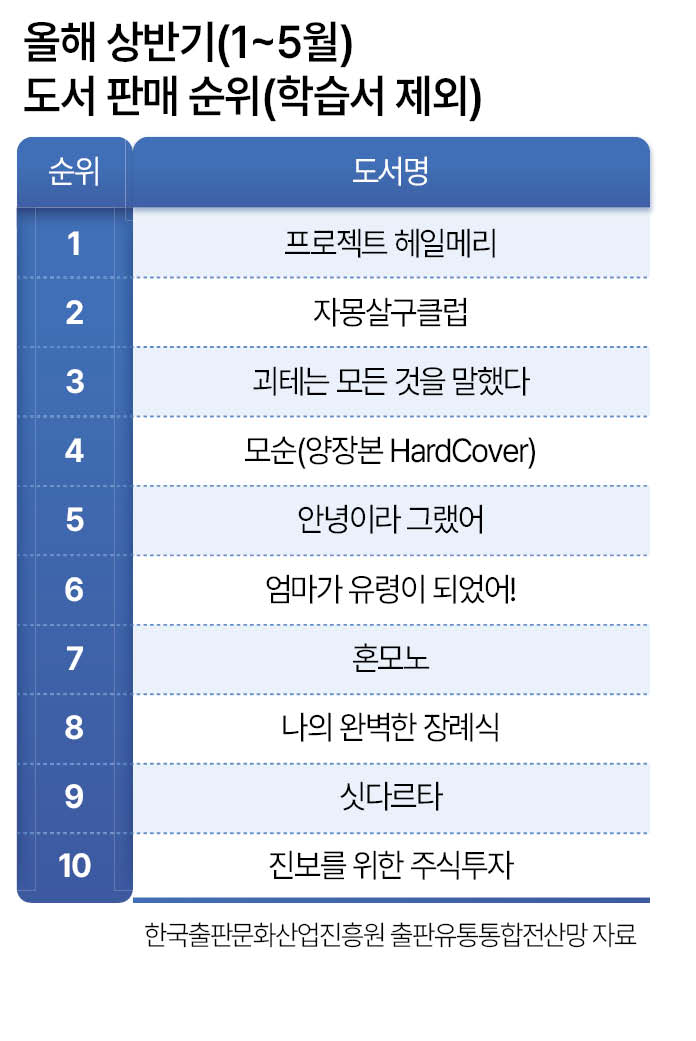
Andy Weir's 2021 novel "Project Hail Mary," the source material for a film of the same name that opened in March, topped the distribution network's general book sales chart and Yes24's overall bestseller list. After the film's release, Yes24 sales jumped roughly 58-fold — a 5,731.7 percent increase — compared with the same period last year. It was the first time a foreign novel had topped Yes24's overall chart on a first-half or full-year basis since "The 100-Year-Old Man Who Climbed Out the Window and Disappeared" led the annual rankings in 2014, a gap of 12 years.
"Project Hail Mary" simultaneously topped print book and e-book sales and led downloads on the Crema Club platform, becoming the defining symbol of the screenceller phenomenon that blurs the line between cinema and publishing.
"Grapefruit Apricot Club" by singer-turned-author Han Roro rode the popularity of the accompanying song to rank second on the distribution network's overall chart, excluding study titles. Yes24 data showed that readers in their 20s accounted for the largest share of purchases at 32.7 percent.
"Goethe Said It All" held a spot in Yes24's weekly top 10 for 14 consecutive weeks — from the first week of January through the first week of April — after film critic Lee Dong-jin recommended it on YouTube, ultimately landing third on the distribution network's overall chart.
Yang Gwi-ja's 1998 novel "Contradiction," which has posted sales gains for three consecutive years from 2023 to 2025, ranked fourth overall in the first half. Readers in their 20s and 30s accounted for 41.4 percent of purchases on Yes24, showing that the novel's universal themes of life choices and personal growth still resonate with young readers nearly three decades after publication.
Kim Ae-ran's "Goodbye, I Said," her first short story collection in eight years, was published last June and generated buzz at launch. It re-entered the top five overall in the first half after a sales rebound following the author's recent appearance on a television talk show.
"The pattern of past titles recapturing the spotlight — and reaching the very top of the bestseller charts — through media exposure such as film adaptations or celebrity recommendations became especially pronounced," a Yes24 official said. "The idea that a powerful story, one that endures over time, can be rediscovered through various media and sustain long-term popularity has solidified as a core formula for the publishing market."
Classics make a comeback; investment books ride Kospi wave
World literature also contributed to fiction's strong first half. Foreign novel sales on Yes24 rose 25.9 percent year-on-year, while sales of the top 50 foreign novel titles jumped 150.6 percent.
Particularly notable: 31 of those top 50 titles were classics published before 2000, reflecting a growing reader preference for narratives with a proven track record. Hermann Hesse's "Demian," Antoine de Saint-Exupéry's "The Little Prince" and Albert Camus's "The Stranger" were among the standouts.
Younger readers drove much of the growth. Purchases of foreign novels by readers in their 20s and 30s jumped 29.7 percent and 33.0 percent, respectively, from the same period last year.
Meanwhile, outside fiction, investment books stood out as a notable bright spot. As the Kospi repeatedly broke all-time highs, interest in investing spread across society. "Stock Investment for Progress" reached 10th on the distribution network's overall chart, while "The Equation of Money" (11th), "The Minimum Economics You Need to Survive in the Age of Capitalism" (13th) and "Park Gom-hee's Pension Wealth Class" (14th) all sustained long runs on the charts.
New investment titles also proliferated. The number of new releases in the category rose from 296 in the first half of last year to 467 this year, with new titles on domestic stocks more than doubling from 21 to 53 over the same period. "Investment book sales jumped 277.8 percent compared with the same period last year, reflecting a rapid surge in demand," a Yes24 official said.
By Kim Hyun-kyung
pink@heraldcorp.com





