
Q1 current account surplus second only to China globally; Bank of Korea signals rate hikes as high exchange rate, inflation and borrowing costs squeeze households
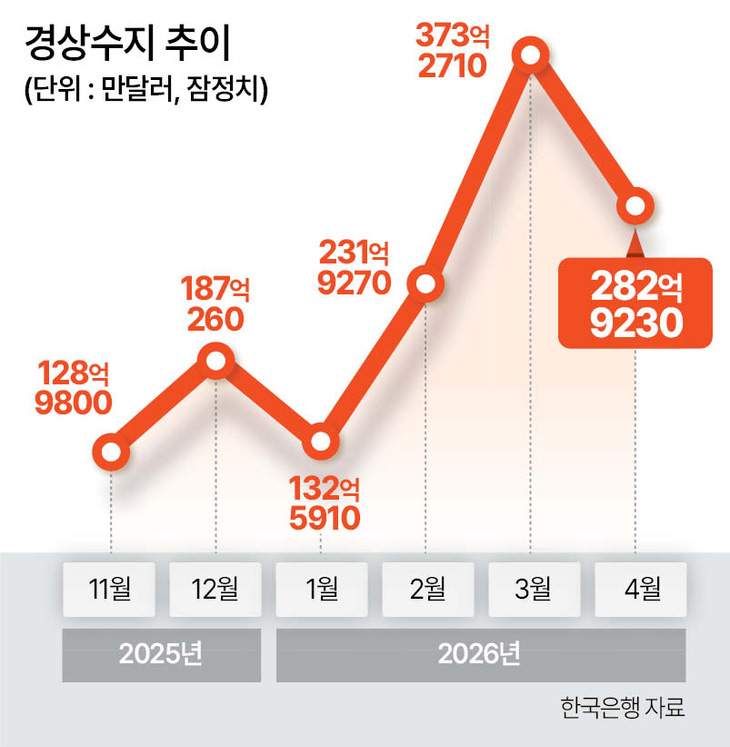
South Korea's current account posted a large surplus for the second straight month in April, extending a 36-month winning streak. May is expected to come close to matching the all-time high. Yet for ordinary households, the picture is darkening — squeezed by a triple threat of a weak won, rising prices and higher borrowing costs.
The second-largest surplus on record in April, despite the fallout from the Iran war, was driven by strong IT exports led by semiconductors, according to the Bank of Korea's preliminary balance-of-payments data released Friday.
Yu Seong-uk, head of the Bank of Korea's financial statistics department, told a briefing Friday morning that the surplus shrank slightly from the previous month's record high due to seasonal factors — a narrower goods trade surplus, a temporary deficit in primary income and a wider services deficit. Even so, he said, South Korea's current account surplus exceeded $20 billion for three consecutive months for the first time in history, pushing the cumulative total through April past $100 billion.
Particularly notable was South Korea's first-quarter current account surplus, which was the second largest in the world, trailing only China.
"Last year South Korea ranked fifth globally — behind China, Germany, Japan and Taiwan — but this time it surpassed Japan, Taiwan and Germany," Yu said.
Semiconductor-led IT exports again drove the surplus. The goods account balance came in at $33.88 billion, the second highest on record, matching the ranking posted in March.
Looking ahead to May, Yu said semiconductors posted record trade surplus figures at a level close to March's strong performance, and he expected primary income to swing back to a surplus as seasonal dividend-related pressures ease, putting the overall current account surplus near March's level as well.
Despite the strong external accounts, conditions for ordinary Koreans are deteriorating. The so-called "triple high" — a high exchange rate, high inflation and high interest rates — is bearing down on household finances.
The exchange rate is the most visible pressure point. A weaker won pushes up import prices almost immediately, which then feeds through to consumer prices with a lag. The won-dollar rate has become entrenched above 1,500 won, and voices within foreign exchange authorities are now asking whether that level should be accepted as the new normal.
Through Thursday, the won-dollar rate had closed above 1,500 won for 13 consecutive trading days — the longest such streak since 49 straight sessions during the 1997–98 financial crisis. It surpassed the nine-session run in March and April immediately after the Iran war broke out, as well as the 11-session run in February and March 2009 during the global financial crisis. On Friday, the won opened at 1,529 won, down 0.7 won from the previous session, before surging to 1,549.25 won around 10:28 a.m.
Inflation is also accelerating. According to the Ministry of Statistics, the consumer price index rose 3.1 percent in May from a year earlier — the largest increase since March 2024 and the first time the index has entered the 3 percent range. A separate lifestyle price index, which tracks 144 frequently purchased items that account for a large share of household spending, climbed 3.3 percent, also the highest since March 2024.
Interest rate pressure on ordinary borrowers is mounting as well. The Bank of Korea has repeatedly signaled the need for tighter monetary policy in recent weeks, and markets expect one or two benchmark interest rate hikes before year-end. A dot plot released last month by the bank's Monetary Policy Board — showing board members' rate expectations six months out — showed 10 of 21 dots, or 47.6 percent, clustered at 3 percent, with two more at 3.25 percent.
Shin Se-don, an economics professor at Sookmyung Women's University, said the central bank would ultimately have to act. "If the Bank of Korea does not raise rates, the exchange rate will become even more unstable," he said. "It will ultimately take the step of raising rates decisively." He added that the bank should send strong warning signals on the exchange rate before the Monetary Policy Board meeting next month.
kimstar@heraldcorp.com
forest@heraldcorp.com
hyuk@heraldcorp.com





