
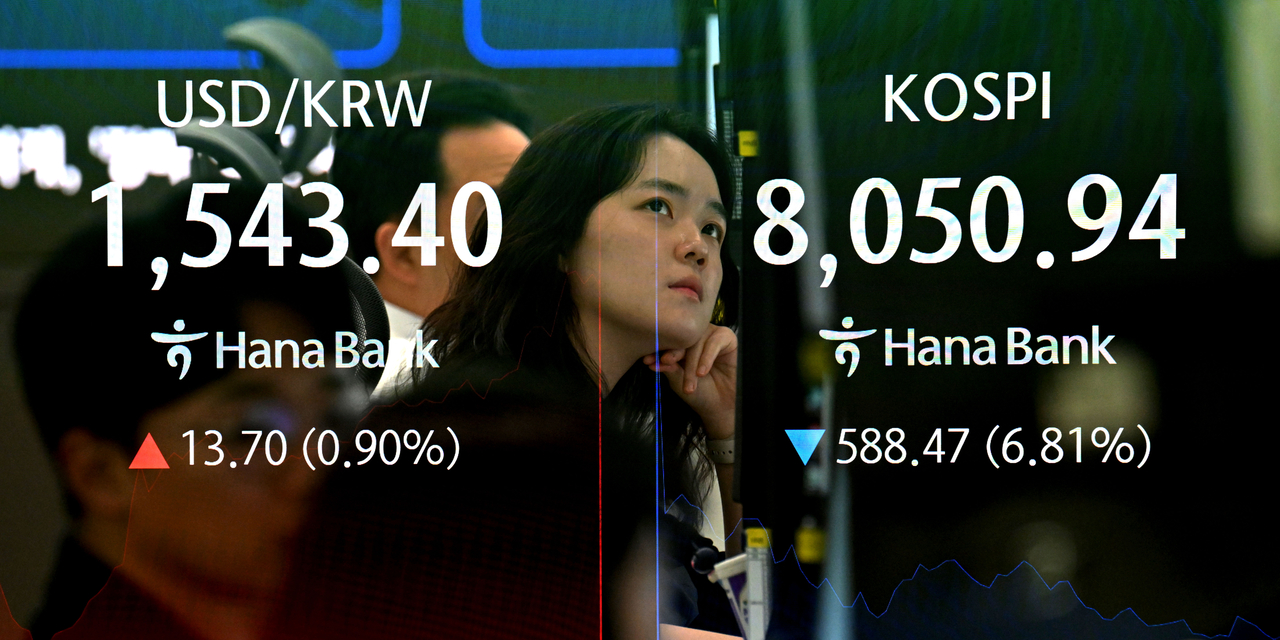
The market concentration around Samsung Electronics and SK Hynix — the pair often dubbed "Samsung-Hynix" — is intensifying. Analysts say the Kospi's so-called K-shaped divergence is deepening, with a handful of stocks driving gains while the vast majority continue to fall.
Korea Exchange data show that an average of 210 stocks advanced on the Kospi over the past two weeks while 596 declined. Compared with the two weeks prior, the number of rising stocks shrank further and the number of falling stocks grew.
Samsung Electronics and SK Hynix together now account for more than 50 percent of total Kospi market capitalization, in effect steering the entire market on their own.
Polarization is just as stark on the Kosdaq. On Wednesday, every sector on the exchange fell except telecommunications, which edged up slightly. Only 452 stocks advanced while 1,266 declined and 64 were unchanged. Seven stocks hit the daily upper limit and one hit the lower limit, underscoring the sharp divergence among individual names.
The Advance-Decline Ratio, a gauge of overall market health, stood at 47.72 percent. The ADR measures the cumulative number of advancing stocks over the past 20 trading sessions divided by the cumulative number of declining stocks, expressed as a percentage. A reading below 100 percent means more stocks are falling than rising.
"The concentration we are seeing in the current market cannot be explained by investor sentiment alone," said Noh Dong-gil, a researcher at Shinhan Investment. "Samsung Electronics and SK Hynix have moved beyond being market leaders — they have become the common underlying asset of the product market." He added that the structure is self-reinforcing: the more the two stocks rise, the greater their weight within the Kospi and the more central they become to related investment products.
dlcw@heraldcorp.com





