Survey of 10 economists and policy researchers marks one year of Lee Jae-myung administration
Eight of 10 rate macroeconomic management as 'generally excellent' or better
Growth of 3% possible this year if exports, domestic demand and fiscal spending hold steady
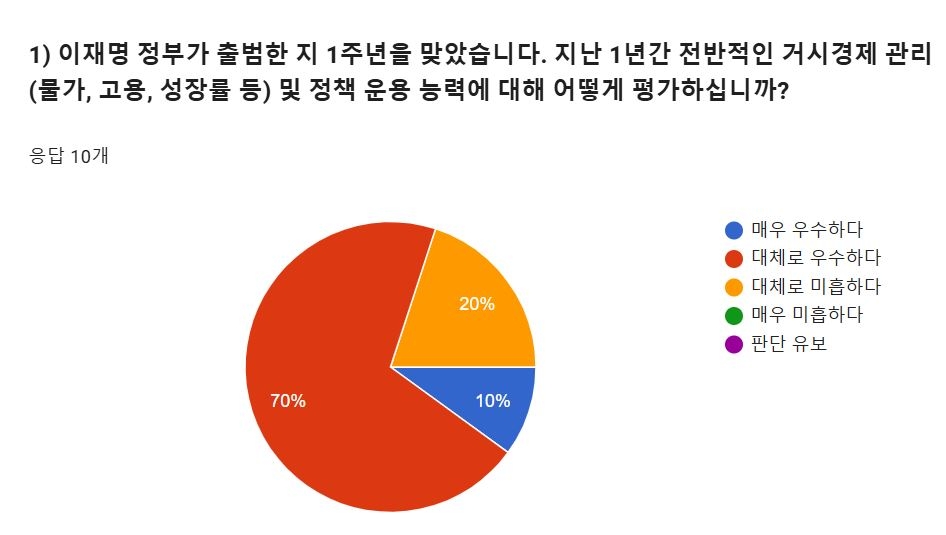
Eight of 10 economic experts rated the Lee Jae-myung administration's macroeconomic management and economic stewardship over its first year as "generally excellent" or better. The experts identified aggressive fiscal spending — including supplementary budgets — as the government's biggest economic achievement, and forecast that the South Korean economy will grow in the upper-mid 2 percent range this year, driven by strong semiconductor exports. Structural reforms to boost growth potential — including deregulation, investment promotion and the nurturing of advanced industries — remain unfinished business, they said.
In a survey conducted Monday to mark the first anniversary of the Lee Jae-myung administration, 10 economists and researchers at national policy institutes rated the government's macroeconomic management and policy execution over the past year. One respondent said it was "very excellent," seven said it was "generally excellent," and two said it was "generally insufficient."
Experts who gave positive assessments cited a rebound in the growth rate, rising share prices, strong exports and price stability as their main reasons.
Hong Seong-wook, head of the industrial data analysis division at the Korea Institute for Industrial Economics and Trade, said the government had driven an economic recovery through active fiscal policy and policy financing while managing inflation relatively stably even as it pursued stimulus measures.
Kang Byung-gu, a professor of economics at Inha University, said the economy, which had contracted in the first quarter of last year, rebounded to 1.7 percent growth in the first quarter of this year, with semiconductor-led export strength and a domestic demand recovery continuing despite US tariff hikes. "The growth rate is likely to improve further going forward," he said.
Jeong Se-eun, a professor of economics at Chungnam National University, said the government had responded appropriately to tariff negotiations with the United States and managed growth and inflation stably. "Given that external conditions were far from easy, the economic management has been commendable," she said.
Woo Seok-jin, a professor of economics at Myongji University, cited economic growth and rising share prices as reasons for his positive assessment. Song Young-gwan, a senior research fellow at the Korea Development Institute, said the government had managed potential conflict factors — including the Samsung Electronics bonus dispute — that could have affected the broader macroeconomy in a relatively stable manner.
On the drivers behind the improved economic indicators, Yang Jun-seok, a professor of economics at Catholic University of Korea, said the growth momentum itself was positive but that the global surge in semiconductor demand had played a large role. "Rather than the government's policies being particularly outstanding, there is an aspect of having benefited from favorable external conditions," he said. Kim Jeong-sik, an emeritus professor of economics at Yonsei University, also said the current account surplus had widened and share prices had risen on the back of strong semiconductor exports.
By contrast, Kang Sung-jin, a professor of economics at Korea University, and Shin Se-don, an emeritus professor of economics at Sookmyung Women's University, rated the administration's economic policies as "generally insufficient." Kang said policies that heightened labor market uncertainty — such as the Yellow Envelope Act — had been strengthened, while measures to promote investment and support self-employed workers had fallen short. Shin said he saw no clear achievements.
The biggest achievement of the Lee administration's economic team, in the experts' view, was aggressive fiscal spending through supplementary budgets and other measures — three respondents named this as the top accomplishment. Others cited the conclusion of trade negotiations with the United States, the establishment of fair economic practices and market order, and the rise of the Kospi.
Assessments of fiscal soundness were relatively favorable. Six respondents said that, despite rising national debt, the current level of fiscal expansion was acceptable for the purposes of economic recovery and future investment. Not a single expert rated the situation as dangerous enough to threaten the country's sovereign credit rating or burden future generations.
Kang Byung-gu said it was meaningful that the government had supported a domestic demand recovery through supplementary budgets and consumer voucher programs. Woo Seok-jin also named aggressive fiscal spending as the administration's greatest achievement.
On the government's energy transition policy — expanding renewable energy and pursuing carbon neutrality — opinions were divided. Five respondents said it should be pursued even if the opportunity costs are high. Three said the direction is right but the pace is too fast and is excessively increasing costs for businesses in the short term. One said the pace and approach need to be adjusted to minimize damage to industrial competitiveness. One said they were unsure.
Experts forecast that the South Korean economy will grow in the upper-mid 2 percent range this year, supported by strong semiconductor exports and a recovery in domestic demand. Some said 3 percent growth was possible if exports, domestic demand and fiscal spending all maintained solid momentum.
Hong said domestic demand improvements — in both investment and consumption — along with semiconductor-led export strength would drive growth, and forecast expansion of around 2.5 percent. Song said semiconductor market conditions would persist at least through next year and projected growth in the upper-mid 2 percent range.
Kang Sung-jin projected 2.7 percent growth, citing expanded access to the US market amid the China-US rivalry and a booming semiconductor market. Woo Seok-jin of Myongji University, pointing to solid exports, domestic demand and fiscal spending, forecast real growth of 3 percent and nominal growth of 10 percent for this year.
Kang Byung-gu, however, projected growth of between 1.8 and 2.5 percent for this year, adding that the forecast could be revised downward depending on global economic uncertainty and semiconductor market conditions.
Deregulation and investment promotion were the most frequently cited policy priorities going forward. Yang Jun-seok called for legal and institutional reforms to revive growth in industries beyond semiconductors, while Kim Jeong-sik urged corporate deregulation in line with global standards along with labor and tax reform.
Nurturing advanced industries was also highlighted as a key task. Hong Seong-wook stressed the need to strengthen advanced manufacturing capabilities and raise the potential growth rate. Woo Seok-jin of Myongji University and Kim Sang-bong, a professor of economics at Hansung University, recommended expanding research and development support for future advanced industries including AI, semiconductors and biotech.
Jeong Se-eun, however, acknowledged the need for an AI transition while cautioning against excessive concentration on specific industries. She said expanding the state's role in welfare, education, healthcare and residential services was necessary to strengthen economic resilience.
Kang Sung-jin recommended building a stronger domestic demand base by addressing global economic uncertainty while improving regional balanced development and income distribution. Shin Se-don of Sookmyung Women's University proposed a temporary cut in value-added tax as a measure to counter sluggish domestic demand.
Song Young-gwan advised that efforts to revise the Commercial Act to enhance corporate value and resolve the Korea discount should continue, and that South Korea should accelerate the expansion of renewable energy and power grid infrastructure — including an energy highway — to maintain competitiveness in AI and manufacturing.
oskymoon@heraldcorp.com
fact0514@heraldcorp.com
y2k@heraldcorp.com