Yeongdeungpo-gu, Dongjak-gu and Dongdaemun-gu lead Seoul's record-price transactions
The share of Greater Seoul apartment transactions setting record-high prices fell below 10 percent for the first time this year, according to new data. Analysts say the decline reflects dampened buying sentiment following the expansion of land transaction permit zones after the government's Oct. 15 measures last year and tightened lending regulations. Still, mid-to-lower-priced apartment complexes in Seoul continued to rise, while areas in Gyeonggi Province outside the regulated zones — particularly those with favorable transport links — saw record-price deals increase.
Property platform Zigbang's analysis of Ministry of Land, Infrastructure and Transport apartment transaction data showed the share of record-high deals in the Greater Seoul area stood at 9.7 percent in May, the lowest reading of the year.
Within Greater Seoul, Seoul's share of record-high apartment transactions climbed to 31.3 percent in February before falling for three consecutive months — to 25.1 percent in March, 21.3 percent in April and 19.3 percent in May. The number of record-price deals, which had exceeded 1,000 per month, dropped to 864 in May (as of June 2), while total transaction volume of 4,467 units also fell short of the monthly average of 6,563 units recorded over the preceding three months (February through April).
By district, the decline was most pronounced in Gangnam-gu, Seocho-gu and Yongsan-gu, which had previously led record-price activity. Gangnam-gu's share fell to 19.3 percent, down 31.1 percentage points from a year earlier, while Seocho-gu (33.8 percent) and Yongsan-gu (26.4 percent) dropped 14.3 percentage points and 9 percentage points, respectively. Analysts attribute the pullback to a growing wait-and-see stance among buyers of high-priced units that require large cash reserves.
By contrast, Yeongdeungpo-gu (41.2 percent), Dongjak-gu (35.3 percent) and Dongdaemun-gu (31.8 percent) each posted record-price shares at least 20 percentage points higher than a year earlier, showing relatively strong upward momentum. The average record-high transaction price in May was 1.29 billion won (about $836,000) in Yeongdeungpo-gu, 1.5 billion won in Dongjak-gu and 1.11 billion won in Dongdaemun-gu, with most deals concentrated in the 1 billion to 1.5 billion won range. Analysts say the gains reflect concentrated end-user demand — including jeonse tenants converting to purchases — as well as a price range less exposed to lending restrictions than Gangnam-area properties.
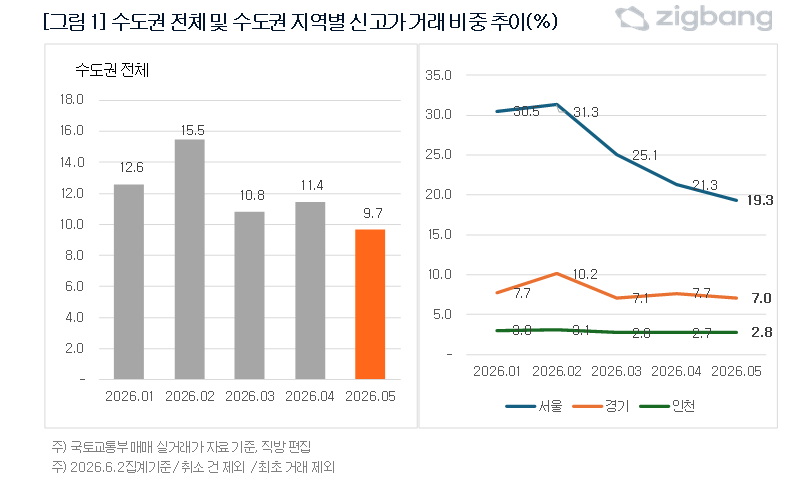
The broader decline in record-price transaction shares reflects weakened buying sentiment following the expansion of land transaction permit zones and tighter lending rules introduced after the Oct. 15 measures last year. The expiration of the multi-homeowner capital gains tax surcharge exemption ahead of May 9 also pushed distressed listings onto the market, further weighing on the record-price share. By region, Seoul's share edged down 2 percentage points from the previous month to 19.3 percent, while Gyeonggi Province fell 0.7 percentage points to 7.0 percent. Incheon edged up 0.1 percentage point to 2.8 percent.
Gyeonggi Province showed wide variation by locality. The province's overall record-price share fell 0.7 percentage points from the prior month to 7.0 percent, but unregulated areas with strong transport links or semiconductor industry-driven housing demand posted sharp year-on-year gains in record-price shares.
Guri (21.1 percent) recorded the largest year-on-year increase in record-price share among Gyeonggi localities in May, up 18.9 percentage points, as transaction volumes rose on expectations surrounding the planned extension of subway Line 6 and anticipated reconstruction of aging complexes. Yongin's Suji-gu (19.4 percent) saw its record-price share rise 16.1 percentage points, driven by access to Gangnam and Pangyo, hopes for remodeling projects and semiconductor industry-related development prospects. Hanam (21.4 percent) and Seongnam's Jungwon-gu (24.6 percent) also posted strong gains of 12.9 percentage points and 11.8 percentage points, respectively, led by areas with good access to Seoul.
In Hwaseong's Dongtan-gu (12.0 percent), the record-price share extended its streak to six consecutive months of month-on-month gains, rising 11 percentage points from the prior month. Dongtan is widely regarded as a key residential hub for workers in the southern Gyeonggi semiconductor belt, home to Samsung Electronics' Hwaseong and Giheung campuses and ASML's Hwaseong campus. With steady housing demand from workers in related industries, market attention has grown around the potential for additional demand following the recent settlement of Samsung Electronics' labor-management wage negotiations, which reportedly includes expanded housing loan support for employees.
Analysts say the Greater Seoul market is now characterized by a divergence between a cautious stance toward high-priced Gangnam-area units and relative strength in mid-priced Seoul districts and select Gyeonggi areas. They note that areas near the semiconductor belt, major business districts and locations with strong Seoul access continue to attract solid demand, with buyers concentrating in economically well-grounded localities.
"With the June local elections now concluded, attention is turning to the government's future real estate policy direction," a Zigbang official said. "The market is watching whether oversight of illegal speculation and tax evasion will be tightened, along with changes in household debt management policy and interest rate trends. As additional transaction reports are filed and the policy and financial environment continues to evolve, it remains to be seen whether this pattern of regional and price-tier divergence and demand concentration will persist."
![[르포] “삼전닉스만 집 사나요?” LG직원들 몰리자, 마곡도 국평 20억 찍었다 [부동산360]](https://wimg.heraldcorp.com/news/cms/2026/06/05/news-p.v1.20260605.de6ec4116abf45aa8dfb8fae8675df6b_T1.jpg)
hss@heraldcorp.com