
Look beyond low PBR, PER to future earnings
AI, semiconductors, data centers draw growth focus
Wealthy investors allocate assets based on future corporate value
'Maintain your investment philosophy, but watch for change'

These days, investors tend to ask similar questions when I meet them: "Should I start investing in shares now?" "Prices seem to have already risen a lot — is it still OK to buy?" "Can I put savings or business operating funds into the market?"
Just a few years ago, share investing was the domain of a select group. That has changed. Salaried workers, the self-employed and even corporate executives are now considering shares as a core pillar of asset management. Investors who have already built up significant share holdings are weighing whether to add more. Share investing has moved beyond a craze and is becoming part of everyday life.
Amid this shift, investors face another dilemma: should they hold firm to their own investment philosophy, or actively follow the market's new trends? These two values have long been in tension in the investment world — a debate over whether principled investors or trend-chasing investors ultimately come out ahead.
Looking at the market recently, the answer does not seem to lie with either camp alone. An investment philosophy must be upheld, but the changes of the times cannot be ignored.
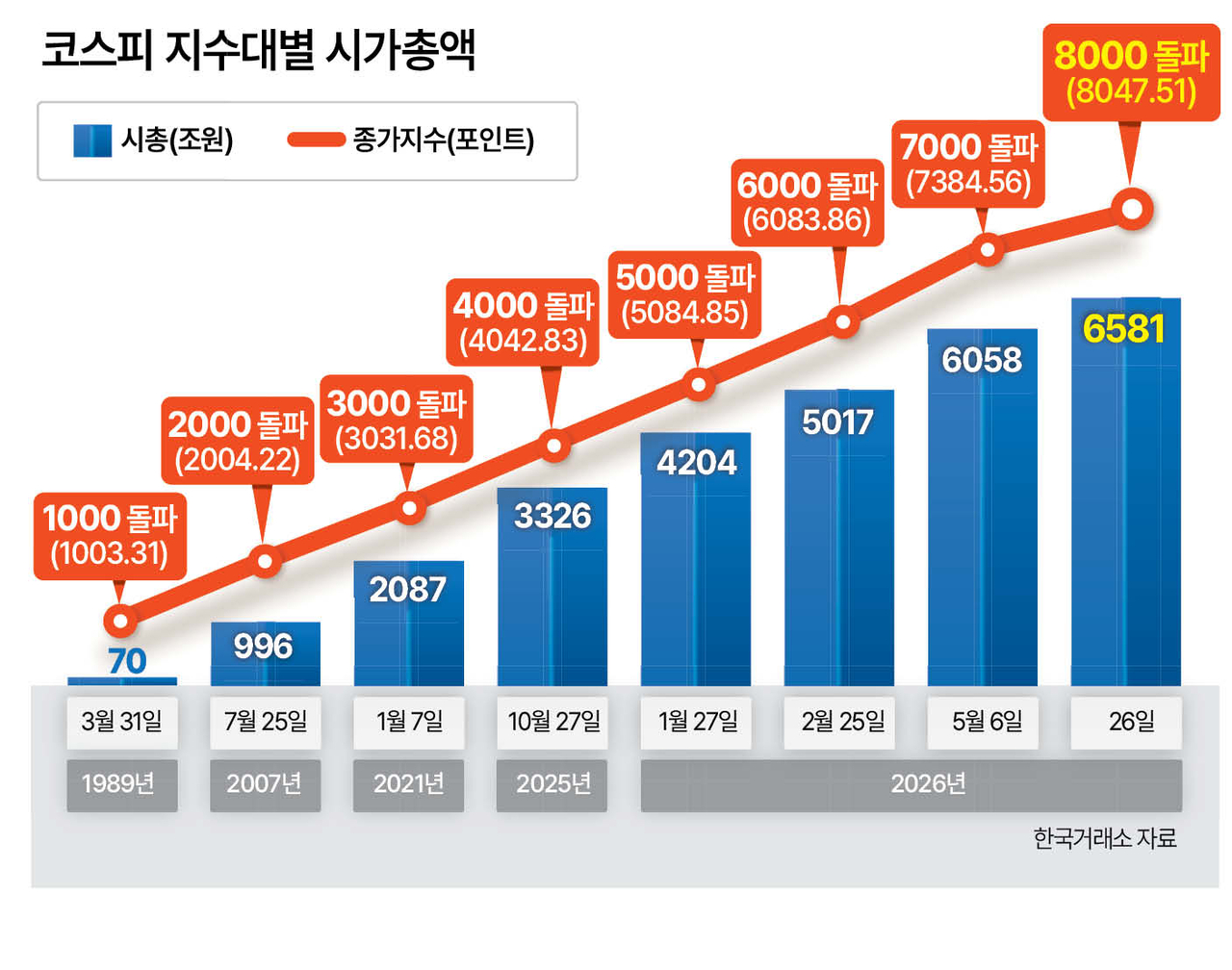
Kospi has risen just 6% a year on average — Since the Kospi broke the 1,000 mark in 1989, the domestic stock market has grown consistently over the past 36 years. It has recently pushed past the 8,000 level. Concerns about a short-term surge exist, but a simple calculation shows the index has risen roughly eightfold over 36 years — an average of just 6 percent a year.
Moreover, the composition of a share index changes constantly. Underperforming companies are dropped and growing ones are added — a phenomenon known as survivorship bias. Taking that into account, the long-term rise in share prices can be seen as a natural reflection of corporate growth and innovation.
The stock market is not a market for trading assets; it is a market for trading corporate capital. Companies use debt to expand assets and generate profit. It is therefore natural that expected returns exceed those of bank deposits.
The scale and speed of capital flowing into financial markets in recent years suggest the market is moving beyond a passing trend and becoming a new norm. Real estate was once the centerpiece of wealth accumulation, but shares are now establishing themselves as an essential asset class.
So what should guide investment decisions? The starting point is ultimately valuation — assessing value against price. The most important role of brokerages and asset managers is to analyze whether an investment target is priced appropriately relative to its current and future value. That applies not only to companies but also to real estate and intangible assets such as goodwill.
The challenge is that future value changes constantly. A company's share price is a living thing. New technologies emerge, industry conditions shift, and policies and regulations evolve. Countless news items and events occur every day, and the market's judgment of a company's future value shifts accordingly.
That is why a common saying in the stock market goes: "First comes supply and demand, second comes valuation." In the short term, capital flows determine share prices. Over a longer horizon, however, share prices ultimately converge with changes in corporate value and growth.
Value investing itself is changing — At this point, the concept of value investing also deserves a fresh look. Traditionally, value investing meant finding companies undervalued relative to their asset worth, with low price-to-book ratios (PBR) and low price-to-earnings ratios (PER) serving as key benchmarks. But as innovative growth companies emerged, led by those in the United States, the definition of value investing has shifted.
Today, value investing is no longer simply about finding companies whose current assets are cheap. It is evolving into an approach that seeks companies undervalued relative to their potential for future earnings growth. Warren Buffett's investment in Apple, which generated strong returns, fits the same logic. Many investors viewed Apple as a growth stock, but Buffett judged it to be a value stock when future cash flows and market dominance were taken into account.
The market's high regard for the AI, semiconductor and data center industries in recent years can be interpreted along similar lines. The market is assigning greater value to future earnings potential than to current earnings.
In practice, the investment approach of high-net-worth individuals illustrates this shift well. They do not necessarily move before everyone else. Rarely do they predict a future no one else can see, like visionary innovators. But when they conclude that a structural change is clear, they move more boldly than anyone.
Among the cases I have encountered, some investors holding financial assets worth tens of billions or even hundreds of billions of won — composed entirely of bond-type holdings — converted most of them into equity-type assets within just a few months after mid-2025. They placed a higher value on the profit opportunities that industrial change would create than on the direction of interest rates.
Such judgments do not always succeed, of course. Investment in the secondary battery and electric vehicle industries, for instance, delivered disappointing results relative to expectations. In a significant number of portfolios, related assets have failed to generate meaningful returns for nearly two years.
What is interesting, however, is that these investors did not exit their secondary battery positions entirely. Instead, they aggressively expanded their semiconductor weighting to defend overall returns while maintaining — or in some cases rebuilding — their secondary battery exposure. They do not believe the structural growth story has been fundamentally undermined.
Ultimately, the investment approach of high-net-worth individuals resembles asset allocation based on conviction about structural change — adjusting weightings — more than concentrated bets on a single industry.
They do not flip their portfolios all at once. They revise and refine gradually as market conditions evolve, correcting misjudgments and reinforcing sound ones. Their response to market change is therefore far more systematic.
Particularly among wealthy investors who run their own businesses, the instinct for reading the times is sharp. They think through how AI will reshape industries, what role semiconductors will play, and how far the electric vehicle and robot sectors will grow — before committing capital.
What they share is a commitment to their investment philosophy while refusing to ignore market change. They neither dismiss new industries in the name of principle, nor invest without discipline in the name of following trends.
Leaving the market out of FOMO is the worst move — Rule No. 1: survive — In recent years, the way society views the stock market has changed dramatically. Particularly among younger generations, a growing movement is pushing away from real estate-centric asset management toward a more active use of financial assets.
However, looking at the market recently, there is cause for concern. The growing interest is not so much in investing itself as in an obsession with rising share prices. In particular, a significant number of investment decisions are being driven by FOMO — Fear Of Missing Out — the anxiety of being the only one left behind.
The problem is that this approach may generate returns when the market is doing well, but is likely to produce heavy losses and disappointment when volatility expands. In practice, many retail investors repeatedly go on the offensive in bull markets, only to exit in bear markets. Investors who have once suffered a major loss often end up turning their backs on the stock market for a long time.
I consider this the investment failure most worth guarding against. The most important thing in share investing is not how much you made on a particular stock, but how long you can stay in the market. Investors do not grow wealthy from a single success; they accumulate assets over a long period by compounding returns.
In that sense, share investing should not become a means of covering today's living or housing costs. The shorter the time horizon, the more susceptible an investor becomes to market volatility. What is needed instead is the perspective of saving for the future — viewing the act of investing current funds in future growth the way one might defer today's spending to tomorrow.
In practice, the high-net-worth investors I meet hold a similar view of investing. They do not simply manage their own returns. They also provide investment education so that the next generation can preserve and grow assets going forward. They place greater emphasis on teaching why one should invest and how to assess a company than on which stocks to buy. Assets can be passed down, but an investment philosophy cannot be inherited without education.
Share prices change every day. Sometimes they surge or plunge for reasons unrelated to corporate value. But a company's competitive strength is not built overnight. Research and development, market share, brand value, technology and management capability all accumulate over a long period.
Investors should therefore follow companies, not share prices. An investor watching share prices is buffeted by the market every day; an investor watching companies can endure market volatility and wait. Such an investor is neither excessively excited by rising prices nor easily discouraged by falling ones.
The question of whether to hold to an investment philosophy or follow trends can ultimately be understood by the same token. An investment philosophy must not be abandoned. But structural change must not be ignored either. What matters is not the movement of share prices but the ability to read changes in companies and industries.
When more investors understand the companies they own rather than chase share prices, retail investors' results will become more stable and sustainable. And that, I believe, is the path by which share investing takes root not as a passing craze but as a healthy culture of asset management.
By Hong Tae-hwa

th5@heraldcorp.com





