Fear grips investors as won, rates and oil pile pressure on stocks; SpaceX IPO seen draining global liquidity; Korea Exchange holds emergency meeting; analysts warn high interest rates are biggest risk for AI and semiconductor sectors
![The Kospi tumbled to the 7,400 range during trading Monday as US semiconductor shares slumped, the won-dollar exchange rate surged and concerns mounted over a Federal Reserve rate hike. The Kospi and won-dollar rate are displayed at the dealing room of Hana Bank's headquarters in Seoul. [Yonhap]](https://wimg.heraldcorp.com/news/cms/2026/06/08/rcv.YNA.20260608.PYH2026060803280001300_P1.jpg)
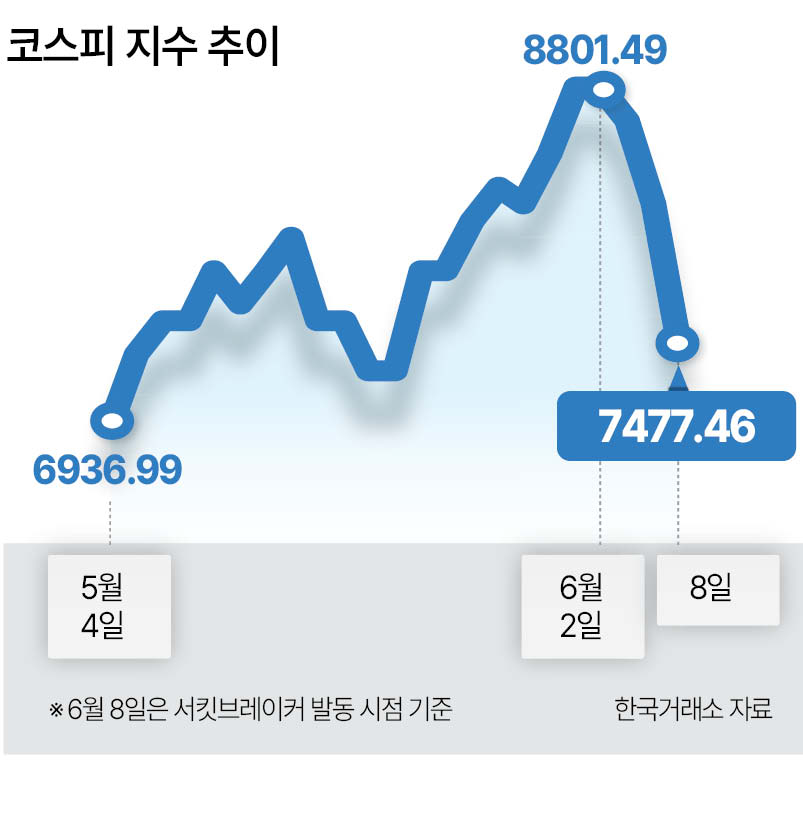
South Korea's stock market is facing a triple crisis. The won has surged to its highest level against the dollar since the global financial crisis, while high interest rates and elevated oil prices have sent the Kospi — which had only recently celebrated the 8,000-point milestone — tumbling to the low-to-mid 7,000 range.
The threat is compounded by the looming initial public offering of SpaceX, widely regarded as the largest in history, which analysts fear will act as a "black hole" sucking global capital away from emerging markets. Some observers are raising the possibility that Monday's selloff marks not a short-term correction but the start of a broader trend reversal.
The won opened at 1,555.2 won per dollar at 9 a.m. Monday on the Seoul foreign exchange market, up 16.1 won from the previous session's closing rate of 1,539.1 won. The opening rate was the highest since March 6, 2009 — during the global financial crisis — when it stood at 1,590 won.
One key driver of the won's recent slide is heavy net selling by foreign investors. They have offloaded roughly 118 trillion won (approximately $76.5 billion) worth of domestic shares on the main bourse this year. In May alone, they sold around 44 trillion won, and in just four trading sessions into June they recorded net selling of about 18 trillion won. On Monday, foreign investors continued to exit the Korean market, dumping more than 300 billion won in net sales in early trading.
The Kospi tumbled more than 8 percent, triggering a circuit breaker that temporarily halted trading. At the time of the halt, the index stood at 7,474.74, down 685.85 points, or 8.40 percent, from the previous session.
The deeper concern is that the exchange rate and foreign capital outflows are feeding each other in a vicious cycle. As foreign money leaves, the won weakens further; the sharper depreciation then amplifies currency-loss fears among remaining investors, prompting additional selling.
High interest rate expectations are further dampening investor sentiment, and rising global oil prices are adding another layer of complexity. Higher oil prices stoke inflation, which in turn raises the likelihood of further rate increases. Analysts warn that a weak won, elevated oil prices and upward rate pressure could combine to form a self-reinforcing drag on equities.
On top of that, the global flow of investment capital toward large US growth stocks and mega-IPOs is adding to the headwinds. The prime example is Elon Musk's space company SpaceX, which is pursuing what would be the largest IPO in history and has drawn intense interest from investors worldwide. Market participants estimate that investor demand has reached roughly $150 billion — about twice the offering's target size.
Securities industry analysts believe the SpaceX IPO will do more than list a single company: it will function as a black hole absorbing global liquidity. Large institutional investors seeking to participate in the offering are raising cash, which could lead them to trim their exposure to emerging market equities — adding yet another layer of selling pressure on the Korean market.
Authorities are closely monitoring the situation. Korea Exchange held an emergency market review meeting Monday to discuss measures to address the surge in domestic and international market volatility. The exchange plans to intensify scrutiny of unfair trading practices that exploit market uncertainty and to strengthen surveillance of illegal short selling.
Korea Exchange Chairman Jeong Eun-bo told the meeting that staff must "stay alert and make every effort to ensure stable market operations so we can respond swiftly to sudden market swings."
Experts forecast that the trajectory of the exchange rate, interest rates and oil prices will be the decisive variables for the Korean stock market. Heightened volatility is likely to persist, they said, until there are clear signs of improvement in foreign investor flows and exchange rate stability.
Lee Sang-jun, a researcher at NH Investment, said rising oil prices driven by fears of a Strait of Hormuz blockade are a key factor behind the current inflationary pressure. "The market is now in a position where it could react even more sensitively to future inflation data and shifts in monetary policy," he said.
Lee Young-won, a researcher at Heungkuk Securities, said inflationary pressure and the resulting rise in borrowing costs represent the single biggest obstacle to AI growth, which requires massive sustained investment. He added that rate levels will also be the key variable governing the scale and pace of benefits flowing to the semiconductor sector from AI investment. "For the AI industry, where investment on a barely imaginable scale has been announced, rising interest rates are likely to grow into a core issue that goes beyond the cost of financing — one that determines whether the entire endeavor is sustainable," he said.
th5@heraldcorp.com
hajun825@heraldcorp.com