
Jang calls for nationwide re-election over ballot shortage; rival floor leader candidates press for his resignation
By Jung Seok-jun, The Herald Business
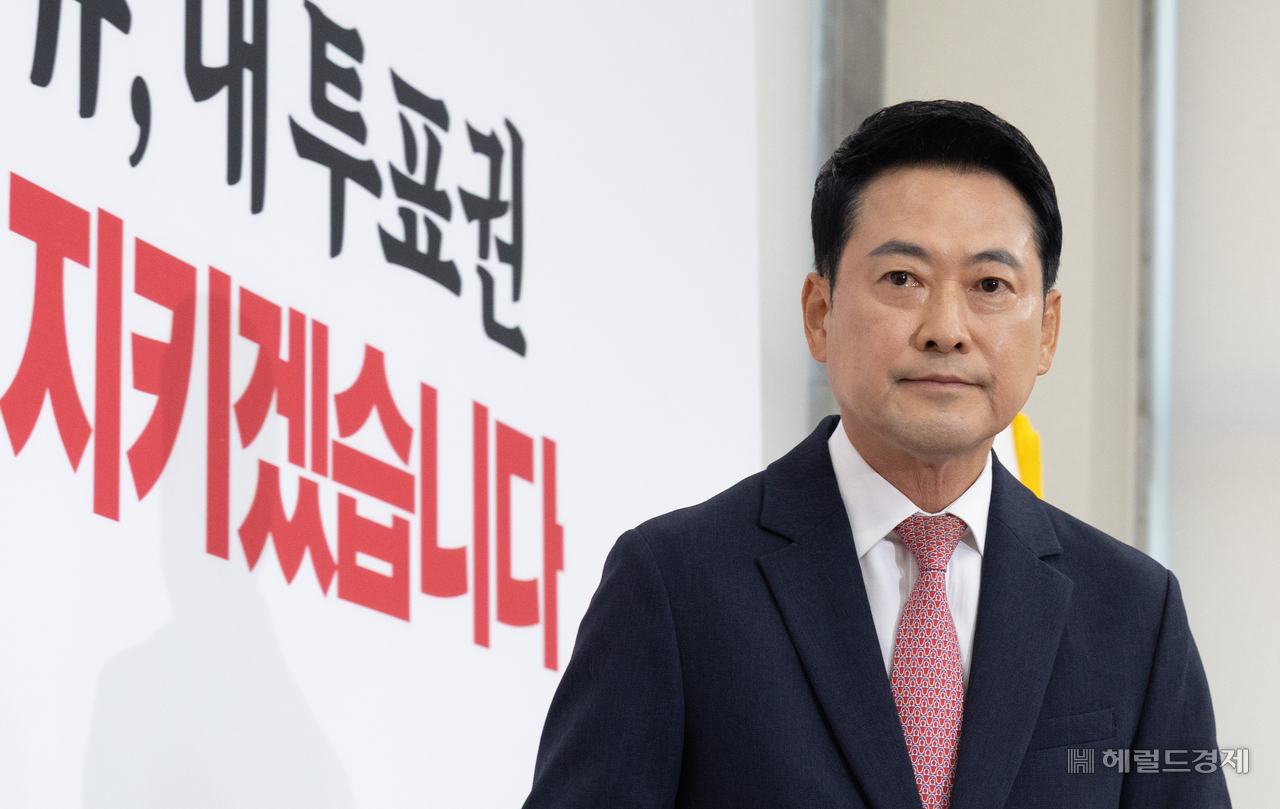
People Power Party leader Jang Dong-hyeok, facing calls to step down over the party's performance in the June 3 local elections, is pushing for a nationwide re-election over a ballot shortage controversy in a bid to go on the offensive. Despite mounting pressure from within and outside the party to resign, he is holding his ground. The outcome of Wednesday's floor leader election is expected to be a turning point for his leadership.
Jang held a press conference at the National Assembly on Tuesday, saying the number of polling stations that actually ran out of ballots had nearly doubled, from 50 to 91. "Ultimately, a nationwide re-election is the only way to fundamentally resolve this disenfranchisement," he said.
Jang has been focused on the ballot shortage issue, making back-to-back protest visits to the National Election Commission and the Seoul Metropolitan Election Commission through Friday, then visiting a protest site at Olympic Park in Songpa-gu, Seoul, on Saturday.
"The most certain path is for the election commission to acknowledge its own wrongdoing, declare this election invalid, and then proceed with a re-election," he said. "How many events as consequential as what has unfolded from June 3 to today have there been in the history of our democracy?"
Political observers say Jang is using the ballot shortage issue to deflect accountability for the local election results. Within the party, questions about leadership responsibility have surfaced despite the victory in the Seoul mayoral race, as the PPP's overall showing in regional government head contests fell short of expectations. Jang's term runs through August next year — less than a year before the 2028 general election. Voices calling for his resignation have continued, particularly among factions aligned with former party leader Han Dong-hoon and younger lawmakers, who argue the party cannot fight the next general election under his leadership.
Polling results released shortly after the election have been cited as a variable working in Jang's favor. A Realmeter survey commissioned by Energy Economy News, conducted June 4–5 among 1,004 adults aged 18 and older nationwide and released Monday, showed the Democratic Party of Korea at 41.8 percent and the People Power Party at 41.1 percent. The Democratic Party fell 3.1 percentage points from the previous survey while the PPP rose 2.6 percentage points, bringing the gap within the margin of error for the first time since the fifth week of January, when the Democratic Party stood at 43.9 percent and the PPP at 37 percent.
The PPP believes the ballot shortage controversy helped rally its base. Chief spokesperson Park Sung-hoon, speaking to reporters after a supreme council meeting Monday, attributed the surge in party support to the incident. "The ballot shortage situation had a decisive impact. We assess that the PPP leadership, which stayed at the scene through election night and into the early hours, played a role in channeling that public anger," he said, adding that the party's victory in the Seoul mayoral race also contributed.
At a press conference Monday, Jang drew a line when asked about calls for his resignation over the election results, countering: "Looking at the objective data, how do you assess the outcome of these local elections?"
With Jang digging in, the floor leader election has emerged as a key internal variable. The PPP holds the vote Wednesday. Three lawmakers have entered the race: Kim Do-eup, Seong Il-jong and Jeong Jeom-sik.
Within the party, the floor leader election is seen as more than a simple leadership contest — it is in effect a vote of confidence in Jang's leadership. Jeong Jeom-sik, a former PPP policy committee chair, is considered aligned with the party establishment. Some observers say that if Jeong wins, Jang's leadership could retain its momentum for now.
Kim Do-eup and Seong Il-jong, by contrast, have publicly raised the question of accountability for the election defeat and called for a leadership overhaul. Speaking on KBS Radio on Tuesday, Seong referenced the results in Seoul and Busan and said the party must "make the right decision about when to step forward and when to step back." Kim, speaking on CBS Radio on Monday, said, "Party leaders who lose elections have typically come forward to declare their intentions. I would expect Jang to make a wise judgment as well."
The survey cited in this article was conducted via automated response on mobile phones. The margin of error is ±3.1 percentage points at a 95 percent confidence level, with a response rate of 5.6 percent. For further details, visit the website of the National Election Survey Deliberation Commission.
mp1256@heraldcorp.com





