
Yoon Jong-kyoo, who built KB Financial into South Korea's top financial group over nine years, shares his views on bonus disputes, the stock market boom, real estate policy and digital assets
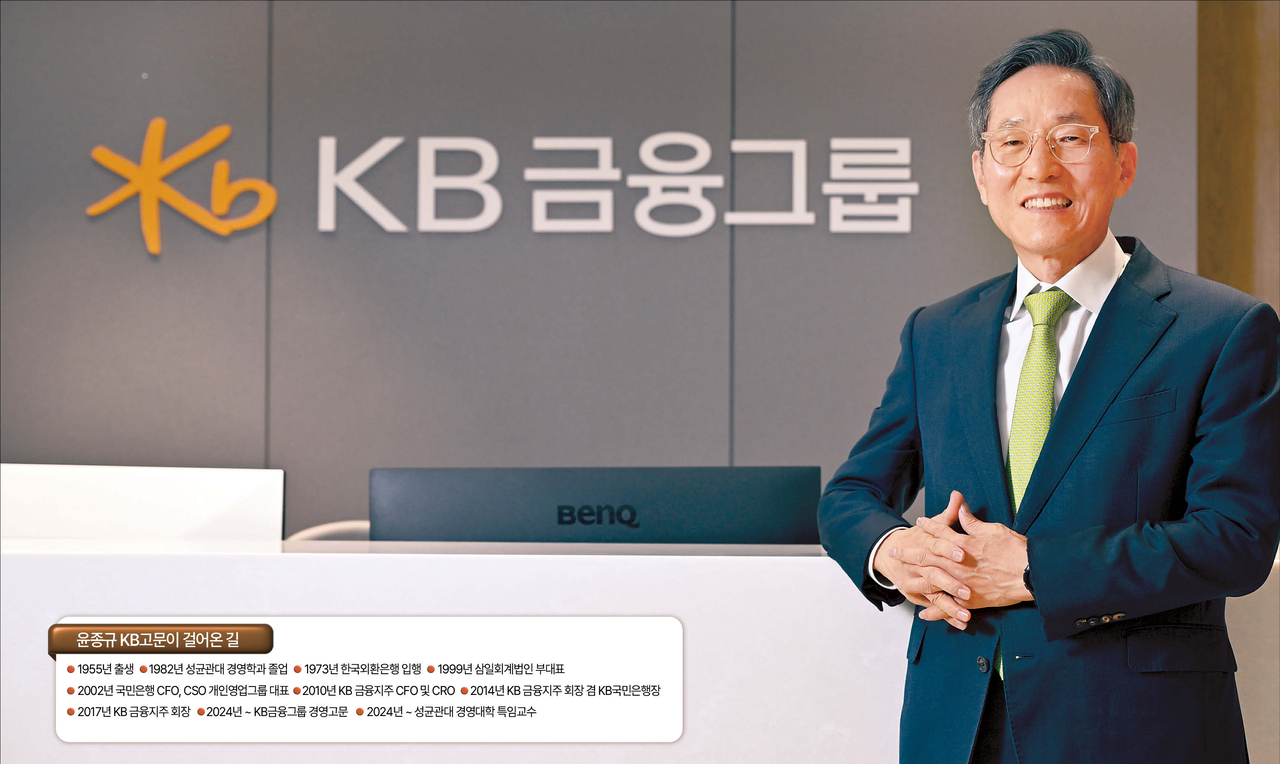
"It is wrong to hand out bonuses based on how hard a union pushes or how a manager feels on a given day. There must be principles and standards."
Yoon Jong-kyoo, adviser to KB Financial Group, offered that diagnosis of the bonus disputes now spreading across South Korean industries, warning that agreements reached without clear principles could send shockwaves through the broader economy.
Yoon led KB Financial as chairman for roughly nine years starting in 2014, building it into the country's undisputed top financial group. He sat down for an interview near Gwanghwamun in Seoul on May 28. Now also a special professor at Sungkyunkwan University, he spoke candidly as a senior business figure on the bonus controversy and a range of other economic issues facing South Korea.
Paying bonuses in stock builds ownership mindset
Among the economic issues drawing the most attention lately, the bonus dispute stood out by far to Yoon. Conflicts between management and labor — and among workers themselves — over bonuses worth hundreds of millions of won per person have spilled beyond individual companies into a broader social problem.
"I worry that the pattern of unions demanding more and management partially giving in will spread bonus conflicts to other industries," Yoon said. The concern is well-founded: after the Samsung Electronics bonus controversy erupted, similar labor disputes over bonuses spread across the industry, including at Kakao.
"In a country like South Korea, where labor market flexibility is limited, this could entrench vested interests and lead shareholders to question the long-term sustainability of companies," he said.
Yoon traced the root of the current bonus disputes to an absence of principles and standards. He recalled negotiations with the Kookmin Bank union during his time as KB Financial chairman. "The union went on strike demanding a larger special bonus," he said. "I was willing to pay more, but I thought it was wrong for the amount to change each time based on how hard the union fought or how the manager felt, with no principles or standards."
At the time, Yoon established three principles. First, any surplus profit above a return on equity of 10 percent would be shared through negotiation. Second, special bonuses would be paid in stock rather than cash. Third, payouts would be differentiated based on individual performance. He particularly stressed that paying bonuses in stock fosters a genuine sense of ownership among employees. "If you give bonuses in stock, employees become shareholders," he said. "When the share price rises, it benefits them directly — that is where real ownership comes from."
'The market is finally getting it right — but debt-fueled investing is dangerous'
Yoon was broadly upbeat about the stock market boom, with the Kospi eyeing the 9,000-point mark, but sent a clear warning about excessive debt-fueled investing.
"Our stock market has been depressed for far too long," he said. "Look at bank stocks — KB Financial is called the leading bank, yet its price-to-book ratio is below 1. That is the reality of the Korean economy and what the market thinks of Korea." The price-to-book ratio measures a company's share price against its net asset value per share.
"There would be a lag, but I believed the market would eventually give a fair valuation," he added. "It is starting to happen now, and I see that positively."
He did, however, raise concerns about the surge in debt-fueled investing accompanying the market rally. According to the Korea Financial Investment Association, the balance of margin loans — money borrowed from brokerages to invest — stood at 38.02 trillion won (about $24.6 billion) as of May 29, surpassing the 38 trillion won threshold for the first time after jumping nearly 1 trillion won in a single day. The figure edged back to around 37.7 trillion won on Thursday but remained elevated.
"Temporarily borrowing to cover a shortfall in an otherwise sound investment is fine, but relying heavily on debt in the expectation of much higher returns is dangerous," Yoon said. "The world does not move the way you expect — that is what worries me about debt-fueled investing."
He drew a line, however, at the risk of such borrowing becoming a systemic threat. "Loans from brokerages are collateralized, so if things go wrong, forced liquidation happens immediately — the actual risk is not large," he said. "Bank credit lines, the so-called minus-account loans, carry some risk, but banks set limits based on borrowers' circumstances, so the scale is not large enough to pose a systemic risk, and risk management should be sound."
Yoon also welcomed the broader shift of money flowing out of real estate and into the stock market. "Close to three-quarters of household assets were concentrated in real estate," he said. "Money moving from real estate toward productive investment and corporate finance is a very welcome development." He predicted that as household lending shrinks, bank funds will migrate toward corporate finance and overseas markets, and ultimately toward a model of direct customer investment — a shift, in short, from a deposit-and-lending model to an investment model.
He added a note of caution, saying the secondary market for stocks has become quite active while the primary issuance market has lagged. "I hope the secondary market's vitality feeds through to the primary market, boosting new capital-raising and ultimately driving more corporate investment in a virtuous cycle," he said.
Some of the gains from rising share prices are flowing back into real estate. A recent Bank of Korea report estimated that households without homes redirect about 70 percent of their stock capital gains into property. "The money shift may fluctuate or reverse at times," Yoon said. "Ultimately, the problem is that real estate never leaves the minds of the Korean people."
!["Bold and Tenacious," a book chronicling the management philosophy and career of Yoon Jong-kyoo, KB Financial Group adviser, during his tenure as chairman. [Provided by 1&1 Books]](https://wimg.heraldcorp.com/news/cms/2026/06/09/news-p.v1.20260605.abbf2e293cfd42978430bbef69c27761_P1.jpg)
'Finance must ask whether it helped fuel excess demand for real estate'
When the conversation turned to real estate, Yoon's tone grew more emphatic. "The basic direction of real estate policy going forward must be clearly established as something that survives changes of government," he said. "I hope the ruling and opposition parties can reach a consensus on the broad framework." He urged a pan-government approach that is comprehensive and systematic. "We need to tackle the fundamental problems boldly," he said.
He also called for the financial sector to reflect on its past household lending practices. "One of the main causes of the real estate problem is excess demand, and the financial sector needs to ask honestly whether it played its proper role," he said. "Jeonse loans were originally meant to help people with lower incomes cover their deposits, but in practice they caused jeonse demand to explode, and as gap investing became possible, excess demand was created."
"Loan-to-value ratio and debt-to-income ratio rules also lacked differentiation based on whether someone already owned a home," he recalled. "Those who were not genuine end-users should have been required to buy property with their own capital — it would have been better if banks had not poured fuel on the fire by helping them."
He said the market mechanism should be used to the fullest, with policy tools applied wisely, and outlined four priorities.
The first is expanding supply. "Gangnam real estate is like a luxury good — it is expensive because supply is scarce," Yoon said. "Regulations on reconstruction and redevelopment should be boldly eased where possible to increase supply." He also called for financial support targeted at genuine end-users. "For end-users, the loan-to-value ratio should be raised boldly to 80 percent, while speculative demand from multi-home buyers should be cut off — differentiation is essential," he said.
Yoon also argued that the price ceiling on new apartments is itself fueling excess demand, and proposed replacing it with a bond-bidding system. Under that system, buyers who purchase a new apartment below the surrounding market price would be required to buy additional bonds on top of the pre-sale price, allowing the government to recapture part of the price gap. "Capping costs through a price ceiling actually encourages excessive apartment subscriptions, but removing all regulation just lets construction companies pocket a windfall," he said. "If someone is willing to pay more to get in, the government can absorb that premium through bonds and use the proceeds for housing construction funds and public rental housing."
Finally, Yoon raised the need for tax reform. "The loose rental income tax structure — single-household exemptions, long-term holding deductions and the like — favors real estate income over earned or business income," he said. "In the AI era, we should be giving more advantages to creative talent, but the tax system is moving in exactly the opposite direction."
He argued that solving economic problems, including those in real estate, requires broader social change. "If I imagine going back to my 20s, deciding to get married requires first having a job, then having hope that I can find a home, and then having confidence about educating my children," he said. "In the end, those three things are the biggest factors squeezing young people today."
On jobs, Yoon said service industries — tourism, healthcare, education, logistics and finance — will account for a far greater share of employment going forward. "We need to raise the competitiveness of the service sector," he said. On childcare and education costs, he proposed fully integrating kindergartens and childcare centers and making them entirely free. "If the state helps and takes responsibility, young parents will feel a sense of relief," he said.
He also called for a rethink of the school system. "I wonder whether we still need to keep the 6-3-3 structure," he said. "Our generation first learned to read and write in elementary school, but children today arrive already knowing hangul, English and math. The 12-year structure could probably be shortened to 10 years, something like 5-3-2."
Universities, too, must change, he said. "In the AI era, does a degree earned through rote memorization still mean anything? Universities have to change," he said. "The government talks about creating 10 universities on par with Seoul National University — but it is worth thinking even further, about specializing national and public university campuses across the country and effectively unifying them into one."
'Digital assets will develop in tandem with traditional finance'
On digital assets, now a defining new paradigm for the financial sector, Yoon argued for coexistence with the existing financial system. "Rather than digital assets creating an entirely new financial system, I expect them to develop in a mutually complementary way — influencing the existing system by expanding customer choice and convenience," he said.
He identified the tokenization of real-world assets, known as RWA, as the most important role for digital assets. RWA refers to the process of converting tangible and intangible assets — real estate, bonds, gold, artwork and the like — into digital tokens using blockchain technology.
"RWA breaks large physical assets into small pieces that can be traded in small amounts — security token offerings and fractional investment are the same idea," he said. "It creates liquidity in assets that were previously locked up. That is the greatest contribution digital assets can make."
On the recent convergence between the financial sector and the digital asset industry, he said digital asset companies are seeking to expand into financial services while traditional financial firms are working to incorporate or replace elements of digital asset technology. "Using blockchain networks for overseas remittances, or improving on the existing SWIFT global financial messaging network, are prime examples," he said. "You could also see it as a turf war — digital asset firms want to do banking, and financial firms want to do digital assets."
He acknowledged that digital assets face significant challenges. "The clash between a state's traditional taxing authority and borderless blockchain technology is the biggest problem governments around the world are grappling with right now," he said. "Governments are moving toward maintaining and reconciling their taxing authority and financial control by exploiting blockchain's technical transparency, regulating real-world gateways such as exchanges, and combining that with international tax cooperation." South Korea's requirement that verified real-name bank accounts be linked one-to-one with digital asset exchange accounts is a prime example, he noted.
On the won-denominated stablecoin legislation currently moving through the legislative process, Yoon advocated a phased approach. A won stablecoin is a digital asset pegged one-to-one to the value of the Korean won, and is considered more stable than general digital assets.
"If stablecoin issuance goes wrong, the damage is borne by society as a whole — profits are privatized but losses are shared," he said. "It may be worth starting by allowing one license for a consortium of traditional financial firms and one for digital asset or platform operators, then expanding further if needed."
Meanwhile, Yoon recently published "Bold and Tenacious," recounting the management philosophy behind his revival of KB Financial — which was mired in leadership conflict in 2014 — into the country's top financial group over nine years. The book captures his principle of prioritizing long-term trust over short-term results.
By Kim Byeo-ri and Jeong Tae-il
kimstar@heraldcorp.com





