First-quarter real GNI hits all-time high; manufacturing, construction and service sectors rebound; upward pressure on annual growth rate with 3% now in view; nominal GDP surge seen easing fiscal burden and boosting domestic demand
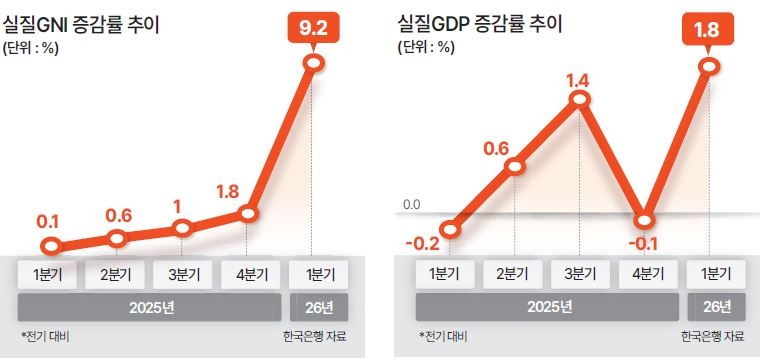
South Korea's first-quarter real gross national income growth hit an all-time high, raising hopes that per capita national income could cross the $40,000 threshold this year. The preliminary first-quarter real GDP growth figure also came in 0.1 percentage point above the advance estimate, adding to expectations of a stronger full-year expansion.
The Bank of Korea released its preliminary national income statistics Tuesday, showing that real GNI posted a record growth rate in the first quarter while real GDP surprised to the upside relative to the advance estimate. The bank attributed the gains to an easing of terms of trade — led by semiconductors — along with stronger-than-expected private consumption and facilities investment.
Attention is now turning to whether per capita national income will surpass $40,000 for the first time this year, given the record first-quarter real GNI performance. Last year's per capita GNI, also released Tuesday, stood at $36,963 — leaving South Korea short of the $40,000 mark for the 12th consecutive year.
Kim Hwa-yong, head of the Bank of Korea's national income division, said at a briefing Tuesday morning that if the current strong growth momentum continues, per capita income is expected to approach $40,000 this year. "In March we said 2028 was the likely target year, but it is now clear that the timeline could be brought forward," he said.
He added that whether the $40,000 level is actually reached will depend on corporate earnings and the direction of the won-dollar exchange rate. A weaker won reduces the dollar value of per capita GNI.
The preliminary first-quarter real GDP figure rose a further 0.1 percentage point above the advance estimate, which had already come in at roughly double the forecast. Kim said private consumption was revised up on stronger spending on securities transactions, services, passenger vehicles and durable goods such as home appliances, while facilities investment was lifted by faster-than-expected progress in display and semiconductor investment.
Breaking down the preliminary first-quarter real GDP by economic activity, manufacturing grew 3.9 percent from the previous quarter, driven by computers, electronics and optical equipment. Construction expanded 2.2 percent on gains in both building and civil engineering work, while the service sector rose 0.6 percent, led by wholesale and retail trade, accommodation and food services, and finance and insurance.
On the expenditure side, private consumption rose 0.6 percent from the previous quarter as spending on both goods and services increased. Exports climbed 5.9 percent, led by IT products including semiconductors, while imports rose 3.9 percent, driven by machinery and equipment and automobiles. Construction investment and facilities investment grew 1.4 percent and 6.6 percent, respectively. Government consumption, however, fell 0.4 percent as national health insurance benefit payments declined.
Upward pressure on the full-year growth rate has also intensified. The Bank of Korea set its annual growth forecast at 2.6 percent in its revised economic outlook last month, but the possibility of achieving 3 percent growth is now being discussed both inside and outside the bank.
Kim said the 0.1 percentage point upward revision to first-quarter real GDP feeds directly into a 0.1 percentage point increase in the annual growth rate. "We will update the annual growth forecast in August based on conditions at that time," he said.
Nominal GDP surged 10.5 percent from the previous quarter and 17.1 percent from a year earlier — the largest quarterly and year-on-year increases since the first quarter of 1976 and the third quarter of 1995, respectively. Nominal GDP strips out the effects of price changes from real GDP. Compensation of employees rose 4 percent from the previous quarter on higher manufacturing wages, while gross operating surplus jumped 17 percent, led by manufacturing and the finance and insurance sector.
Nominal GDP is closely watched in financial circles because it affects key ratios including the national debt-to-GDP ratio and the household debt-to-GDP ratio — a higher nominal GDP mechanically lowers both. Markets are now projecting that South Korea's full-year nominal GDP growth rate could reach double digits this year for the first time in 24 years.
Semiconductor-driven tax revenue growth is also helping ease the government's fiscal burden, and analysts expect the government to pursue a more active fiscal policy going forward.
Kim said the expansion in nominal GDP should be distinguished from past cost-push inflation because it is not being driven by domestic price increases. "Nominal GDP growth driven by improved corporate profitability will significantly ease the government's fiscal burden while also having a positive effect on domestic demand," he said.
He added that higher corporate operating profit translates into greater corporate tax revenue, which can fund not only fiscal stability but also structural reforms — such as nurturing future industries — to lift potential growth, and can support domestic demand through expanded research and development and facilities investment. "The likelihood that ratios such as household debt and government debt will fall substantially has also increased significantly," he said.
kimstar@heraldcorp.com