Investment strategy in a world of persistently high global rates
Semiconductor prices rising faster than oil
$350 billion current-account surplus dismisses crisis fears
US debt burden seen driving national-level AI push
Past 20 years of ultra-low rates were the anomaly, not the norm
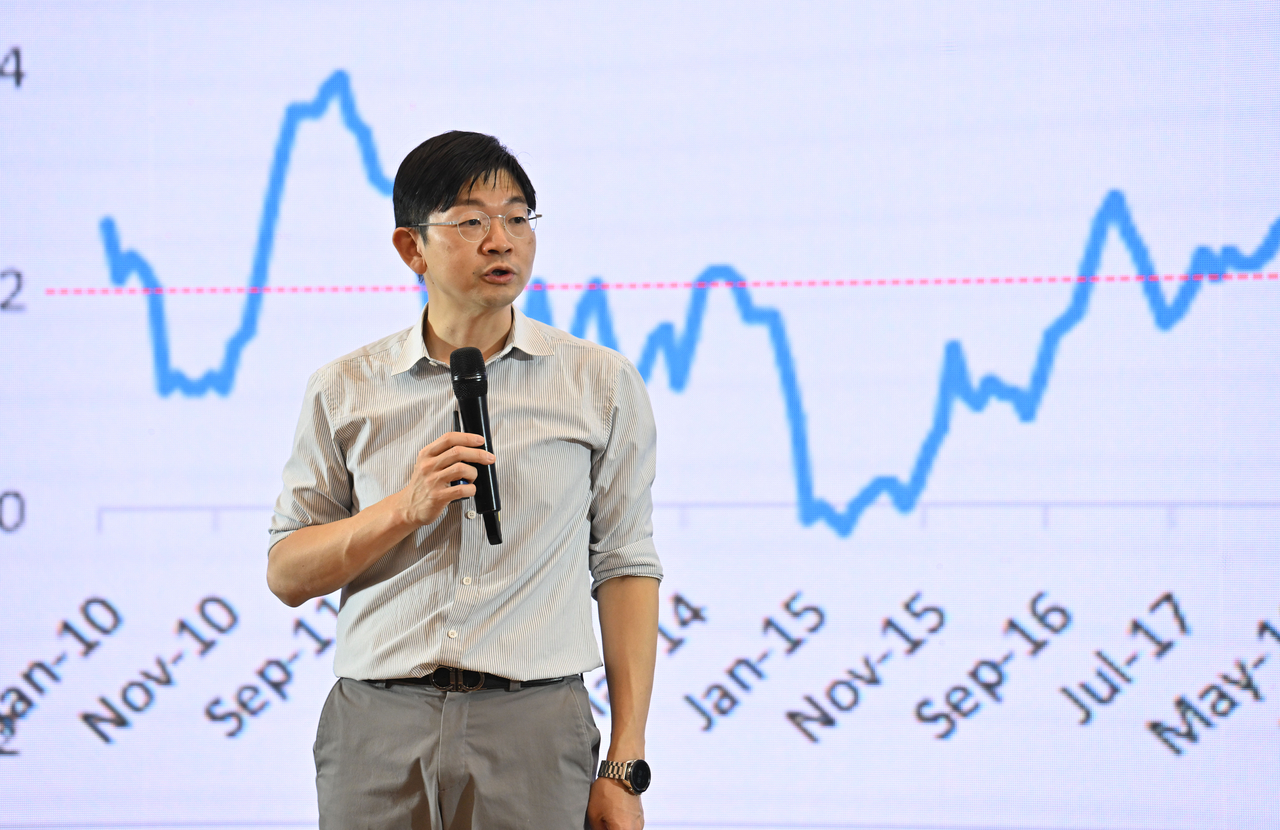
"This week's stock market decline is not a crisis — it is a reversal of expectations that had been concentrated in certain sectors."
Oh Geon-young, head of Shinhan Bank's Pathfinder division, opened his lecture at Herald Money Festa 2026 on Friday with that assessment. Speaking at Art Hall 1 of Dongdaemun Design Plaza under the theme "The Chaos Created by Trump 2.0 and Shifts in the Macro Environment," Oh said the recent sharp drop in equity markets likely reflects an unwinding of sector-specific optimism rather than a systemic breakdown.
"Normally, when share prices plunge, the dollar rises as a safe-haven asset — but recently, both share prices and the exchange rate have fallen together," Oh said. SK hynix shares have dropped 30 to 40 percent from their July peak, yet over the same period the won-dollar rate actually fell more than 200 won, from around 1,560 won to 1,340 won. On that point, he drew a sharp distinction: "When share prices fall and the dollar jumps, that is a correlation; when a crisis hits and the dollar jumps, that is causation." A crisis causes share prices to crash and the dollar to surge, he said, but falling share prices do not necessarily mean the dollar will rise.
Oh cited the current-account balance as evidence that the economy is not in crisis. "We used to say earning $100 billion in annual current-account surplus was an A-plus," he said. "This year, the cumulative surplus through July alone has already reached $230 billion, and it looks set to exceed $350 billion for the full year." He added that this reflects how much faster semiconductor prices are rising compared with oil prices, and went on to say that while a major crisis would take a long time to resolve, the current situation is more a supply-demand issue and should prove less severe.
Oh also shared his views on smart investment strategy as global interest rates trend higher. "The entire world is beginning to enter a rate-hiking cycle again," he said, adding that the United States looks likely to raise rates in December and that South Korea could follow, possibly in November but more likely next year. While some have called for a slower pace given how quickly rates have risen, he said further hikes through next year still appear to be the base case.
Inflation is the key variable. The US consumer price index has remained stuck near 3 percent since surpassing the Federal Reserve's 2 percent target in March 2021. "It has been five years and seven months since inflation broke above the target, and it still has not come back," Oh said. "Some are asking whether this has become a chronic condition." He warned that a chronic condition is hard to treat and prone to relapse, and that the world may face a prolonged period of keeping interest rates significantly higher than in the past.
Even so, Oh said this rate-hiking cycle differs from previous ones. After the global financial crisis, he explained, companies stopped borrowing to invest, demand for money dried up, and central banks flooded the system with liquidity, keeping rates low. "Back then, there was no growth, and a 0.25 percentage-point rate hike was enough to rattle markets," he said. "Now, growth has returned, and the money unleashed during COVID-19 is compounding with massive capital expenditure on AI data centers and the like, driving up demand for money." Against that backdrop, he cautioned: "If you carry over the old thinking that 'rising rates spell disaster,' you will find yourself caught off guard time and again."
Oh predicted that the United States and other major economies will continue pouring investment into an AI-driven productivity revolution. Citing the roughly $40 trillion US national debt, he said that clawing back the money already pumped into the system risks a prolonged slump like Japan's, while trying to grow out of the debt would push up incomes, consumption, prices and ultimately interest rates — making the debt burden even heavier. "If growth can be achieved while keeping inflation low, rates can stay low — but that requires a productivity revolution," he said. "If the AI revolution collapses, the debt problem will not be solved either. National-level support for AI will continue."
Oh added that because no one knows which sectors will outperform on any given day, diversification is essential. "That is why we spread our investments," he said. "If you take a long view, your portfolio should be tilted toward AI."
Oh closed with a broader warning about the investment environment. "It may not be that interest rates are excessively high right now — it may be that the past 20 years of ultra-low rates were the anomaly," he said. "High rates could persist longer than expected, and when that happens, investing becomes harder. Your approach to investing needs to change."
"In a world of higher rates, we cannot respond the way we did when rates were low," he added. "Remember that holding cash can also gain in value in this environment — cash is a safe asset, and it is the ammunition that lets you enter the market at the bottom when asset prices fall." He urged investors to think about spreading their bets rather than concentrating them in one direction.

kimstar@heraldcorp.com