
Mega-IPO wave raises fears of capital flight from tech and semiconductor shares; index inclusion rules and lock-up expiry add to volatility risk
The global investment community is watching SpaceX's initial public offering closely — drawn not only by the company's own appeal but by the shockwaves its blockbuster debut could send through markets worldwide.
With OpenAI, Anthropic and other major private technology companies lining up for listings in SpaceX's wake, analysts warn that capital flows concentrated in semiconductor shares could begin to shift.
That shift could become a meaningful variable for the share prices of Samsung Electronics and SK Hynix. Some analysts argue, however, that given the market capitalization of the two Korean chipmakers, investors need not overreact to any sentiment drag from the SpaceX listing.
As SpaceX prepares to begin trading on the Nasdaq on Friday, market watchers say the debut could trigger a broader reallocation within US technology stocks and stoke expectations for listings by large unlisted AI companies such as OpenAI and Anthropic. The prospect of major companies — previously unavailable on public markets — finally going public has raised the possibility that capital flowing into semiconductor stocks could find new destinations.
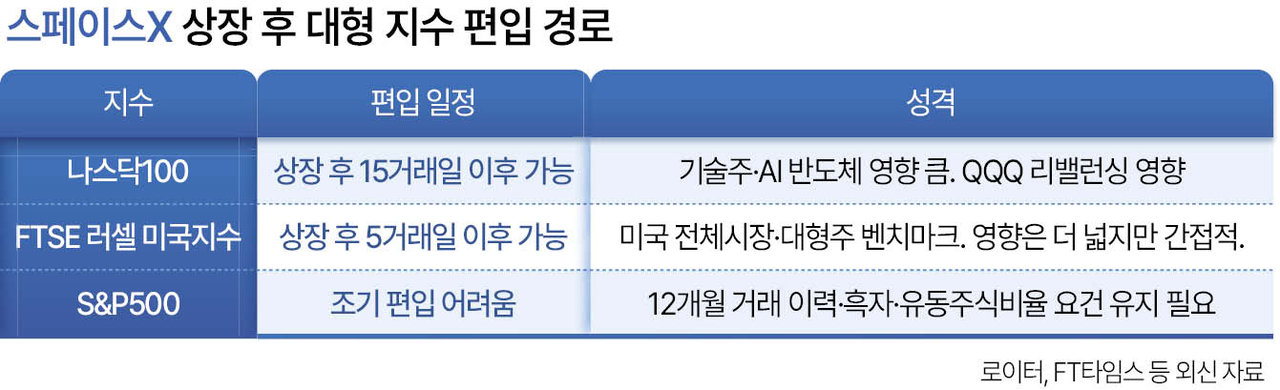
Index inclusion timelines could amplify that rotation within US tech. The Nasdaq 100 has relaxed its rules to allow large IPOs to join the index as soon as 15 trading days after listing. FTSE Russell's US indexes have introduced a similar regime, permitting qualifying large IPOs to be added just five trading days after their debut.
If SpaceX secures early inclusion in major indexes, ETFs tracking those indexes would need to buy SpaceX shares while trimming existing holdings. The initial index-driven flows are more likely to center on the Nasdaq 100 and FTSE Russell US indexes than on the S&P 500.
Shares available to the market immediately after the SpaceX listing are expected to represent only about 4 percent of total equity. If early index inclusion materializes, ETFs will face large buying requirements against a thin public float.
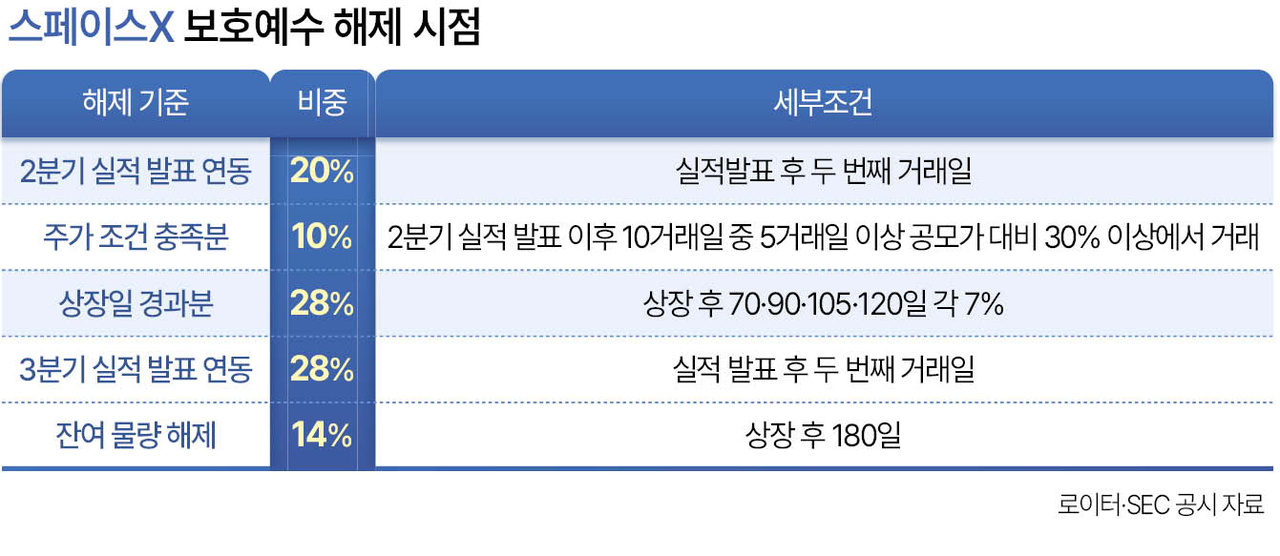
That mismatch could amplify price volatility. Once lock-up periods expire and more shares enter circulation, the added supply could weigh on the share price. For the Korean market, the key question is what happens to Samsung Electronics and SK Hynix — when US AI semiconductor stocks wobble, the two Korean heavyweights tend to follow.
"With SpaceX's Nasdaq listing scheduled for Friday, concerns about capital outflows from existing market leaders could emerge from a supply-demand perspective," said Lee Sang-jun, a researcher at NH Investment.
Lee Kyung-min, a researcher at Daeshin Securities, said global liquidity will inevitably concentrate in the United States ahead of the SpaceX listing, and that derivatives-related supply and demand pressures could also intensify on Thursday when futures and options expire simultaneously. "Amid an already unusual degree of concentration, stocks tied to the AI value chain — semiconductors, IT hardware and home appliances — that have driven the Kospi's re-rating could find themselves at the center of heightened volatility," he said.
Some analysts, however, caution against reading too much into the listing's potential impact on Samsung Electronics and SK Hynix.
SpaceX's IPO demand is reported to have reached roughly $150 billion, about twice the offering size. Given that Samsung Electronics' market capitalization approaches 2,000 trillion won (approximately $1.29 trillion), analysts say the SpaceX listing alone is unlikely to be a decisive variable for either chipmaker's share price. The more appropriate framing, they argue, is to treat it as an external factor that could add to volatility in a market already prone to wider swings.
kacew@heraldcorp.com





