
Expansion of long-term rental housing and land development projects drives 27 trillion won rise in public institution debt; Korea Housing Finance Corp. and Kamco also add liabilities to fund policy programs; public-sector debt reaches 1,739 trillion won
![The headquarters of Korea Land and Housing Corp. (LH). [Yonhap]](https://wimg.heraldcorp.com/news/cms/2026/06/11/news-p.v1.20260204.b3208a1439f3401ca7f9debc7e0669d2_P1.jpg)
Debt held by South Korea's public institutions approached 770 trillion won last year, rising more than 27 trillion won in a single year, with Korea Land and Housing Corp. (LH) alone accounting for nearly half the increase. LH's debt grew by 13.5 trillion won as the state housing developer expanded public housing supply and land development projects, pushing up its borrowing burden.
According to "Public Institutions of the Republic of Korea 2026," published Thursday by the National Assembly Budget Office, the combined debt of 342 public institutions stood at 768.6484 trillion won at the end of 2025 — up 27.1534 trillion won, or 3.7 percent, from the previous year. Over the same period, total assets rose 58.0039 trillion won, or 5.0 percent, to 1,210.2504 trillion won, while net profit for the period increased 5.1826 trillion won to 13.2502 trillion won.
Breaking down the figures by institution type, debt at state-owned enterprises reached 550.3516 trillion won, up 13.0666 trillion won from the prior year, while quasi-governmental agencies posted 181.3430 trillion won in debt, an increase of 11.3221 trillion won. Other public institutions added 2.7646 trillion won in debt.
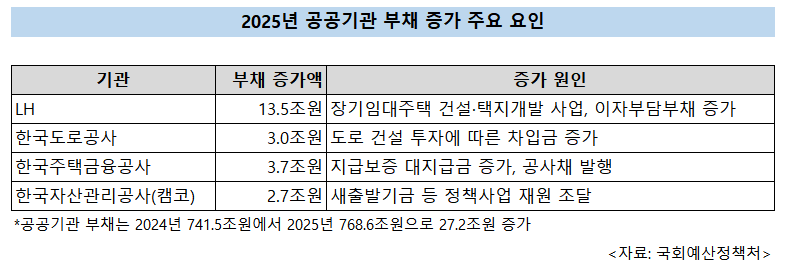
LH was the primary driver of the rise in state-owned enterprise debt. The National Assembly Budget Office said the increase in public enterprise debt in 2025 compared with 2024 was attributable to higher liabilities at LH and Korea Expressway Corp.
LH's debt alone grew 13.5 trillion won in a year — nearly half of the 27.1534 trillion won increase across all public institutions. The report identified a 12.1 trillion won rise in interest-bearing debt as the main cause, stemming from construction costs for long-term rental housing and the pursuit of land development projects.
LH's assets also expanded by 15.2 trillion won over the same period, as rental assets tied to long-term housing construction grew by 9.5 trillion won and inventory assets — including pre-sale land and housing — rose 4.3 trillion won. Assets and liabilities grew in tandem, driven by front-loaded investment to expand public housing supply.
Korea Expressway Corp. also saw its debt climb 3 trillion won, largely due to increased borrowing for road construction. However, a 1.0068 trillion won reduction in debt among market-type public enterprises kept the overall increase for state-owned enterprises to 13.0666 trillion won.
Among quasi-governmental agencies, Korea Housing Finance Corp. and Korea Asset Management Corp. (Kamco) posted the most notable debt increases.
Korea Housing Finance Corp. issued 3.2 trillion won in bonds to raise funds following a rise in guarantee payment obligations, pushing its total debt up by 3.7 trillion won. Kamco's debt expanded by 2.7 trillion won as it issued more bonds to finance policy programs, including the Fresh Start Fund.
The rise in public institution debt is also weighing on indicators of national fiscal health. Public-sector debt (D3) stood at 1,738.6 trillion won as of 2024, equivalent to 68.0 percent of gross domestic product — up 65.3 trillion won from the previous year. Within that figure, debt held by non-financial public enterprises reached 518.4 trillion won, an increase of 14.4 trillion won over the year.
The National Assembly Budget Office said the increase in public institution debt largely reflected "policy-driven liabilities" arising from LH's expansion of public housing supply and the policy programs carried out by Korea Housing Finance Corp. and Kamco. It added that if the high-interest-rate environment persists, the risk that a heavier interest burden could erode financial soundness warrants close attention.
fact0514@heraldcorp.com





