Korean business community representative addresses ILO General Conference
'Social dialogue that burdens only one side is not sustainable'
Calls for reform of rigid job protection, uniform working-hour rules
Says cooperative labor-management relations are key in AI era
![Korea Employers Federation Chairman Son Kyung-shik delivers remarks at the 38th Korea Labor-Management Cooperation Award ceremony at the Four Seasons Hotel in Jongno-gu, Seoul, on May 14. [Korea Employers Federation]](https://wimg.heraldcorp.com/news/cms/2026/06/10/news-p.v1.20260514.edd5f3e877e244d2a7e857f41eb87e6d_P1.jpg)
Korea Employers Federation Chairman Son Kyung-shik called for labor market reforms suited to the AI transition era and the building of cooperative labor-management relations at the International Labour Organization General Conference. He particularly flagged recent demands by unions at major Korean companies for high performance bonuses, saying such demands risk weakening the long-term growth engines of those businesses.
Son addressed the 114th ILO General Conference in Geneva, Switzerland, on Wednesday morning local time, representing South Korea's business community. Also attending were Kim Young-hoon, minister of employment and labor, and Kim Dong-myung, chairman of the Federation of Korean Trade Unions, representing the government and labor respectively.
In his speech, Son said global economic uncertainty is mounting. "The world economy is facing sharply heightened uncertainty driven by geopolitical risks, high oil prices and the restructuring of global supply chains," he said. "Rapid technological innovation and advances in AI are bringing about sweeping social and economic transformation that is reshaping human life."
On the spread of AI technology, Son said it holds the potential to generate new value across industries but also raises concerns about changing ways of work. "AI will merge with virtually every existing industry to create broad new value," he said, "but concerns also exist around changes in the way people work as companies pursue innovation."
Son identified fostering an environment for entrepreneurship as the first priority in responding to the AI era. "To further improve the quality of human life, we must create an environment that spreads a strong entrepreneurial spirit for AI innovation," he said.
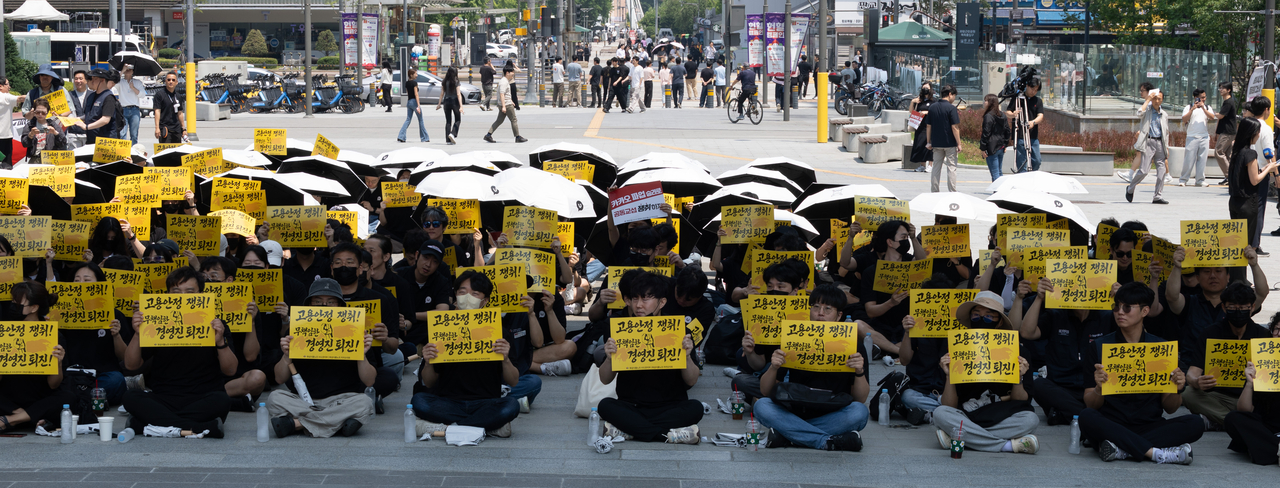
Son said outdated laws and regulations must be overhauled to achieve that goal. "In South Korea's case, it is urgent to flexibly reform overly rigid labor market regulations — such as strong protections for permanent workers and a uniform working-hour system," he said.
He also stressed the need to support labor market transitions driven by AI innovation. Son said infrastructure support and expanded vocational training are needed for companies and workers to adapt to the new AI environment and remain competitive. As AI reshapes job structures and working methods, he said, institutional and education frameworks must evolve alongside them.
On labor-management relations, Son called for building a cooperative relationship. "Cooperative labor-management relations are essential to fully harnessing the benefits of AI development and efficiently addressing its challenges," he said.
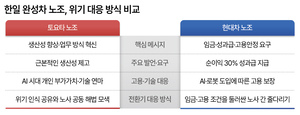
He then turned to bonus demands by unions at major Korean companies. "Unions at major Korean companies have recently been demanding excessively high performance bonuses," Son said. "Given that most of these are already high-wage companies, such unreasonable demands are likely not only to worsen labor-management relations but also to undermine long-term corporate growth and widen wage disparities."
Son also called for balance in social dialogue. "Social dialogue that places the burden on only one side can never be sustainable," he said, adding that social dialogue should focus on supporting corporate innovation and facilitating labor market transitions in preparation for the AI era.
He went on to say that "companies must make every effort to ensure employment stability, and trade unions must also refrain from excessive demands, so that a cooperative labor-management relationship in which both sides win becomes the norm."
Son also urged the ILO to account for differences in labor market conditions across countries. "We ask that the ILO, when establishing international labor standards, give balanced consideration to the diverse circumstances and autonomy of each country, so that labor market actors can continue to innovate and improve quality of life in ways suited to their own situations," he said.
The ILO General Conference runs from June 1 through Friday in Geneva, bringing together representatives of governments, employers and workers from 187 member states to discuss the implementation of conventions and recommendations, the establishment of international labor standards for the platform economy, social dialogue and gender equality.
Following the conference, Son will visit Germany on Thursday and Friday to explore avenues for tripartite cooperation on industrial transition. He will be joined by Kim Ji-hyung, chairman of the Economic, Social and Labor Council; Kim Dong-myung, chairman of the Federation of Korean Trade Unions; Kim Young-hoon, minister of employment and labor; and ruling and opposition party lawmakers from the National Assembly's Climate, Environment, Energy and Labor Committee.
kwater@heraldcorp.com