Korea Federation of Banks revising rules governing primary creditor bank system; large conglomerate affiliates in advanced strategic industries to benefit; flexible reporting requirements; move aims to allow more debt for state-priority sectors; 42 business groups to undergo second-half financial reviews
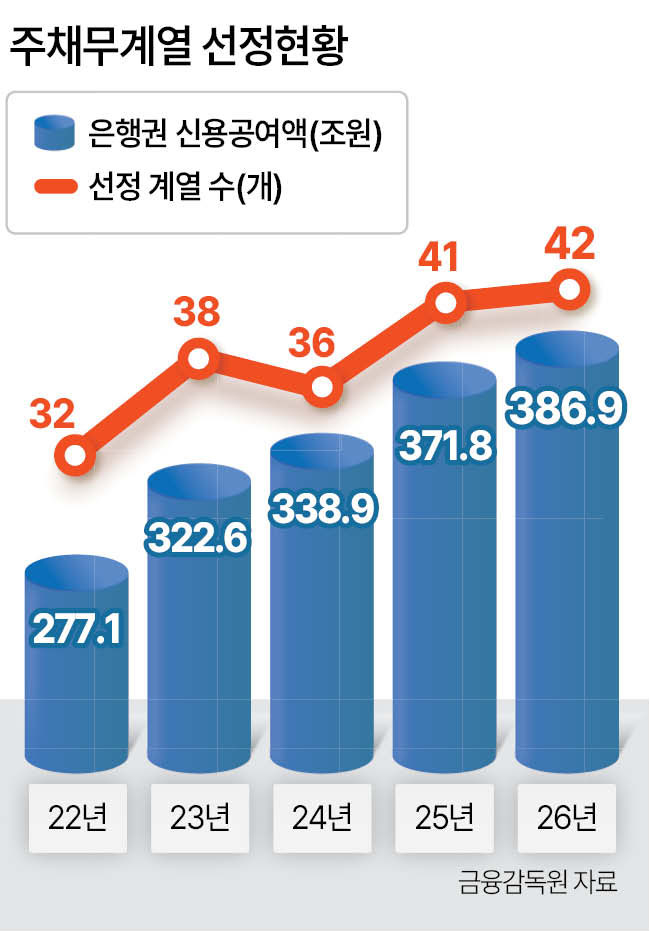
Large conglomerate affiliates investing in advanced strategic industries such as batteries are set to receive relaxed financial assessment standards under a rule change being pursued by the banking sector. Until now, companies that fell short of the financial benchmarks set by their primary creditor banks faced improvement recommendations and other oversight measures — but that is about to change.
According to financial industry sources Wednesday, the Korea Federation of Banks has recently been revising its operational guidelines for the primary debtor group financial restructuring system.
The core of the revision is a new preferential provision that would award bonus points to affiliates engaged in nationally designated core strategic businesses when their financial structures are assessed. Under the current framework, companies that fail to meet financial assessment thresholds receive improvement recommendations from their primary creditor banks and face restrictions such as mandatory real-time reporting on financial decisions. The revision aims to ease those thresholds and give companies greater flexibility.
The federation is currently gathering opinions from member banks and plans to finalize and publish the revised guidelines this month, with immediate application to this year's primary debtor group assessments. Each primary creditor bank is scheduled to conduct full-scale second-half financial structure reviews of the 42 business groups designated as primary debtor groups this year.
The primary debtor group management system annually designates large conglomerate groups with heavy borrowing whose financial health could significantly affect the national economy. It evaluates their financial condition and, when results fall short, requires them to enter into agreements aimed at improving their financial structures.
In effect, it functions as a periodic financial health check for major conglomerates. The assessments are conducted by primary creditor banks under banking supervisory regulations, while the operational guidelines that serve as the working standards are set and managed independently by the federation.
The revision was driven by the recognition that advanced industries inevitably require massive capital outlays for large-scale facility construction and research and development, making a rise in debt unavoidable. The intent is to account for industry-specific characteristics rather than relying on blunt metrics such as the sheer size of a company's debt.
The move also aligns with the government's push to shift toward productive finance and foster growth in strategic industries.
Alongside this, the federation is discussing ways to make more concrete the criteria for qualitative assessments — evaluations covering items not reflected in financial statements, such as deteriorating earnings trends and financing capacity.
"The revision discussions started in the battery sector and have since expanded to industry as a whole," a banking industry official said. "Different affiliates within the same parent group carry different debt ratios by business unit. The idea is to allow companies in industries expected to improve in the future, or those the country has determined need to be nurtured, to carry more debt even if their profitability is not strong right now."
At a regulatory review committee meeting of the federation held May 27, all eight committee members agreed to revise the guidelines to grant incentives to affiliates engaged in nationally designated core strategic businesses — taking into account industry-specific characteristics in the primary debtor group assessment criteria — and to make the qualitative assessment standards more concrete.
However, the committee members agreed that effective monitoring would be necessary to ensure the revised financial assessment approach does not adversely affect banks' asset soundness. Accordingly, the federation plans to refine language where interpretive ambiguity exists, such as in expressions relating to industry-specific characteristics or inadequate response capacity.
The guidelines revision is understood to have been decided through close consultation with financial supervisory authorities. "The intent is not to single out specific advanced industries, but to broadly reflect the characteristics of each industry and give more room in financial structure assessments," a financial authority official said. "We expect the financial structure assessments to improve in a direction that is more fair."
ehkim@heraldcorp.com