June volatility rate reaches 1.5%, up 0.5 percentage points from May
Foreign net selling compounded by offshore NDF speculation
Weak-won bets drive dollar demand, pushing exchange rate higher
Early-morning NDF activity amplifies shock to spot market
Authorities weigh tighter NDF oversight, shift to onshore DF market
Won internationalization seen as long-term solution
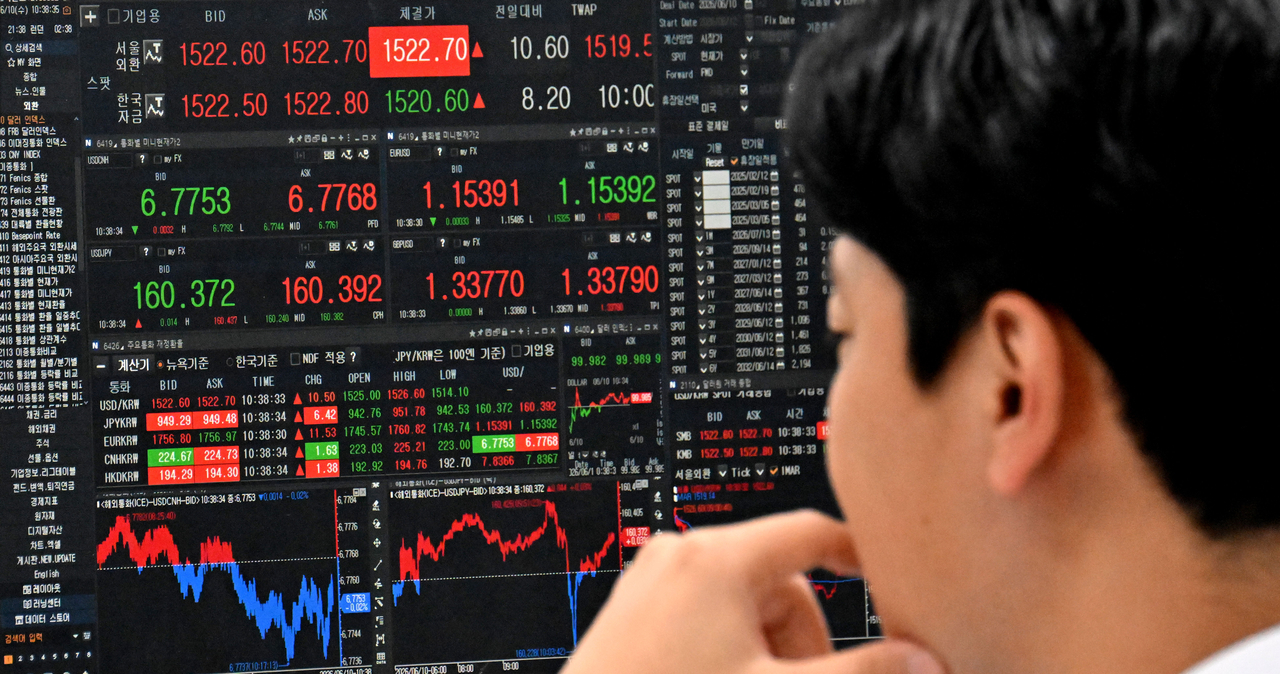
South Korean foreign exchange authorities have identified offshore non-deliverable forward, or NDF, trading as the primary driver of the recent surge in the won-dollar rate and have signaled an aggressive response — a sign that the current high-rate environment cannot be explained by economic fundamentals or supply-and-demand dynamics alone.
South Korea's cumulative current account surplus through April reached $102.67 billion, a record high, driven by strong semiconductor-led exports, according to financial industry sources Wednesday. First-quarter real GDP growth was revised upward twice, reaching a preliminary reading of 1.8 percent, with some analysts forecasting annual growth of around 3 percent. Under normal circumstances, a booming economy draws in foreign currency and pushes the exchange rate down.
Sustained foreign net selling of domestic equities has clearly added upward pressure on the exchange rate. Net selling means investors sold more shares than they bought. As foreign investors convert won proceeds from stock sales into dollars, demand for the US currency rises and the exchange rate climbs. On Tuesday, foreigners net sold 1.9850 trillion won (approximately $1.31 billion) worth of domestic shares, extending their net selling streak to 22 consecutive trading sessions.
Even so, authorities believe the current exchange rate trajectory has become excessive. When foreign net selling pushes the rate higher, NDF speculators pile on by betting on further won weakness, which amplifies upward pressure and fuels expectations of additional gains — a vicious cycle that keeps repeating. Volatility has risen sharply as a result. The average intraday range between the daily low and high this month through Tuesday reached 1.5 percent, up 0.5 percentage points from May's 1 percent and the highest level this year.
NDFs were originally introduced to help hedge currency risk for emerging-market currencies with restricted capital flows. When the won had limited exposure in global foreign exchange markets, NDFs played a positive role in providing foreign investors with a hedging tool and helping to develop the market. Today, however, speculative trading dominates NDF activity. Market estimates suggest that 60 to 80 percent of NDF transactions are speculative in nature.
In simple terms, an NDF is an offshore contract in which parties bet on where the exchange rate will be at a future date. A party might agree today to buy or sell dollars at the current rate one month from now. If the rate rises over that period, the dollar buyer profits by locking in a cheaper price; the dollar seller takes a loss. The reverse holds if the rate falls.
A key feature of NDFs is that no actual currency changes hands — only the difference between the contracted rate and the settlement rate is exchanged. If the won-dollar rate moves from 1,500 won to 1,600 won, only the 100-won difference per dollar is settled. This structure allows speculators to pursue exchange-rate gains with relatively little capital, making it easy to scale up positions quickly.
When demand for dollars — that is, bets on won weakness — builds in the NDF market, foreign bank branches operating in South Korea buy dollars in the domestic spot market to hedge their exposure. That additional dollar demand in the spot market then pushes the exchange rate even higher.
The NDF market's influence is greatest in the early morning hours. Unlike the domestic foreign exchange market, which operates from 9 a.m. to 2 a.m. the following day, the NDF market runs around the clock. NDF activity therefore has an outsized effect on the exchange rate between 2 a.m. and 9 a.m., when the domestic market is closed. The most critical window runs from 2 a.m. until around 6 a.m., when the New York market is open.
In short, exchange rate pressure that builds in the overnight NDF market transfers directly into the domestic market the moment it opens. This is what Bank of Korea Governor Shin Hyun-song has repeatedly described as "the tail wagging the dog."
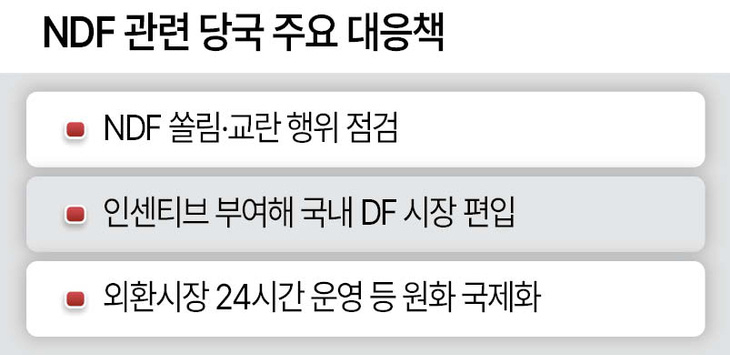
Authorities have declared an all-out offensive against NDF speculation and are weighing a range of countermeasures.
The first priority is tightening oversight of the NDF market. Because NDF trading takes place offshore, direct monitoring has its limits, but authorities plan to manage the market indirectly through the foreign bank branches that link the NDF and domestic spot markets. The Bank of Korea and the Financial Supervisory Service launched inspections Wednesday targeting foreign exchange banks suspected of manipulating or fixing exchange rates for improper gain or to benefit third parties.
Authorities are also pursuing measures to draw NDF activity into the domestic deliverable forward, or DF, market. Unlike NDFs, DF contracts are settled with actual currency at maturity and are traded within the domestic foreign exchange market, which limits the leverage and scale of speculative activity and brings transactions within the regulatory perimeter. Officials are reportedly considering price incentives to attract NDF participants. Market observers say the key challenge will be designing incentives compelling enough to shift participants away from the NDF market.
Over the longer term, won internationalization may offer the most fundamental solution. The Federal Reserve Bank of New York noted in a past report that NDF markets "tend to disappear naturally once full currency convertibility is achieved." If the won were freely exchangeable anywhere in the world — like the dollar, euro or yen — the NDF market's influence would fade on its own.
Bank of Korea Governor Shin has consistently championed won internationalization since taking office in April, calling it "an important task of building monetary infrastructure befitting the status of our economy." The central bank plans to extend domestic foreign exchange market hours to 24 hours starting in July and is also developing an offshore won settlement system.
kimstar@heraldcorp.com