Offshore forward contracts settled in dollars at maturity
Used for currency hedging — and speculative trading
Authorities convene expanded macro-fiscal-financial meeting
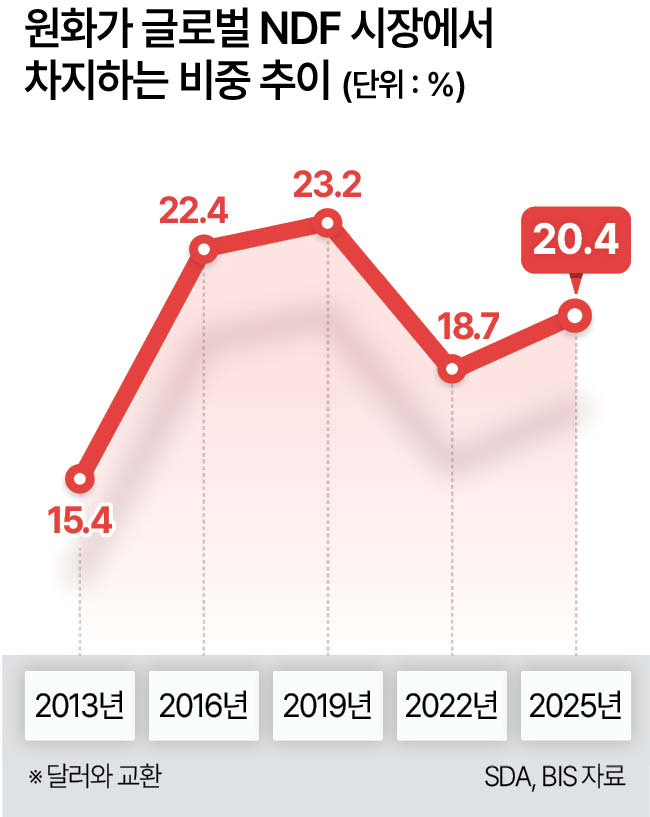

The non-deliverable forward market has been identified as the primary driver behind the recent one-sided moves in the won-dollar exchange rate, amid data showing the Korean won accounted for more than 20 percent of all global NDF trading last year.
According to the International Swaps and Derivatives Association (ISDA) and the Bank for International Settlements (BIS), the won-dollar pair made up 20.4 percent of average daily NDF trading volume worldwide last year, up from 18.7 percent in 2022 — a gain of roughly 1.7 percentage points over three years.
The won's share was the second highest globally last year, trailing only the Indian rupee-dollar pair at 21.2 percent. The Taiwan dollar-dollar pair followed at 19.6 percent, with the Brazilian real-dollar pair at 14 percent. Together, those four currency pairs accounted for 75.2 percent of all global NDF trading.
Overall NDF trading has surged as well. Average daily NDF turnover rose 28.6 percent over three years, from $259.1 billion in 2022 to $333.2 billion last year. Compared with $127.3 billion in 2013, volumes have nearly doubled in a decade.
An NDF is an offshore forward foreign exchange contract — an agreement to buy or sell a currency at a predetermined rate on a set future date. Unlike standard foreign exchange transactions, no actual currency changes hands; instead, only the difference between the contracted rate and the spot rate at maturity is settled in dollars.
NDFs were originally introduced as a hedging tool for emerging-market currencies subject to capital controls. Today, however, hedge funds and other players also use them widely for speculative currency trading.
Foreign exchange authorities have singled out speculative NDF-centered trading as the chief culprit behind the recent one-sided moves in the won and are drawing up countermeasures. The focus is on scrutinizing suspected market-distorting behavior and speculative positioning that has ridden the won's weakness, as well as measures to bring NDF trading onshore into the domestic foreign exchange market. The shift marks a change in tone from the authorities' previous emphasis on supply-demand imbalances — chiefly the expansion of domestic investors' US equity holdings and net selling of Korean shares by foreign investors.
The two heads of foreign exchange policy have both spoken out against speculative trading in recent days. Deputy Prime Minister and Minister of Economy and Finance Koo Yun-cheol said at an emergency market review meeting Sunday that "herd behavior through offshore NDF derivative trading is affecting our foreign exchange market." Bank of Korea Gov. Shin Hyun-song has also repeatedly raised the NDF's influence on the domestic currency market, saying "the tail is wagging the dog."
The won-dollar rate has stubbornly refused to fall below the 1,500-won level, and some inside and outside the authorities have begun calling it the "new normal." The rate closed the daytime session above 1,500 won for 16 consecutive trading days through Tuesday — the second-longest such streak since 49 consecutive trading days during the financial crisis in late 1997 and early 1998. On Wednesday, the won-dollar rate opened the daytime session in Seoul at 1,525 won, up 12.9 won from the previous session.
Also on Wednesday, Deputy Prime Minister Koo, Minister of Planning and Budget Park Hong-keun, Financial Services Commission Chairman Lee Eok-won and Bank of Korea Gov. Shin convened an expanded macro-fiscal-financial meeting at the Government Seoul Complex. The officials agreed to closely monitor the impact on small and midsize importers and import-processing businesses exposed to the rising exchange rate, and to strengthen coordination among relevant agencies to stabilize household economic conditions and manage risk.
Separately, the Financial Supervisory Service held a foreign exchange market stabilization meeting Tuesday, chaired by Deputy Governor Kim Seong-uk, who oversees banking and small financial institutions. Executives in charge of foreign currency and funding at major commercial banks — including KB Kookmin, Shinhan, Hana, Woori, NH NongHyup and SC First Bank — as well as domestic branches of foreign banks including State Street and HSBC attended.
The FSS called on banks to refrain from aggressive promotional events and marketing campaigns tied to dollar-denominated deposits amid the current high-volatility environment, and to strengthen consumer guidance on the risk of foreign exchange losses.
The FSS also said it plans to temporarily tighten oversight of major banks by shortening the monitoring cycle for foreign currency positions from monthly to weekly or even daily.
By Kim Byeo-ri, Kim Eun-hee and Yang Young-kyung
kimstar@heraldcorp.com