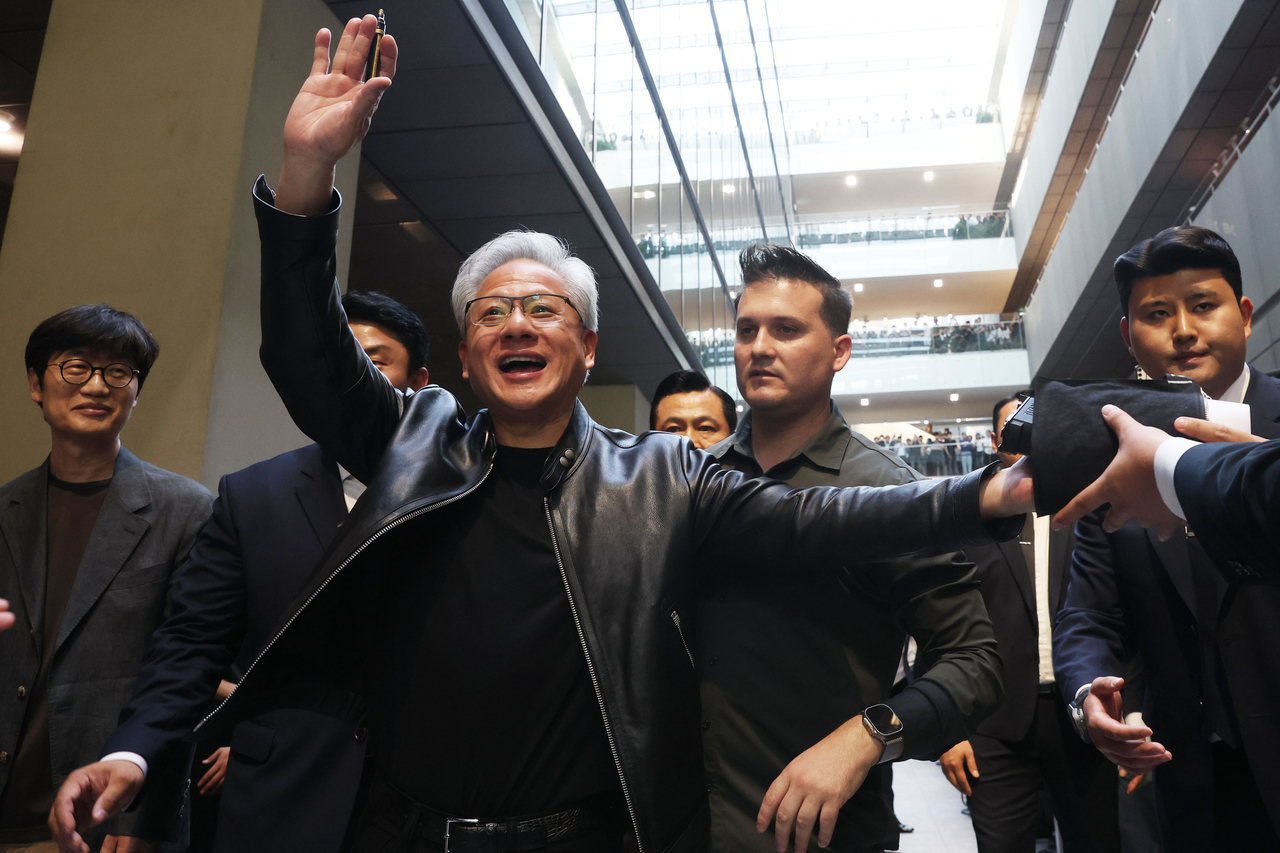
Naver's share price has retreated to the low 220,000 won range, erasing most of the gains driven by what markets dubbed the "Jensen Huang effect." The stock briefly crossed the 300,000 won threshold on optimism over a potential Nvidia partnership, only to begin a sharp decline the moment Huang left South Korea.
Securities analysts are nonetheless maintaining a broadly positive outlook. They cite Naver's AI infrastructure project as still on track, and argue that even under conservative assumptions the business carries a present value of 19 trillion won.
According to Korea Exchange data, Naver opened Thursday down 3.74 percent from the previous session at 218,500 won.
The stock had soared to an intraday high of 304,000 won on June 1, when Huang's visit to South Korea put a spotlight on the prospect of deeper cooperation with Nvidia. The move set a new 52-week high and marked the first time Naver had traded above 300,000 won since April 2022 — a recovery roughly four years in the making.
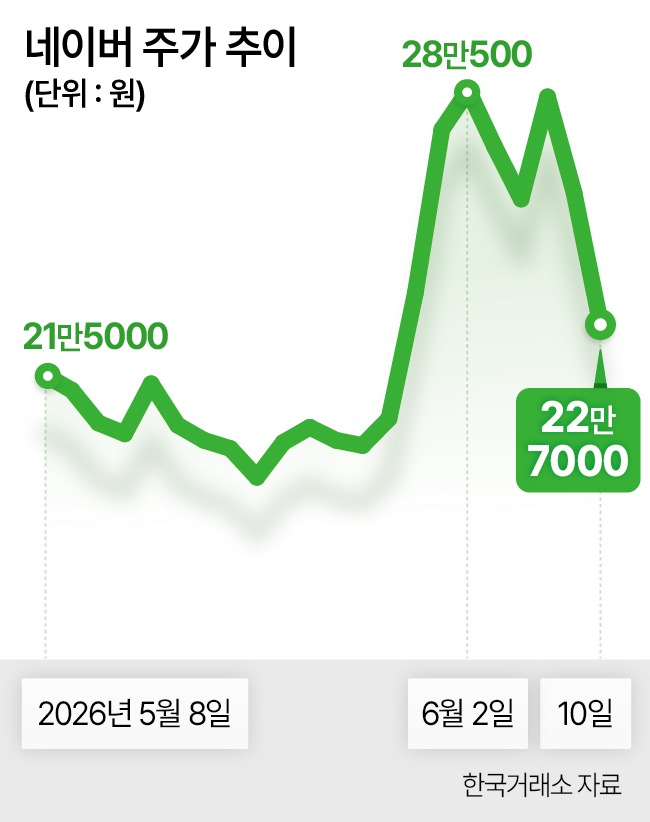
The rally proved short-lived as sentiment shifted toward the view that expectations had already been priced in. On Monday, the day Huang left the country, Naver closed down 7.89 percent at 257,000 won on the main bourse. Losses deepened in subsequent sessions, pushing the stock into the low 220,000 won range by Thursday. Analysts attributed the slide to a wave of profit-taking after the rapid run-up.
The pullback leaves Naver's share price still far below its all-time high of 465,000 won, set in July 2021. With most of the recent rebound now reversed, the stock sits at less than half its record peak.
A surge in margin-financed buying during the rally has added to the burden on retail investors. According to Koscom Check, Naver's margin balance rose by approximately 187.7 billion won ($136 million) in the first week of June (June 1–5). Given that total margin balances stood at around 787.4 billion won as of Wednesday, that single week's increase accounts for more than 20 percent of the current outstanding balance.
The jump far exceeded the increase recorded by Samsung Electronics over the same period — just 5.8 billion won — and was roughly on par with SK Hynix, which saw margin balances rise by 188.3 billion won. The figures suggest retail investors piled into leveraged positions on Nvidia partnership hopes, and those who entered near the peak are estimated to have suffered significant losses as the stock reversed.
Analysts in the securities industry, however, view the recent correction as a natural unwinding of short-term excess rather than a fundamental reversal. Their argument is that the Nvidia cooperation story is not merely a thematic trade but a genuine growth catalyst tied to the expansion of AI infrastructure.
Naver and Nvidia agreed on June 8 to jointly develop a global AI factory, announcing plans to begin operating a 55-megawatt infrastructure facility in 2027 and to expand their AI infrastructure project in phases. Analysts say a full-scale buildout — encompassing AI data center construction and operation — could prompt a revaluation of Naver's corporate worth.
Choi Seung-ho, a researcher at DS Securities, said the AI factory business carries a present value of 19 trillion won even under conservative estimates, and maintained a buy rating with a target price of 450,000 won.
Seo Jeong-yeon, a researcher at Shinyoung Securities, said Nvidia views Naver as a key partner in expanding the sovereign AI market, which lends weight to the company's roadmap. "The company should be able to generate approximately 20 trillion won in additional sales from the AI factory business within the next five years," she said.
Seo added that if Naver establishes itself as a seller of AI solution services combining Korean-style AI infrastructure with a sovereign AI platform, "it will be able to further enhance its long-term appeal in terms of growth and profitability." She maintained a buy rating with a target price of 400,000 won.

th5@heraldcorp.com