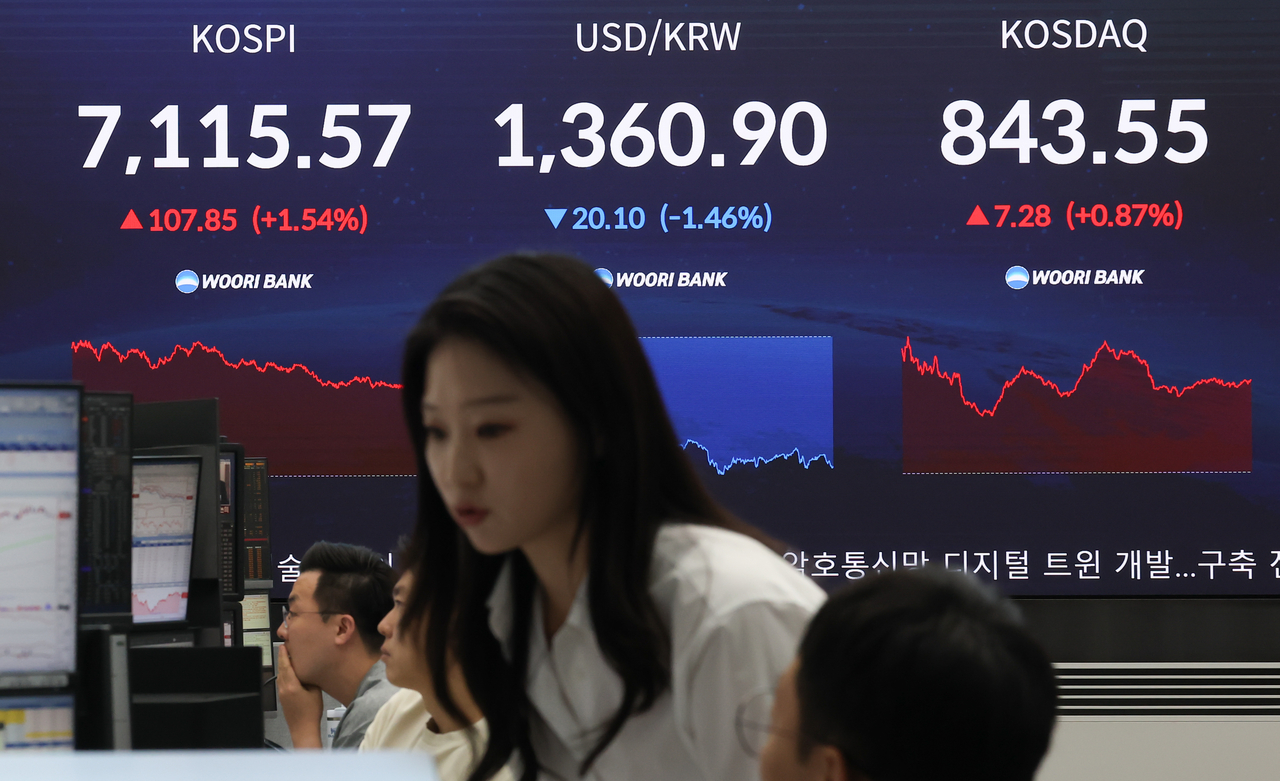
The Kospi has climbed back above 7,000, but the domestic stock market has yet to regain its vitality. Retail investors who flooded in during the sharp rally in the first half of the year have been taking profits and selling at breakeven following the steep correction, and daily trading value has fallen by more than half in just three months to its lowest level of the year.
According to Korea Exchange, the daily average trading value on the Kospi market this month stands at around 21 trillion won ($15.2 billion), the lowest reading so far this year. That is less than half the roughly 50 trillion won recorded in June.
Trading activity had expanded rapidly alongside the market's rise earlier in the year. Daily average trading value was around 27 trillion won in January before surging to around 50 trillion won in May and June.
It then fell to 37 trillion won in July and slipped further to 26 trillion won in August. This month it has barely held above the 20 trillion won mark, and analysts say the monthly average could slip below that threshold if the downtrend continues.
The pullback is largely attributed to retail investors exiting the market quickly after the Kospi's sharp correction following its earlier surge. As the index climbed back toward 7,000, a wave of breakeven selling and profit-taking from existing buyers has weighed on trading activity even as the index itself has recovered.
The dynamic was on full display Tuesday, when the Kospi closed at 7,017.91, up 10.19 points, or 0.15 percent, from the previous session, even as retail investors unloaded more than 1 trillion won worth of shares. The index jumped more than 2 percent in early trade on strength in US technology and semiconductor stocks but gave back most of those gains by the close.
At the regular session close, retail investors posted net selling of 1.61 trillion won on the main board. Institutional investors, who had been net buyers early in the session, swung to net selling of 119 billion won. Foreign investors were net buyers of 85 billion won.
Analysts say selling pressure from retail investors could persist for some time, given the concentration of buy positions near the 7,000 level — meaning the index's recovery itself triggers more selling. Investors who entered the market late during the rally and then suffered losses in the subsequent downturn are focused on unwinding existing positions rather than deploying fresh capital, even as the index rebounds.
The divergence within the market is also striking. Although the Kospi held above 7,000 on Tuesday, advancing stocks numbered only 384, fewer than the 462 that declined.
Yuanta Securities Korea noted that foreign buying has been concentrated in large-cap semiconductor names such as Samsung Electronics and SK hynix rather than the broader market. The brokerage said the index surged in the morning on semiconductor strength but pared gains sharply in the afternoon as oil prices rebounded, US equity index futures weakened, and profit-taking emerged near the 7,000 level and the upper end of the semiconductor trading range.
"Looking at foreign investor flows, the number of advancing stocks, and sector breadth, the market has not yet reached the stage where the uptrend has broadened to the market as a whole," said Lee Jae-won, a researcher at Yuanta Securities Korea.
Lee said the key factors for further upside are whether foreign buying in the electronics and electrical equipment sector is sustained and whether Samsung Electronics and SK hynix can break above the top of their recent trading ranges. He also cautioned that the continued decline in trading value could weigh on earnings in the brokerage sector.
While the Kospi has reclaimed the 7,000 level on an index basis, trading value and retail investor flows suggest market confidence has not fully recovered. Foreign investors and other corporate entities buying back shares are absorbing retail selling and propping up the index, but analysts say it will take time before retail buying returns in earnest.
Kim Hak-kyun, head of the research center at Shinyoung Securities, said the current pattern differs from past cycles in which money continued to flow into the market for an extended period even after a bear market turn. "The key to supply and demand has shifted to foreign investors," he said, adding that foreign trading patterns in Samsung Electronics in particular would serve as a "litmus test" for gauging the direction of foreign investor flows.

th5@heraldcorp.com