Genesis enters Le Mans 24 Hours for the first time under its Magma performance sub-brand, marking a new milestone for Korean motorsport. The brand also unveiled the Magma GT and GT3 concepts while announcing plans to expand its European presence from seven countries to 11.
![The GMR-001 hypercar that Genesis Magma Racing will field in the Le Mans 24 Hours Hypercar class on Saturday. [Genesis]](https://wimg.heraldcorp.com/news/cms/2026/06/12/news-p.v1.20260612.e0224eba423248ec8c821d3ee6a9a805_P1.jpg)
Genesis is entering the Le Mans 24 Hours Hypercar class for the first time, using the world's most prestigious endurance race to validate the direction of its high-performance Magma sub-brand and expand its presence in the global motorsport market.
The race takes place at the Circuit de la Sarthe in Le Mans, France, from Saturday to Sunday local time, with the start set for 11 p.m. Saturday Korean Standard Time.
In qualifying held Thursday, the two GMR-001 hypercars secured sixth and ninth on the grid, demonstrating competitiveness from the outset.
The Le Mans 24 Hours is the centerpiece of the FIA World Endurance Championship (WEC), a flagship endurance race that dates to 1923.
Genesis's dedicated motorsport team, Genesis Magma Racing, will handle the campaign — marking the first time a Korean automotive brand has competed in the top class of the race. Beyond brand promotion, the team sees the event as a proving ground for vehicle performance and operational capability under extreme conditions.
Jose Munoz, president of Hyundai Motor Co., said Le Mans 24 Hours is "an important stage to test Genesis's performance in extreme conditions," adding that lessons from the race would feed into the development of Magma performance vehicles and broader business operations. "The process of teams working together to find solutions amid unpredictable race conditions aligns with Genesis's direction in technology and customer experience," he said.
![The GMR-001 hypercar that Genesis Magma Racing will field in the Le Mans 24 Hours Hypercar class on Saturday. [Genesis]](https://wimg.heraldcorp.com/news/cms/2026/06/12/news-p.v1.20260612.f4f812eef21e42ca98ab1f2f5f14b852_P1.jpg)
Points scored in debut WEC season — Le Mans goal is to finish
Genesis Magma Racing entered the WEC for the first time this year. Despite it being a debut season, the team scored points at the WEC Round 2 Spa-Francorchamps 6 Hours in Belgium last month, confirming its ability to run consistently and manage races effectively. At Le Mans, Genesis has set race completion as its primary goal while also aiming for a meaningful result.
Lee Si-hyeok, executive vice president and head of the Genesis Business Division, said the team would translate "experience and data gained on track into customer value in high-performance production models," adding that Genesis would broaden engagement with new audiences through racing, esports and other touchpoints.
![The GMR-001 hypercar that Genesis Magma Racing will field in the Le Mans 24 Hours Hypercar class on Saturday. [Genesis]](https://wimg.heraldcorp.com/news/cms/2026/06/12/news-p.v1.20260612.8fbaeba7d34e40b0af5c4660da48869b_P1.jpg)
GMR-001 wears Magma Orange — with hangul lettering
The car Genesis is fielding at Le Mans is the GMR-001 hypercar.
The special livery centers on a gradient flowing from Magma Orange at the front to deep red at the rear, expressing the speed and energy of a high-performance race car through color. The word "Magma" in hangul appears on the side. Cars No. 17 and No. 19 share the same livery concept but differ in detail: No. 17 emphasizes an orange-and-black combination, while No. 19 features white logos and additional highlights.
French film manufacturer Hexis served as technical partner for the livery. A specially developed wrapping film was applied to withstand the heat, airflow and debris encountered in endurance racing.
Luc Donckerwolke, chief design officer and chief creative officer of Hyundai Motor Group, said the livery is "a design that expresses Genesis's performance identity through color and form."
![The Magma GT Concept unveiled by Genesis at the Le Mans 24 Hours. The two-seat luxury grand tourer concept embodies the direction of Genesis's high-performance Magma sub-brand. [Genesis]](https://wimg.heraldcorp.com/news/cms/2026/06/12/news-p.v1.20260612.db320e085b5143f5aa51a2a274cfa908_P1.jpg)
From road-going GT to race car — Genesis lays out high-performance vision
Genesis also unveiled concept models at Le Mans to illustrate its high-performance vision. The brand revealed the interior design of the Magma GT Concept — first shown in November last year — for the first time, and gave the world premiere of the Magma GT3 Concept.
The Magma GT Concept is a two-seat luxury grand tourer built around Genesis's design philosophy of "Athletic Elegance." The cabin features a twin-cockpit layout separating driver and passenger, with analog instruments inspired by mechanical motorsport watches and physical controls that emphasize tactile feedback.
![The Genesis X Gran Convertible Concept in Midnight Teal. The concept model emphasizes elegant sensibility through a subdued teal color and tartan-patterned materials. [Genesis]](https://wimg.heraldcorp.com/news/cms/2026/06/12/news-p.v1.20260612.4e254706a0bc4f2cb82f578023708401_P1.jpg)
The Magma GT3 Concept was conceived as a standalone concept — not intended for mass production — optimized for racing by incorporating GT3 technical regulations. Genesis is using the model to explore the potential for expansion in motorsport and high-performance segments. The design prioritizes aerodynamic performance, cooling efficiency, thermal management and durability as the core requirements of a competitive racing environment.
Donckerwolke said the Magma GT Concept and Magma GT3 Concept "each demonstrate the potential of Genesis performance in road and racing environments respectively."
![The Magma GT3 Concept, given its world premiere by Genesis at the Le Mans 24 Hours. The race car concept was designed to reflect GT3 technical regulations. [Genesis]](https://wimg.heraldcorp.com/news/cms/2026/06/12/news-p.v1.20260612.18aad50c4edd42799982d2034363d0a5_P1.jpg)
Le Mans platform drives brand expansion — European network to reach 11 countries
At the Le Mans city driver parade, Genesis also unveiled two vehicles developed from the Genesis X Gran Convertible Concept — architecture studies based on the G90 with enhanced Magma design elements. The "Liquid Titanium" model emphasized the dynamism of racing, while the "Midnight Teal" model conveyed a composed and elegant sensibility.
Genesis brand ambassador and racing advisor Jacky Ickx and reserve driver Jamie Chadwick drove the vehicles in the parade.
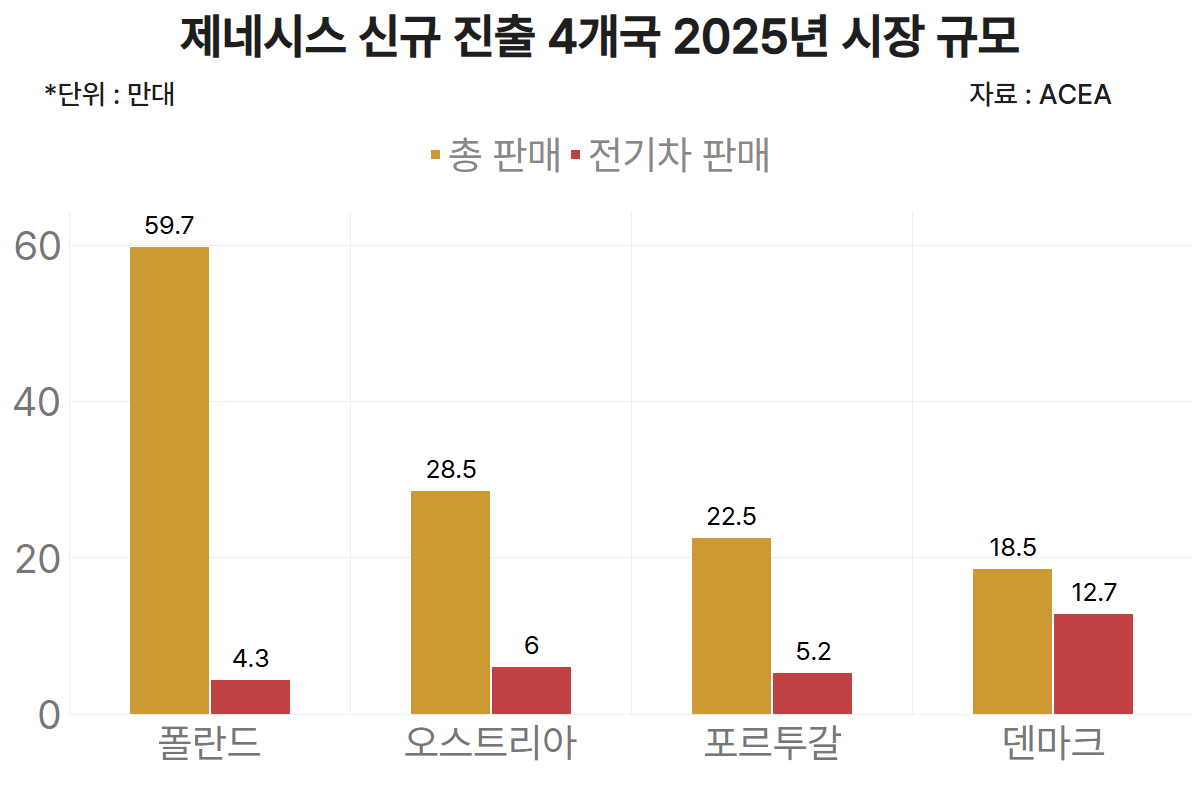
Alongside its motorsport activities, Genesis is expanding its European sales footprint. The brand currently operates in seven countries and plans to grow that to 11 next year, adding Poland, Austria, Portugal and Denmark. The strategy is to raise brand awareness and reinforce its high-performance image.
![마그마 오렌지 입은 제네시스…첫 르망 24시 ‘새 얼굴’ 공개 [여車저車]](https://wimg.heraldcorp.com/news/cms/2026/06/02/news-p.v1.20260602.d2646f8f84d740268a8de1b458f31b0b_T1.jpg)
![“왜 우리보다 빠른건데!” 페라리 놀래킨 제네시스, WEC서 화려한 데뷔 [여車저車]](https://wimg.heraldcorp.com/news/cms/2026/04/29/news-p.v1.20260429.45910b698472460c9cefdecacf9eedc1_T1.jpg)
kwater@heraldcorp.com