Remarks at 76th founding anniversary ceremony
Growth, prices, financial stability all point same direction on monetary policy
Structural challenges including macroprudential coordination also raised
By Kim Byeo-ri, The Herald Business
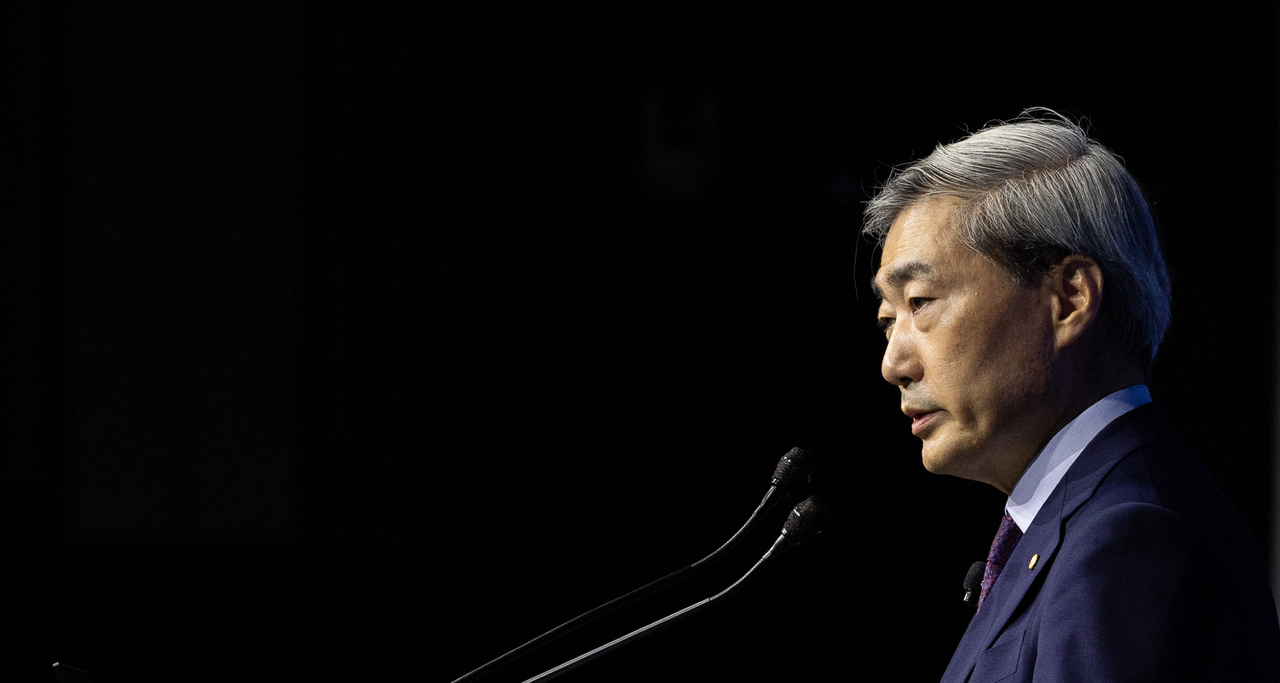
Bank of Korea Governor Shin Hyun-song said the central bank needs to raise its benchmark interest rate "without delay, with a focus on price stability."
Shin made the remarks Friday morning at a ceremony marking the Bank of Korea's 76th founding anniversary, held at the central bank's annex building. "The outlook for growth, prices and financial stability is pointing relatively clearly in one direction from a monetary policy standpoint," he said. Shin has publicly raised the need for tighter monetary policy on multiple occasions since the bank's first monetary policy board meeting last month.
On the current state of the South Korean economy, Shin said growth "is expanding significantly, driven by strong semiconductor exports amid the global spread of AI, despite high uncertainty surrounding the situation in the Middle East." South Korea's preliminary GDP growth rate for the first quarter came in at 1.8 percent quarter-on-quarter. Nominal growth reached 10.5 percent as rising semiconductor prices rapidly improved the terms of trade. Gross domestic income and gross national income — both measures of real purchasing power — also posted growth rates approaching double digits.
Looking ahead, Shin said the economy "will sustain solid growth as domestic demand recovers, supported by stronger tax revenues from rising nominal GDP, improved incomes and expanded investment, even as the semiconductor sector continues to perform well." He added, however, that "attention should be paid to the fact that the economy's heavy dependence on the IT sector means sectoral gaps remain."
Concerns over inflation are mounting. Shin said consumer price inflation "climbed into the 3 percent range in May as the impact of rising international oil prices began to materialize in full, and core inflation — which had been stable — also edged up to the mid-2 percent range due in part to rising prices for some personal services." He added that "the cost-of-living price index, which is closely tied to what households actually feel, is rising faster than the headline consumer price index and could affect household inflation expectations."
He went on to say that while government price-stabilization measures would help ease upward pressure, inflation "is expected to remain above the target level for a considerable period as the spillover effects of supply shocks broaden and demand-side price pressures intensify." He also warned that "there is a latent risk that elevated household inflation expectations and the possibility of corporate price increases could add further upward pressure on prices, particularly given the delayed normalization of energy supply chains."
Financial stability and foreign exchange market risks also persist. Shin noted that "housing prices in the Greater Seoul area — both for purchases and for jeonse and monthly rent — continue to rise sharply, and expectations of further gains have picked up again." He also said that debt-financed investing, known colloquially as "bittoo," has surged as share prices have climbed steeply.
On the foreign exchange market, he said the won-dollar rate "has been fluctuating at elevated levels above 1,500 won despite rising share prices and a large current account surplus, as foreign investors have been pulling equity funds out of the country." He noted, however, that markets expect the won-dollar rate to gradually stabilize as the large current account surplus boosts demand for the won through corporate tax payments and expanded domestic investment. He cautioned that "if high exchange rate volatility persists due to developments such as the Middle East situation, it could add to inflationary pressure through higher import prices."
Shin also outlined structural challenges for the central bank, including macroprudential policy coordination, won internationalization and raising the economy's growth potential.
He said the Bank of Korea "must continue to closely monitor potential risks in the housing market and household debt while maintaining macroprudential policy coordination with the government," adding that efforts to ease the concentration of economic activity in the Greater Seoul area and redirect capital toward productive sectors must continue over the medium to long term.
On won internationalization, Shin said it is important to "deepen our foreign exchange market and build its underlying strength." He said the bank will work with relevant agencies to expand foreign investor access to the won market and absorb offshore non-deliverable forward trading demand onshore — through the planned 24-hour foreign exchange market opening next month and a subsequent offshore won settlement system.
Shin also said "a significant part of the current economic situation reflects the favorable shift in external conditions," and that "it is important, especially at times like this, to calmly assess reality and prepare for future changes rather than rest on immediate results." He called for expanding investment to raise future growth potential, drawing on strengthened fiscal capacity and improved corporate financial conditions, and said efforts to ease polarization across regions, generations and social strata must continue. He added that "alternatives must continue to be developed for accumulated structural problems such as demographic change."
![기준금리 인상 시 주담대 이자 8% 뚫나…3억 차주 월부담 60만원↑ [머니뭐니]](https://wimg.heraldcorp.com/news/cms/2026/05/29/news-p.v1.20260417.00d30d15077a41bfb649fe33f3735988_T1.jpg)
kimstar@heraldcorp.com