South Korea's initial public offering market had a dismal third quarter, with both the number of new listings and total funds raised falling sharply in the absence of major deals. Expectations for a rebound are growing, however, as mid- to large-cap candidates including Musinsa and Sono International line up for the fourth quarter.
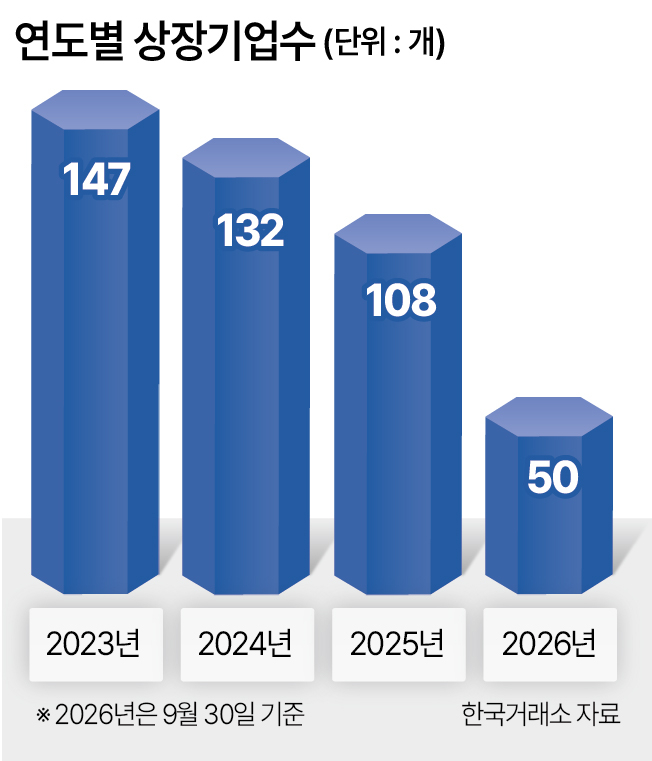
According to Korea Exchange data released Thursday, 50 companies had listed on the Kospi, Kosdaq and Konex markets combined through the first three quarters of this year. Even accounting for the fourth quarter not yet being reflected, that figure trails 147 listings in 2023, 132 in 2024 and 108 in 2025.
Eugene Investment & Securities data showed the number of IPOs in the third quarter alone stood at 23 companies, well below the five-year quarterly average of 34.
Of the companies that listed in the third quarter, only one — Hanwha Machinery & Service Holdings — debuted on the main Kospi board. Twenty companies listed on the Kosdaq and two on the Konex.
Total funds raised through IPOs came to 543.4 billion won ($406 million), far below the five-year quarterly average of 3.32 trillion won. The combined market capitalization of newly listed companies was approximately 3.14 trillion won, a sharp drop from the five-year average of 17.58 trillion won.
Analysts attributed the market's weakness to the government's tightened regulations on dual listings, dampened investor sentiment toward the Kosdaq, a lack of large-cap offerings and the poor long-term performance of companies that listed earlier.
"This year saw a marked shortfall in both the number of listings and the scale of fundraising compared with prior years," said Kang Young-hun, a researcher at Samsung Securities. "As long-term returns continued to disappoint and Kosdaq investor sentiment remained subdued, institutional and retail subscription competition rates fell in the second half, and short-term share price performance was also significantly weak."
Securities industry analysts expect the IPO market to turn a corner in the fourth quarter.
Between 10 and 12 companies are expected to go public in October alone, with total funds raised projected in the 400 billion to 500 billion won range — slightly above the historical average for the same month. As of Sept. 30, 44 companies had already filed for IPO review.
Analysts see room for improvement not only in volume but also in quality. Musinsa, Sono International, Estec System and Bumhan Mechatech are among the mid- to large-cap companies awaiting listing, with Musinsa, Sono International and Estec System already undergoing Kospi listing reviews. Large unicorns including Megazone Cloud, Rebellions and Upstage are also expected to pursue listings by the end of this year or early next year.
Elis Group, a Kosdaq-bound candidate targeting a 1 trillion won IPO, is also drawing attention. The company provides AI education and cloud services to public institutions and major conglomerates, and is expanding into AI cloud and data center businesses.
"A number of companies in AI, semiconductors and robotics — sectors that have attracted strong market interest recently — are preparing to list, which should drive heightened attention to the fourth-quarter market," said Tae Yun-seon, a researcher at KB Securities.
Some analysts caution, however, that the flood of new offerings warrants a selective approach. "When companies in the same sector list in quick succession, IPO investment funds are likely to be spread thin," Kang said. "As new issues pile up, the scarcity and visibility of individual stocks may diminish, so investors will need to be even more discerning — weighing sector competitiveness and whether valuations are appropriate."
jiyun@heraldcorp.com