Fourteen years after the first petition in 2012, the Seoul Metropolitan Government grants final approval; eight buses to serve the roughly 9.5-kilometer route, with service targeted to begin by year's end
Gwanak-gu has received final approval from the Seoul Metropolitan Government to launch the "Gwanak 12" village bus route, which will serve residents of high-elevation residential neighborhoods currently without public transit access.
The new route has been a long-standing wish of residents in Haengundong and Cheongnyongdong. First petitioned in 2012, the line is the product of 14 years of collaboration between residents and the district office. The high-elevation, densely populated areas along the route are home to a disproportionately large share of elderly and mobility-impaired residents, yet public transportation has remained out of reach — making the case for a village bus line a consistently raised concern.
Progress on the route had stalled for years due to various obstacles, but in 2023 the district office accelerated efforts by overhauling relevant ordinances, commissioning a feasibility study and selecting a bus operator to lay the groundwork for the project.
The push then hit another snag when nearby schools and parents raised safety concerns about bus traffic along school commute routes.
In response, District Mayor Park Jun-hee personally chaired multiple parent forums and school principal meetings. The district then carried out nine safety measures — installing heated road surfaces on steep sections, improving traffic safety visibility within school zones, and replacing vehicle guard barriers along school commute paths — to raise safety standards in the area.
Armed with those improvements, the district submitted a revised route proposal and mounted an active lobbying effort, ultimately securing final approval from the Seoul Metropolitan Government.
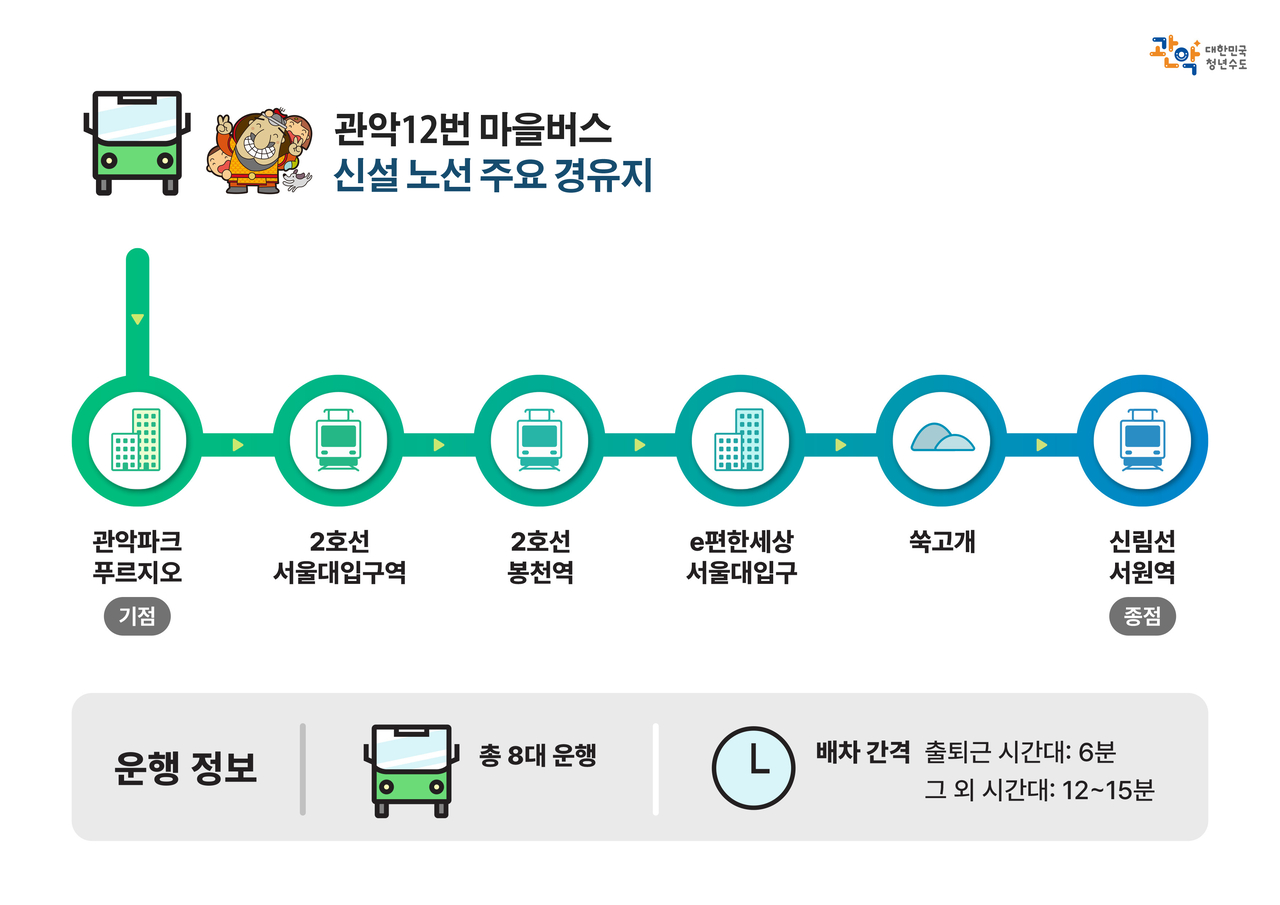
The Gwanak 12 village bus will run a round-trip course of roughly 9.5 kilometers, starting from Gwanak Park Prugio Apartment and traveling via Haengungil, Bongcheon-ro Intersection, Bongcheon Station and e-Pyeonhansesang Seoul National University Entrance Apartment before terminating at Seowon Station. Eight buses will be deployed, with headways of six minutes during peak commuting hours and 12 to 15 minutes at other times. The district expects the service to significantly improve mobility for commuters as well as elderly and other transit-dependent residents.
The district will now begin full-scale preparations with a target launch date of late this year. It plans to focus on securing the necessary bus fleet and installing stops along the route to ensure the line operates without disruption.
"I am deeply grateful to the residents who waited 14 long years and to the school officials who worked with us to build a safer commute environment and better transportation," District Mayor Park said. "We will handle all remaining steps — including securing vehicles — without a hitch, and prepare carefully so that residents can start riding the village bus as soon as possible."
seouldream01@heraldcorp.com