When the ministry's abbreviated name dropped 'employment' for 'labor,' critics warned jobs policy would take a back seat — and now a drop in employed workers is reviving that debate
![The Ministry of Employment and Labor [Photo by Kim Yong-hun]](https://wimg.heraldcorp.com/news/cms/2026/06/14/news-p.v1.20260612.a451308949fd41ed94d03a0d1cfebaad_P1.jpg)
"Employment has been erased. Only labor remains."
That was the criticism that greeted the Ministry of Employment and Labor last year when it officially changed its abbreviated Korean name from "고용부" — emphasizing employment — to "노동부," meaning labor ministry. At the time, the ministry said the change was meant to encompass all working people, including non-wage workers and platform workers.
But many warned the shift signaled that labor policy would overshadow jobs policy. Less than a year later, that debate is back — triggered by a fresh warning sign: a decline in the number of employed workers.
Youth extended unemployment rate at 16.6% — more than double the official figure
According to the Ministry of Statistics' May 2026 employment survey released Sunday, the number of employed people aged 15 and older stood at 29.12 million last month, down 40,000 from a year earlier. It was the first year-on-year decline since December 2024, when employment fell by 52,000. Among workers aged 15 to 29, the number employed dropped by 255,000 from a year ago. The youth employment rate fell 2.4 percentage points to 43.8 percent, while the youth unemployment rate rose 0.6 percentage point to 7.2 percent.
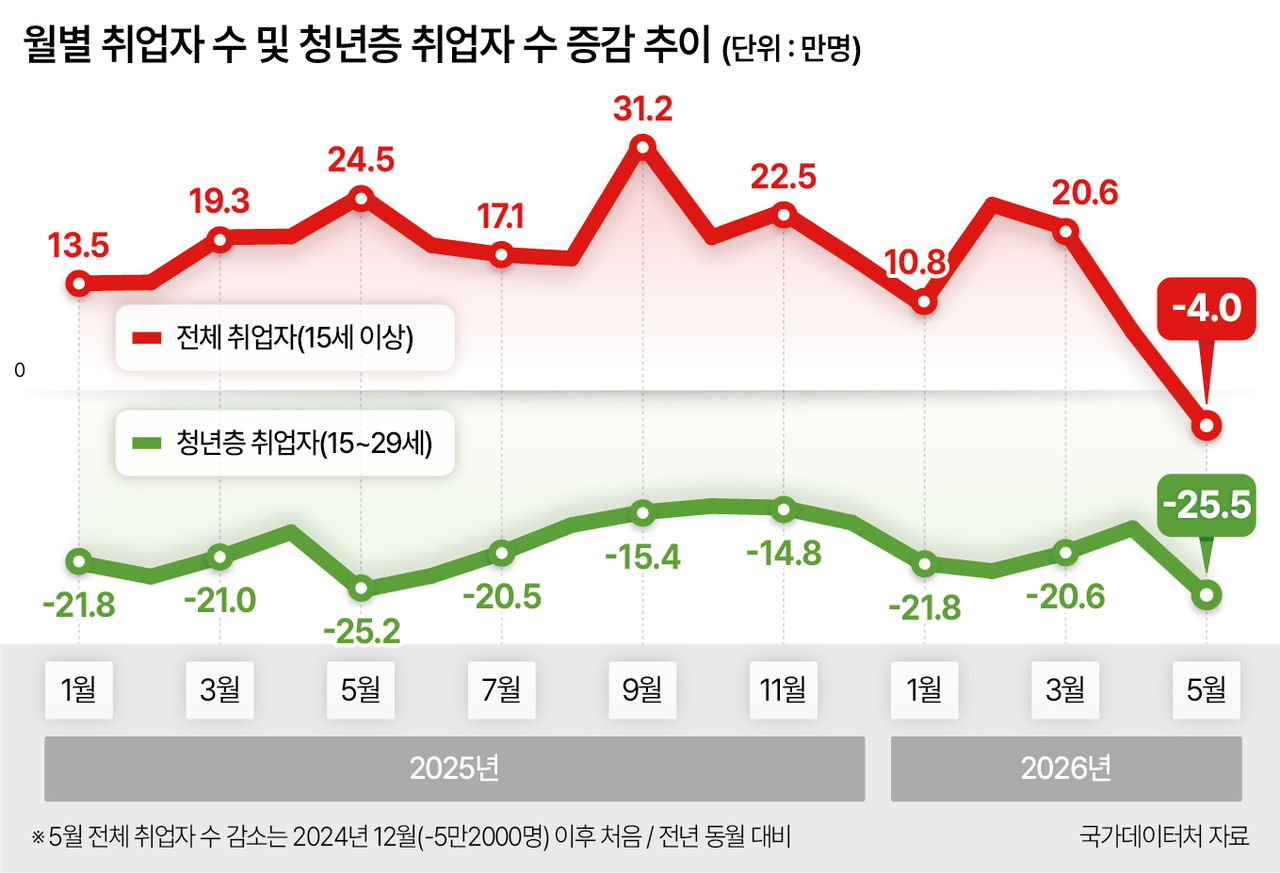
The picture looks even grimmer when measured by youth underemployment. The supplementary labor market indicator for young people — which includes job seekers, discouraged workers and those seeking additional work — came in at 16.6 percent, up 0.3 percentage point from a year earlier. That is more than double the official youth unemployment rate of 7.2 percent, meaning more than one in six young people is in effect unemployed or underemployed.
To be sure, the drop in employment cannot be laid solely at the ministry's door. External factors abound: prolonged uncertainty from the war in the Middle East, a slump in the construction sector and restructuring in manufacturing. But the ministry is not entirely free from scrutiny either. Since the new government took office, the policy messages coming from the ministry have consistently put "labor" ahead of "employment."
That priority is visible in the ministry's annual work plan. The ministry set "real growth alongside labor" as its vision for this year, centering its agenda on closing labor market gaps and driving an industrial transformation built around decent work. Traditional employment targets — raising the youth employment rate, growing the number of employed workers, creating jobs by sector — were relatively lower priorities. Worker rights protection, industrial safety, and protections for special-employment and platform workers dominated the policy narrative.
Deputy minister sidelined, meetings delayed — the employment control tower wobbles
The pan-government jobs task force, created to provide ongoing monitoring of the labor market, has also been a less prominent presence than before.
When the task force launched in December 2022, it was designed as a deputy-minister-level body co-chaired by the first vice minister of the Ministry of Finance and Economy and the deputy minister of the Ministry of Employment and Labor. The government pledged at the time to hold monthly meetings to get ahead of uncertainty in the jobs market.
After the new government took office, however, the task force did not convene for the first time until September — roughly three months after the administration began. The government described it as "the new government's first jobs task force meeting." At the November meeting that same year, the Finance and Economy deputy minister attended, but the Ministry of Employment and Labor sent its director general for employment policy instead of its deputy minister — leaving the lead ministry without its No. 2 official at a pan-government deputy-minister-level meeting on employment.
The weight of a government meeting depends on who shows up. In that sense, the November task force meeting effectively running at the director-general level was telling — a sign that the employment control tower had lost much of its clout. This year was little different. The task force's first meeting of the year did not take place until May 13, a far cry from the monthly cadence the body promised at its launch.
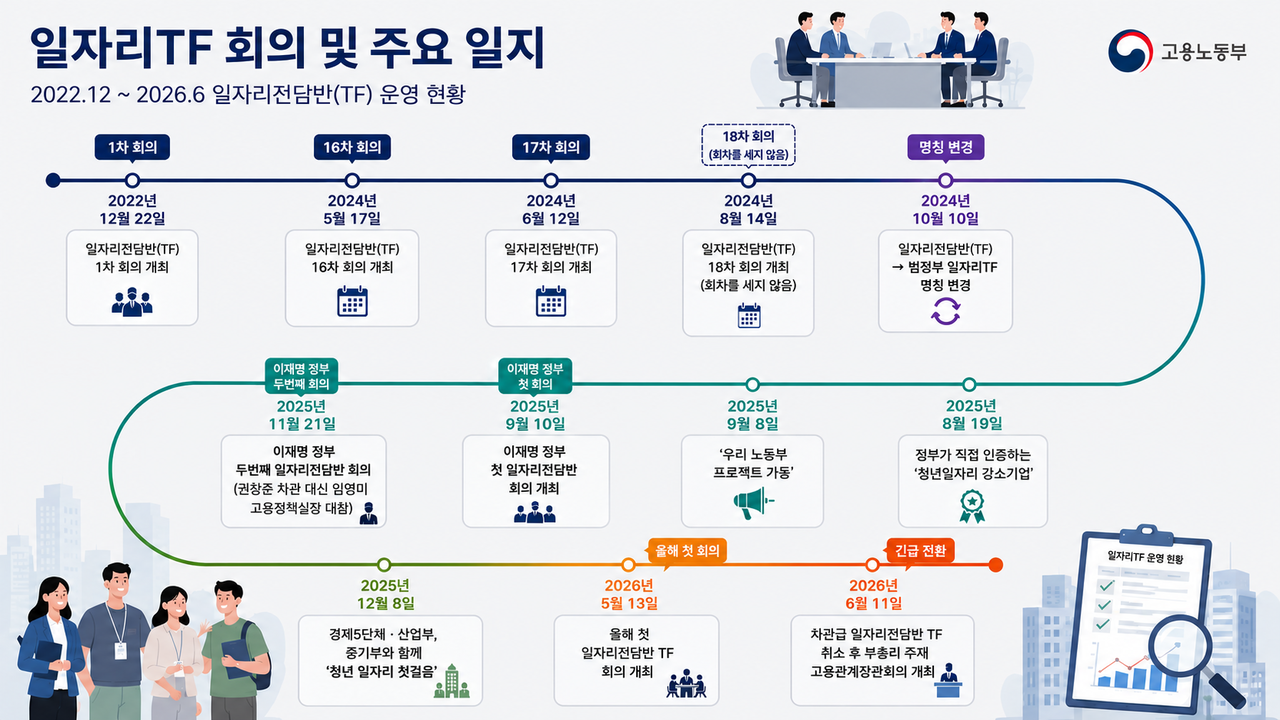
Once the employment decline became reality, the deputy-minister-level meeting that had been running below full strength was urgently elevated to a minister-level gathering chaired by the deputy prime minister. The Ministry of Employment and Labor and the Ministry of Finance and Economy canceled a task force session scheduled for Thursday and instead convened a minister-level employment policy roundtable chaired by Deputy Prime Minister Koo Yun-cheol. The following day, Koo also presided over a joint emergency economy headquarters and economic ministers' meeting, where he said improving youth employment conditions was a priority. The Ministry of Employment and Labor separately held an emergency employment situation review meeting chaired by its deputy minister.
A ministry official said the government had been working through the emergency economic ministers' meeting — in addition to the jobs task force — to address employment issues. "Internally, as soon as the war in the Middle East broke out at the end of February, the minister began holding regular regional employment situation review meetings," the official said. "We have continued efforts to tackle employment challenges, including easing eligibility requirements for employment retention subsidies and designating regions for preemptive response to employment crises."
fact0514@heraldcorp.com