
Samsung Electro-Mechanics is positioning silicon capacitors as a key growth driver, landing a roughly 1.5 trillion won ($982 million) supply deal with a global tech giant. The company says it is the only supplier capable of bundling silicon capacitors, MLCCs and package substrates — a total-solution edge it believes will prove decisive as AI data center demand accelerates.
![A silicon capacitor made by Samsung Electro-Mechanics. [Samsung Electro-Mechanics]](https://wimg.heraldcorp.com/news/cms/2026/06/14/news-p.v1.20260612.299b5bd35e8b44bd80f80ed0eb28f8c5_P1.png)
![Kim Won-gi, head of Samsung Electro-Mechanics' silicon capacitor development group, explains the technology at a briefing Thursday morning. [Samsung Electro-Mechanics]](https://wimg.heraldcorp.com/news/cms/2026/06/14/news-p.v1.20260612.e6c67de1b6e541228fdb431bb9bd683d_P1.png)
"The silicon capacitor market is growing fast, and there are not many suppliers," said Kim Won-gi, head of Samsung Electro-Mechanics' silicon capacitor development group. "Samsung Electro-Mechanics is the only company with the total-solution capability to supply silicon capacitors, MLCCs (multilayer ceramic capacitors) and package substrates all at once."
Samsung Electro-Mechanics has been cultivating silicon capacitors as a new growth engine to capture the AI infrastructure market. The effort paid off in May, when the company signed a supply agreement worth roughly 1.5 trillion won ($982 million) with a global tech firm, covering a two-year period starting in 2027. On Thursday morning, the company held a technology briefing to explain how silicon capacitors work and outline its business strategy around the component.
A capacitor is a component that stabilizes power inside an electronic circuit. When current surges too high or drops too low, devices malfunction. A capacitor acts as an electrical cushion — storing electricity like a water tank or dam, releasing it when needed and absorbing the excess to protect the device.
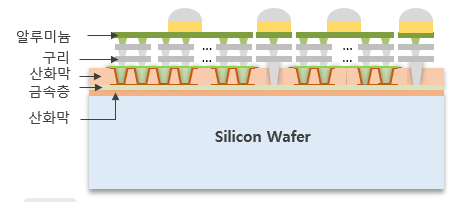
A silicon capacitor is manufactured through a semiconductor process based on silicon wafers. It serves a similar purpose to an MLCC but is thinner, making it easier to embed inside a semiconductor package. It also delivers higher capacitance within a smaller footprint than an MLCC.
As conventional miniaturization processes approach their limits, the industry has increasingly turned to advanced packaging — arranging components such as GPUs (graphics processing units) and HBM (high-bandwidth memory) on a single substrate to function as one chip.
Because silicon capacitors are thinner than MLCCs, they enable smaller packages and higher-density integration. Depending on the application, they can be placed beneath a semiconductor substrate or inside a package, giving customers greater design flexibility.
AI server packages are larger than those used in ordinary PCs, and as layer counts rise, stable power delivery and signal integrity become critical competitive factors.
Silicon capacitors have more than 100 times lower equivalent series inductance (ESL) than MLCCs, minimizing signal loss in high-performance CPUs and GPUs, suppressing noise effectively and allowing semiconductors to operate stably even at high frequencies.
As a result, their use is expanding across applications that demand high reliability and fast response times — AI servers, self-driving cars, high-performance medical equipment and aerospace systems among them.
Silicon capacitor market forecast to grow 18% a year for five years; Samsung Electro-Mechanics the only supplier offering total solution with MLCCs and substrates
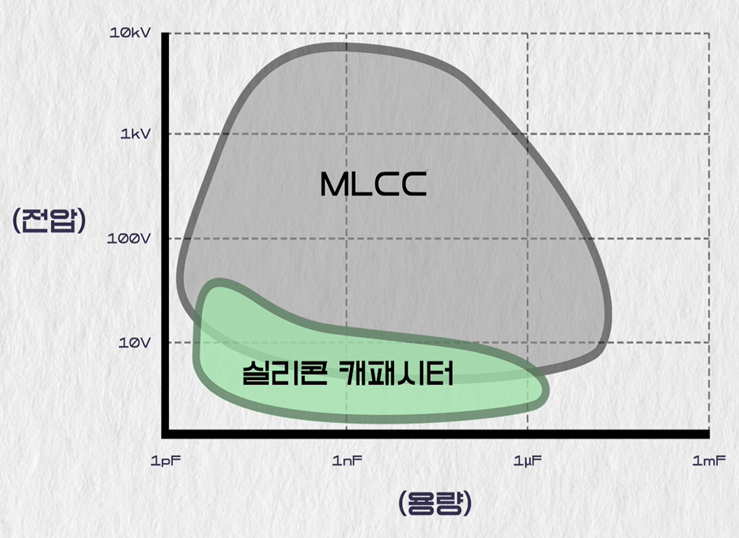
Kim said early concerns that silicon capacitors might cannibalize MLCC sales had proved unfounded. "Instead, the two are playing complementary roles and together helping to expand the overall market," he said.
He added that the AI data center market, where voltage and capacity requirements have risen sharply, is expanding rapidly, and that automotive applications — including autonomous driving — and physical AI represent the next frontier. "In those markets, silicon capacitors, which offer greater stability at high frequencies than MLCCs, are likely to see active adoption," he said.
As investment in AI infrastructure grows and the importance of power-stabilization solutions rises with it, the silicon capacitor market is forecast to expand at a compound annual growth rate of 18 percent from 2026 through 2031.
![Silicon capacitors made by Samsung Electro-Mechanics. [Park Ji-young]](https://wimg.heraldcorp.com/news/cms/2026/06/14/9/news-p.v1.20260612.2c1da7b214564565b3f1db19c7a59f37_P1.png)
Samsung Electro-Mechanics is the only supplier able to provide MLCCs and package substrates alongside silicon capacitors, giving it a total-solution capability to deliver core AI data center components in a single package.
The company has also built a differentiated quality assurance edge. Drawing on its existing MLCC quality management systems, it developed proprietary testing equipment capable of inspecting individual capacitors at the unit level — rather than at the wafer level — establishing what it describes as an industry-leading high-reliability quality evaluation framework.
"From the end customer's perspective, receiving silicon capacitors and package substrates together as a single bundle shortens development time," Kim said. "Customization is also possible. Cutting the time from product planning to actual market launch — that is Samsung Electro-Mechanics' biggest advantage."
Park Gang-ho, an analyst at Daeshin Securities, said silicon capacitors differ from the company's existing businesses in that they follow a fabless model — outsourcing production while Samsung Electro-Mechanics handles design and testing — which keeps capital expenditure low while offering higher margins than other products. "This becomes an additional factor in the revaluation of Samsung Electro-Mechanics," he said.
go@heraldcorp.com





