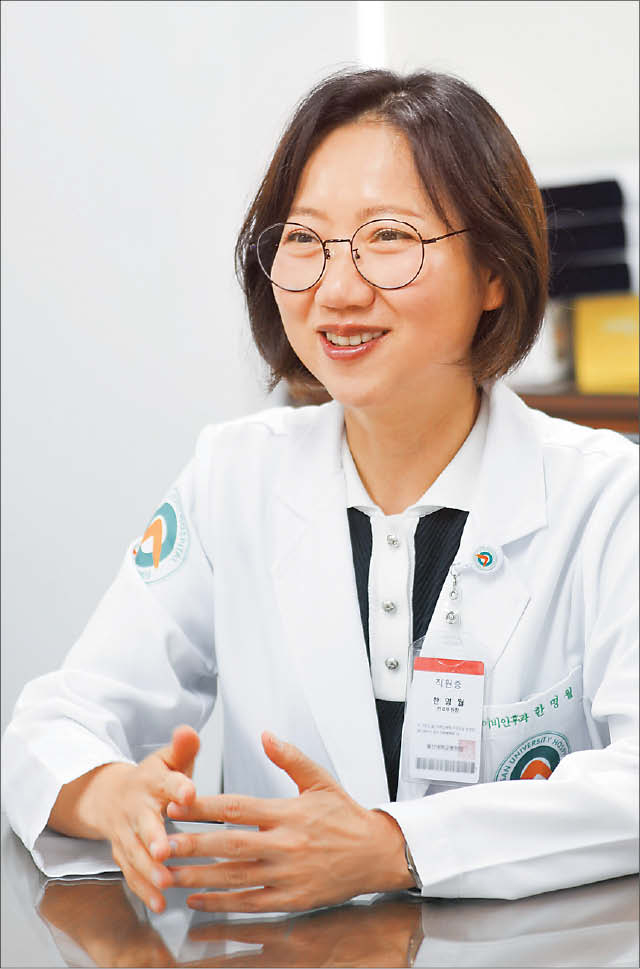
Han Myeong-wol, deputy medical director of Ulsan University Hospital
6,500 robot surgeries logged — cancer cases account for half
Same-day imaging and consultation fast track in place
Quality-driven growth aims to narrow healthcare divide with Greater Seoul
Ulsan, South Korea's leading industrial city, ranks first nationwide in gross regional domestic product per capita — yet its medical infrastructure lags far behind. The city's total hospital bed count amounts to just 2.2 percent of the national supply, and among major cities with populations of around 1.1 million, Ulsan is the only one without a public hospital providing general care. As a result, 25.6 percent of Ulsan patients travel to other regions for treatment, generating an estimated 347.8 billion won ($228 million) in out-of-region medical spending each year.
Against that backdrop, Ulsan University Hospital — the city's sole tertiary care center and designated regional anchor hospital — is drawing attention for building a self-sufficient medical system for complex, high-acuity treatment, led by robot-assisted surgery. In the 2024 fifth-cycle tertiary hospital designation evaluation, the hospital ranked third overall among all non-Greater Seoul institutions.
"The essential role of a regional hub hospital is to complete high-level, trustworthy treatment close to where patients live, so they do not have to travel to the metropolitan area," Han Myeong-wol, deputy medical director and professor of otolaryngology at Ulsan University Hospital, said in a video interview. "We have prioritized quality of care, patient safety and faster recovery over sheer volume, and have been refining our systems accordingly."
The hospital introduced the da Vinci Xi robotic surgery system in 2014 and has since moved proactively to expand single-port capabilities. Even in December 2024 — during the height of the physician-government standoff — it added another da Vinci SP unit to reduce wait times for cancer patients. In 2025, it became the first hospital in South Korea to install the Ion robotic bronchoscopy system for lung cancer diagnosis, a move that has begun drawing patients from other regions.
The hospital's cumulative robot surgery caseload has now surpassed 6,500 procedures, with more than 1,500 expected this year alone. Robot surgery already accounts for 56 percent of all cancer operations performed — surpassing laparoscopy — and the share reaches 85 percent in urology.
A comparative analysis of 2,965 robotic and laparoscopic procedures at the hospital found that robot surgery reduced the open-conversion rate by 98 percent, complication rates by 37 percent, 30-day readmission rates by 7 percent, and surgical site infection rates by 18 percent compared with laparoscopy. A separate analysis of 1,907 cases across 13 cancer surgery types identified approximately 1.2 billion won in social healthcare cost savings.
When factoring in transportation costs and the opportunity cost borne by caregivers when patients travel to Seoul for treatment, the savings amount to roughly 2.4 million won per patient in the first year.
The value of robot surgery extends beyond economics to environmental sustainability. An analysis of the annual increase in the 13 cancer surgery types found that total inpatient days fell by 403. Applied against carbon dioxide and medical waste research benchmarks, that translates to annual reductions of 18,626 kilograms of carbon dioxide and 2,245 kilograms of medical waste — equivalent to the carbon absorption of roughly 850 trees.
"Environmental gains followed naturally from our pursuit of evidence-based, high-quality care," Han said. He added that the hospital plans to establish an "Ulsan Integrated Cancer Care Fund," linked to the da Vinci 5 system introduced this year, to support treatment costs for vulnerable cancer patients and fund regional cancer research.
The Head and Neck Thyroid Cancer Center, which Han also leads as director, became the first center outside the greater metropolitan area to perform a fully scarless transoral robotic thyroidectomy in August 2025. The procedure involves an incision only on the inner lower lip, leaving no scarring on the neck or chest. Han also personally developed a single-port robotic hairline approach — requiring only a 5-centimeter incision along the inner hairline — that has made surgeries completable within 90 minutes and discharge within two days a reality.
To cut wait times for cancer patients, the hospital has built and is operating a fast track system that links same-day imaging with same-day consultations for major cancer screenings. "We want patients to feel, firsthand, that they can receive high-level treatment right here in the region without going to the metropolitan area," Han said. "We will build a regional healthcare model where advanced medicine and public responsibility go hand in hand."
silverpaper@heraldcorp.com