Young Koreans misreading basic hanja-derived words
Literacy seen as the foundational fitness of all learning
Gaps widen as low-literacy students fall further behind
Critical media literacy now essential in age of fake news
KNUE strengthening teachers' subject-literacy instruction
Mentoring program launched for struggling young readers
'Hangeul Run' to receive continued public-education backing
In August 2022, a cafe's written apology containing the phrase "simsimhan sagwa" — meaning a "deep and heartfelt apology," with "simsimhan" being a hanja-derived word — set off a national conversation about literacy. Commenters who misread "simsimhan" as meaning "boring" sparked what became known as the "digital generation literacy controversy."
Since then, a string of cases emerged in which young people failed to correctly interpret common words such as "saheul" (three days), "geumil" (today) and "muun" (good fortune in battle), elevating what had seemed like isolated incidents into a serious social issue.
Korea National University of Education (KNUE), the country's only national comprehensive teacher-training university, took notice. Its Basic Academic Ability Research Institute held the 2026 KNUE Basic Academic Ability Research Institute Academic Seminar on May 20, diagnosing the state of foundational learning in schools and exploring practical solutions. The event reflected the university's attentiveness to voices from teachers and schools warning that poor literacy was dragging down basic academic achievement.
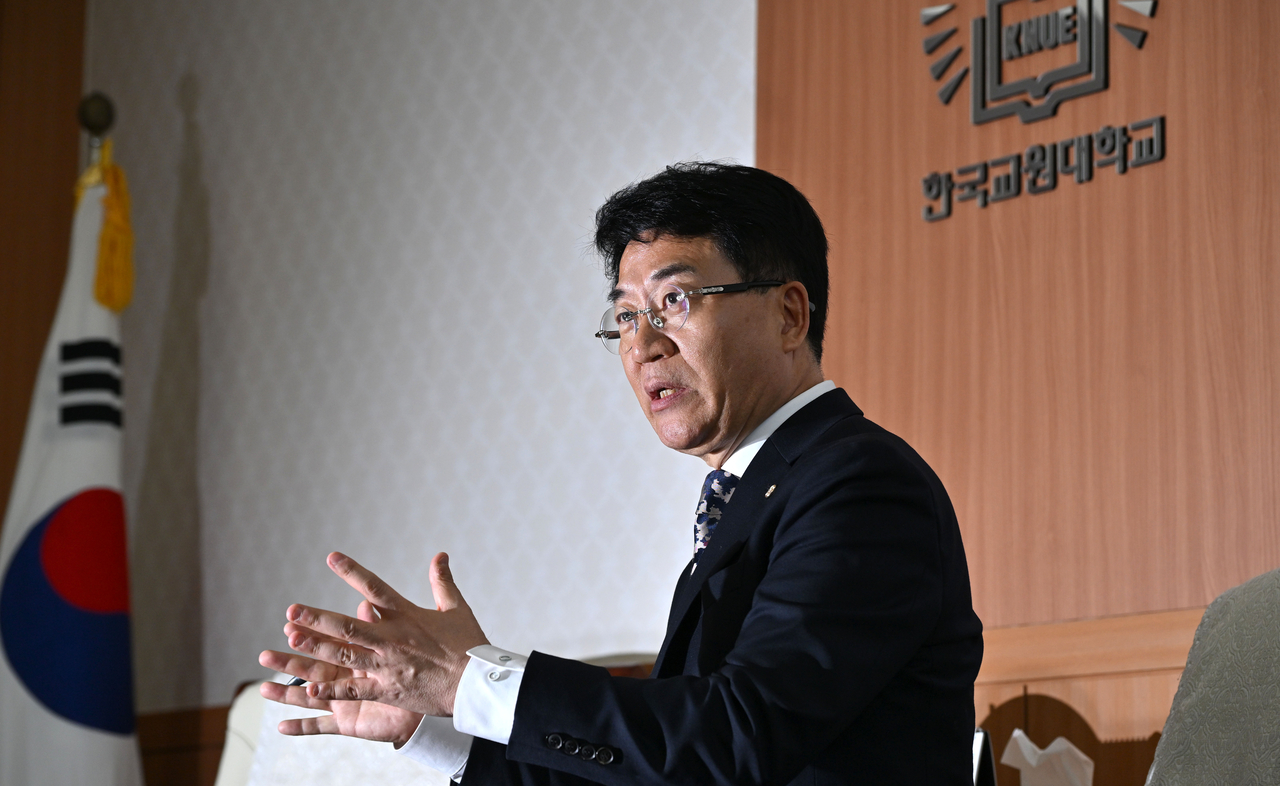
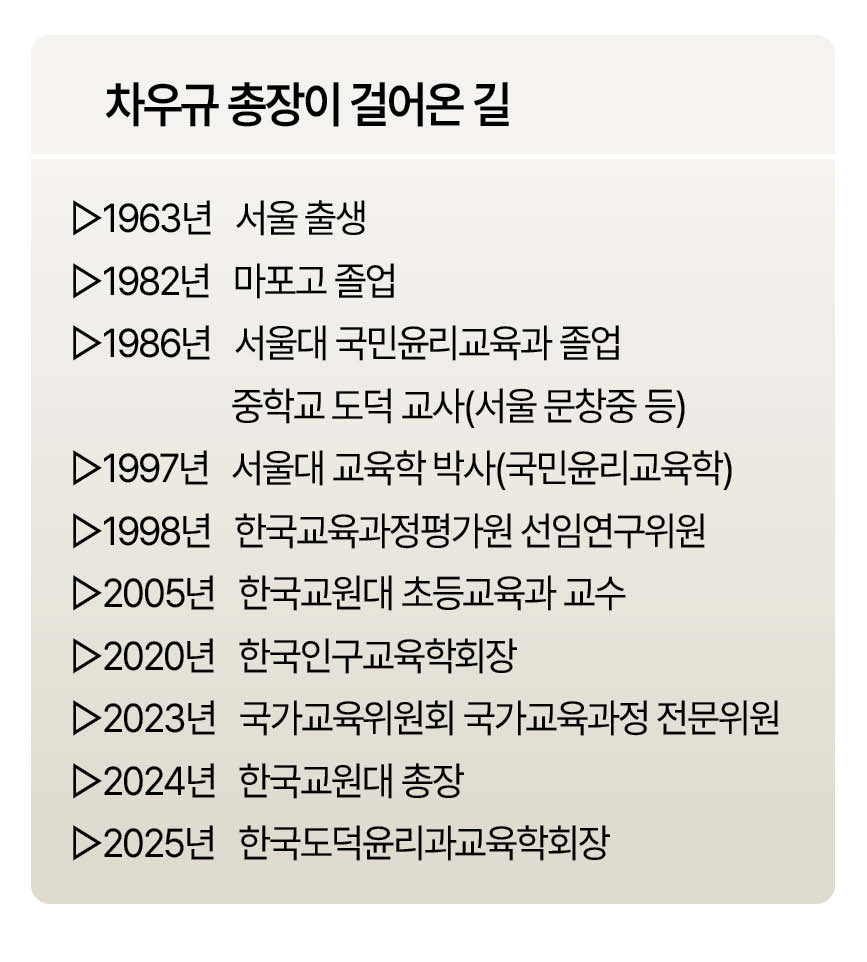
The Herald Business sat down with KNUE President Cha Woo-gyu at the university's main administration building in Cheongju, North Chungcheong Province, on Thursday. In an interview lasting roughly 70 minutes, Cha — an expert in curriculum and digital education — spoke candidly about his concerns over literacy.
"When literacy is lacking, teachers have to spend a large portion of class time explaining vocabulary, which means students cannot understand textbook passages or key subject concepts," he said, explaining what drew KNUE to the issue. "There was a strong sense of crisis and responsibility — that if we leave students' literacy problems unaddressed, the entire public education system could eventually collapse."
The following is an edited transcript of the interview.
— The popularity of smartphones and short-form content has led many to say that literacy is declining not only among the MZ generation but also among children and teenagers. What exactly is literacy?
▶ The recent surge in short-form content and over-reliance on smartphones has made declining youth literacy a major social topic. Literacy is not simply knowing how to read letters. It is the "muscle of thought" — the ability to sift through an overwhelming flood of information, identify what is true, grasp the context and hidden intent of a text, and ultimately solve problems through critical thinking and communication.
— Why is literacy necessary? Some say students even need it to solve math problems on exams.
▶ To solve a math problem correctly, a student must first understand what the question is actually asking. Many students reportedly cannot solve problems not because they lack mathematical ability, but because they cannot understand the question itself. Ultimately, literacy is not confined to Korean-language skills — it is the foundational fitness that underpins all academic subjects and everyday life.
— Kim Jin-myung, author of the newly published book "The Nation of Sejong," said in an interview that literacy is necessary to protect democracy. What is your view?
▶ Democracy is a system in which citizens make sound decisions through healthy debate and rational criticism. A crisis in digital literacy amounts to fundamentally losing the tools of thought itself. When people can no longer think and judge for themselves, they become easy to lead wherever a demagogue directs them. Ultimately, if the literacy that allows us to distinguish true information from false is paralyzed, rational debate disappears from our society and we are left with a distorted structure dominated by emotional conflict and fake news — and democracy collapses.
— Many worry that a lack of literacy leads directly to lower academic achievement and declining foundational learning ability.
▶ When literacy is lacking, teachers must devote a large share of class time to explaining vocabulary. That makes it difficult to maintain a normal curriculum pace and becomes a cause of declining lesson quality. In severe cases, students fall into a state of "learned helplessness" and give up on learning altogether. The learning gap between students caused by literacy deficits widens as they advance through the grades, potentially producing what researchers call the "Matthew effect" — the academic equivalent of the rich getting richer and the poor getting poorer.
— How did KNUE come to focus on literacy, and what activities is the university carrying out to improve literacy among students and young people?
▶ KNUE is the country's only comprehensive teacher-training university, producing kindergarten, elementary, middle and high school teachers, as well as special education teachers, all on a single campus. As a national university, it also leads national education policy. That is precisely why there was such a strong sense of crisis and responsibility — that neglecting students' literacy problems could eventually bring down the entire public education system. Literacy does not suddenly become complete in elementary school; it follows a continuous developmental arc that begins with phonological awareness in early childhood, moves through hangul acquisition in the early elementary years, and culminates in integrated thinking skills in middle and high school. The university's Basic Academic Ability Research Institute has continuously developed public-education solutions for children on the borderline of dyslexia and for slow learners, and has expanded its research scope to include "subject literacy" — understanding the texts of math, science and social studies textbooks, not just reading letters. The university is also strengthening its curriculum so that all pre-service teachers across every department, from elementary to secondary, develop literacy instruction competencies before they are certified. It plans to continue offering specialized literacy training courses and foundational-learning teacher training programs for in-service teachers nationwide. The university is also pursuing a mentoring program in which KNUE students work one-on-one with struggling readers in local elementary, middle and high schools during vacations and after school hours, alongside curriculum programs designed to build literacy instruction skills among pre-service teachers.
— I understand you yourself once taught at a middle school. How much has the educational environment changed since then, particularly in terms of literacy?
▶ When I was teaching, literacy deficiencies were mostly cases of "non-literacy" — students who could not read letters at all — or slow hangul acquisition, where reading speed was the main issue. Today's students, by contrast, can generally read text fluently, but a striking pattern has emerged: they do not know the meanings of words within sentences, or they cannot grasp context, so even after reading a textbook passage they do not properly understand what it means. In the past, students mainly consumed print media — books, newspapers and magazines — where text was structured in a linear, logical way, and the ability to sustain attention through long passages developed naturally. Today's students consume information primarily through video and short-form platforms such as YouTube, TikTok and Instagram. They find long texts extremely tedious and have grown accustomed only to rapid "scanning" — scrolling quickly up and down a screen. As a result, the ability to patiently reason through the core logic of a text has declined markedly compared with the past.
Comparing his teaching days 30 to 40 years ago with the present, Cha elaborated: "In the past, most students' literacy tended to develop to a broadly similar, average level after going through the regular school curriculum. Today, however, the 'rich get richer, poor get poorer' phenomenon in literacy is extremely serious. Top students develop highly sophisticated critical thinking skills, while lower-performing students remain at an elementary-school reading level even in middle and high school — the gap between students is far more extreme than it used to be."
"In the past, we mostly read verified texts, so there was little need to seriously question the reliability of information — accepting a text at face value rarely caused problems," he said. "But today, the internet and social media are flooded with fake news, patchwork information and distorted content generated by AI. Literacy today requires more than simply reading — it demands the ability to question and filter: 'Is this information real? What was the intent behind writing it?' Critical media literacy has become an essential competency."
— This outlet has worked to promote the excellence of hangul and strengthen literacy through events such as the Hangeul Run, and has collaborated with KNUE in that effort. What are the university's related plans?
▶ The Hangeul Run organized by Herald Media Group and Sejong City is, in my view, a highly symbolic initiative — one that, in step with the global rise of K-culture, seeks to share the cultural value of hangul with the world and raise public literacy. If Sejong City positions itself as a "hangul culture city" and Herald amplifies that message to the public, then KNUE should serve as the solid public-education backbone that supports it through academic and institutional means. For large-scale public events like the Hangeul Run, we can actively consider having KNUE students run educational experience booths, or having our research team participate in developing hangul-learning apps and content for foreign learners. We are also keenly interested in refining a system that uses AI to analyze the patterns in which students read text on digital devices — tracking eye movement, reading speed and similar metrics — to precisely diagnose literacy levels. We also plan to continue regularly expanding humanities lectures on literacy to raise the overall literacy level of the surrounding community.
— What are your plans going forward, both personally and for KNUE?
▶ We intend to comprehensively overhaul the curriculum so that all pre-service teachers, before they graduate, can freely use AI courseware — software that integrates AI technology into digital textbooks to deliver personalized learning for individual students — and can directly teach students "digital media literacy," the ability to assess the reliability of information in digital spaces. We will strengthen KNUE's role as the leading public teacher-training institution by sharing high-quality future education content and literacy instruction infrastructure with pre-service teachers across the country. Through the university's comprehensive education training institute, we plan to greatly expand not short-term training courses but full professional certification programs that equip teachers to directly support students with dyslexia or borderline cognitive ability — slow learners — within the school setting.
Interview conducted by Shin Sang-yoon, national desk chief
Written by Son In-gyu
ken@heraldcorp.com
ikson@heraldcorp.com