Outstanding SME loan balance reaches 683.9 trillion won
Monthly lending volume up 520 billion won since Lee administration took office
Delinquency rate soars from 0.76% to 0.92%
'Tackling the perception that debts don't need to be repaid is critical'
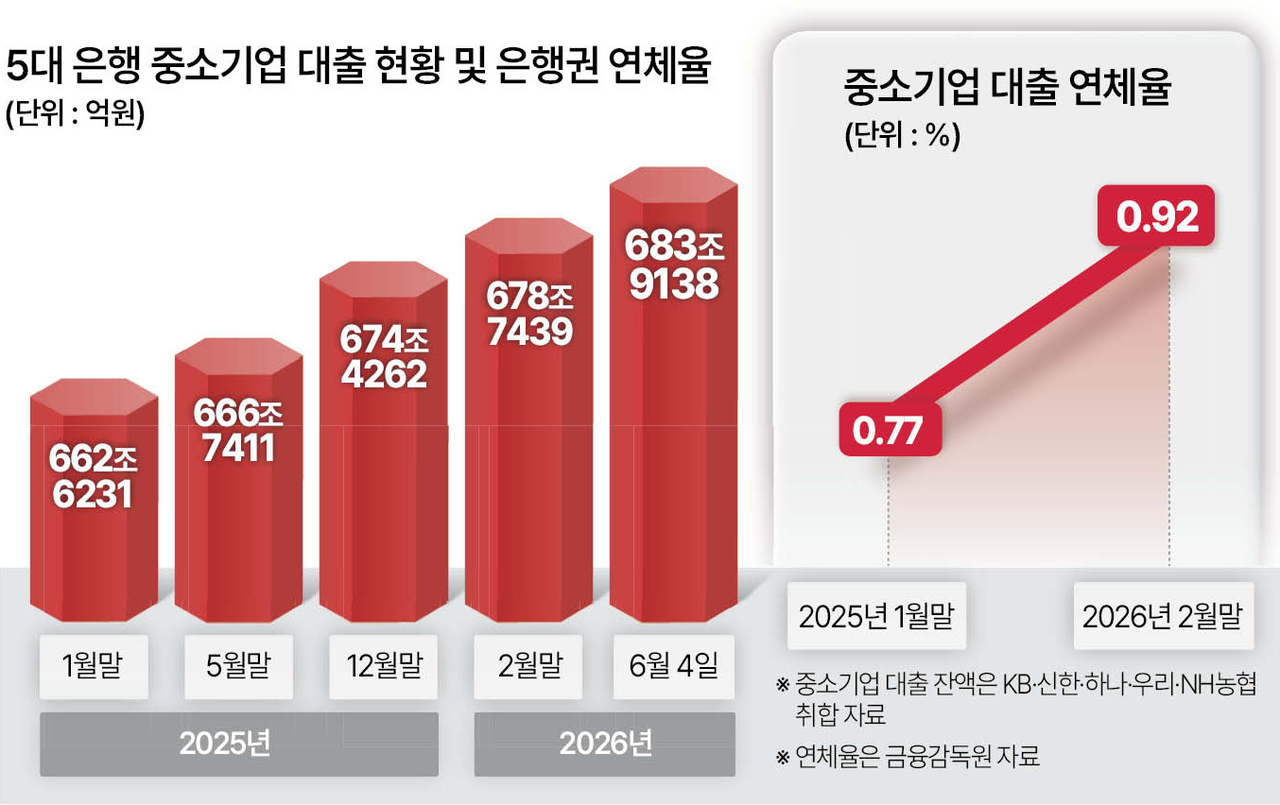
Outstanding loans to small and medium-sized enterprises — including sole proprietors — at KB, Shinhan, Hana, Woori and NH NongHyup banks have grown by more than 17 trillion won ($12.5 billion) over the past year. The surge reflects the banking sector's push to expand SME lending in line with the government's "productive finance" agenda, but rising delinquency rates are intensifying pressure on asset quality. Concerns about moral hazard stemming from the expansion of inclusive finance also remain an unresolved challenge.
The combined SME loan balance at the five major banks stood at 683.9138 trillion won as of June 4, up 17.1727 trillion won from 666.7411 trillion won at end-May last year, just before the Lee Jae Myung administration took office, according to financial industry data released Friday.
The increase reflects the banking sector's active pursuit of SME lending as the Lee administration has emphasized "productive finance" — channeling credit into specific industries. During this period, the five banks extended an average of 1.4310 trillion won in SME loans per month, roughly 520 billion won more than the monthly average of 902.4 billion won recorded in the five months from January through May last year, before the administration took office.
While productive finance has taken hold as a core business model for banks and driven a visible expansion in loan volumes, the financial industry broadly acknowledges that credit risk has grown in tandem. SME loans are classified as high-risk credit given the domestic economy's structural vulnerability to external shocks and its relatively weak consumer demand base.
Delinquency rates are already on an upward trajectory. According to the Financial Supervisory Service, the delinquency rate on bank SME loans soared from 0.76 percent at end-March 2025 to 0.92 percent at end-February this year.
The current delinquency rate reflects defaults on loans extended in the past. Banks warn that if the more recently expanded loan book begins to sour, the rate could climb even faster — in part because lending standards for SMEs have been loosened as productive finance has been rolled out.
"We can't ignore our performance metrics when the government is pushing the productive finance agenda so hard," said an official at one commercial bank. "Banks are competing to offer SMEs ever-lower interest rates." Another official added: "It's not easy to expand productive finance and tighten loan screening at the same time. Loans are going out under the productive finance banner to companies that would not have qualified before."
Shin Yong-sang, a senior research fellow at the Korea Institute of Finance, warned that delinquency rates could climb further if domestic demand deteriorates. "At some point, there may be a ceiling on how much loan supply can be expanded," he said.
Inclusive finance is also seen as a potential drag on bank asset quality. Financial regulators plan to release a comprehensive inclusive finance evaluation framework for the banking sector this month. The framework is expected to cover not only policy loans but also banks' own lending to low- and mid-credit borrowers and their volume under the "Sae Huimang Holssi" program — a government-backed loan product for low-income borrowers — raising concerns that intensified competition could worsen asset quality.
Major financial holding companies have flagged in annual reports filed with the US Securities and Exchange Commission that the expansion of productive and inclusive finance could weigh on asset quality. "Asset quality issues can affect a financial institution's international credibility, so careful management is essential," said a senior official at one financial holding company.
Experts say banks should proactively build capital buffers to strengthen their loss-absorption capacity before asset quality risks materialize. While accounting standards impose certain limits on loan-loss provisions, there is no ceiling on capital accumulation. "Risk-weighted asset thresholds for loan portfolios should be eased, but that must go hand in hand with additional capital building," Shin said.
Alongside the push for productive and inclusive finance, regulators face the challenge of preventing moral hazard — finding the operational balance that advances financial inclusion without encouraging borrowers to treat debts as optional.
Financial regulators have adopted debt cancellation as the default approach for long-overdue loans under the inclusive finance framework. The statute of limitations on commercial claims such as loans is five years, and authorities are considering a plan under which — even if the limitation period is extended once — repayment capacity would be assessed at the three-year mark, with the debt written off if repayment is deemed impossible. Under this approach, the effective lifespan of a loan claim would likely not exceed 10 years. Regulators also plan to disclose data on the volume of delinquent debts written off.
Regulators plan to hold a kickoff meeting of the Inclusive Finance Strategy Task Force in mid-June to discuss the full range of inclusive finance initiatives, including an overhaul of the credit scoring system. Some have also raised the possibility of introducing a "basic loan" — an ultra-low-interest policy lending product.
"As a financial institution with a public mandate, we understand the intent behind inclusive finance," said one banking industry official. "But it is critical to address moral hazard concerns so that the perception that debts don't need to be repaid does not take hold."
How regulators navigate criticism that their approach to productive and inclusive finance amounts to heavy-handed government intervention is another challenge they must address. Market attention is also focused on proposed governance reforms, including legislation to limit the reappointment of financial company CEOs. Institutional Shareholder Services, the world's largest proxy advisory firm, has gone on record opposing the proposed legislative cap on CEO reappointment.
hyuk@heraldcorp.com