Yellow Envelope Law triggers legal chaos at worksites; 26 appeals filed with central labor board; final rulings may take years, raising strike fears


Three months after the so-called Yellow Envelope Law — the revised Trade Union Act — took effect, legal disputes over whether prime contractors qualify as employers are roiling industrial worksites across the country. Appeals against initial rulings by regional labor commissions are flooding into the National Labor Relations Commission, and fears are growing that the battles will drag on for years as cases work their way through administrative courts. "The destructive force of the Yellow Envelope Law, briefly overshadowed by bonus disputes, will kick into full gear this summer," a business community official said. "Corporate uncertainty and bargaining-related costs could rise exponentially."
Data submitted to People Power Party lawmaker Jo Ji-yeon of the National Assembly's Climate, Energy, Environment and Labor Committee by the National Labor Relations Commission show that 26 cases had been filed with the commission as of Wednesday. Seven of those were filed this month alone. The disputes span heavy industries with high rates of in-house subcontracting — shipbuilding, energy, construction and steel — as well as the parcel-delivery and logistics sector, and have drawn in public institutions and local governments as well.
Of the 26 total cases, 14 were appeals filed by employers. This month, prime contractors including Keukdong Engineering & Construction, Hyundai Engineering, CJ Logistics and the Electronics and Telecommunications Research Institute all challenged regional commission rulings by filing appeals. On the other side, the National Plant Construction Workers' Union and the National Parcel Delivery Workers' Union have filed their own appeals after having their bargaining requests rejected at the regional level.
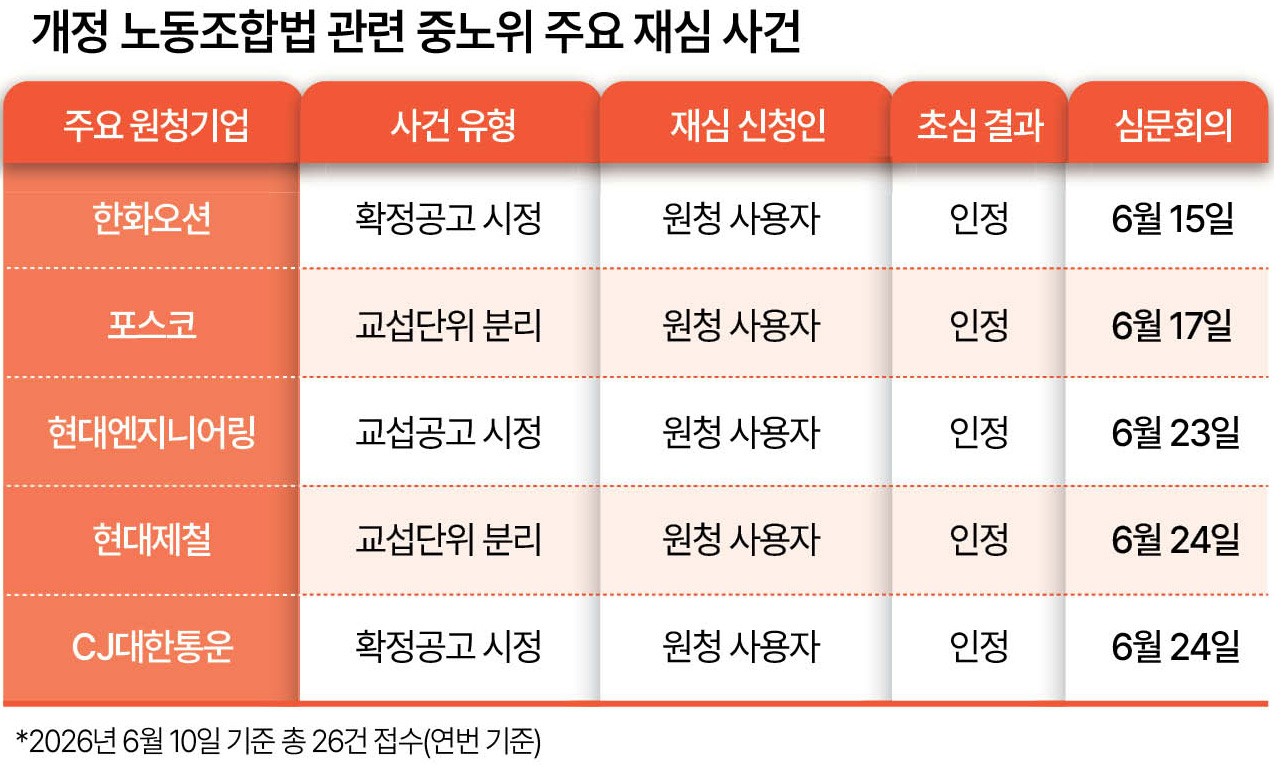
Hearings on key disputes involving major conglomerates are set to begin at the National Labor Relations Commission starting Monday. The commission will hold a hearing Monday on Hanwha Ocean's appeal against the Metal Workers' Union over a ruling requiring the company to include a cafeteria workers' union in its bargaining notice. Earlier, Hanwha Ocean had challenged a regional commission decision ordering it to add the in-house food-service union to the list of unions covered by the bargaining announcement. A hearing on CJ Logistics' appeal over a similar bargaining notice dispute is scheduled for June 24, with more head-on clashes between large prime contractors expected to follow.
As rulings at the regional level begin to diverge, both labor and management are increasingly inclined to push cases all the way to the National Labor Relations Commission. Analysts say the legal standard written into the law — whether a company holds a position to "substantially and specifically dominate or determine" working conditions — remains too vague for either side to accept a regional ruling as final, accelerating a domino effect of appeals.
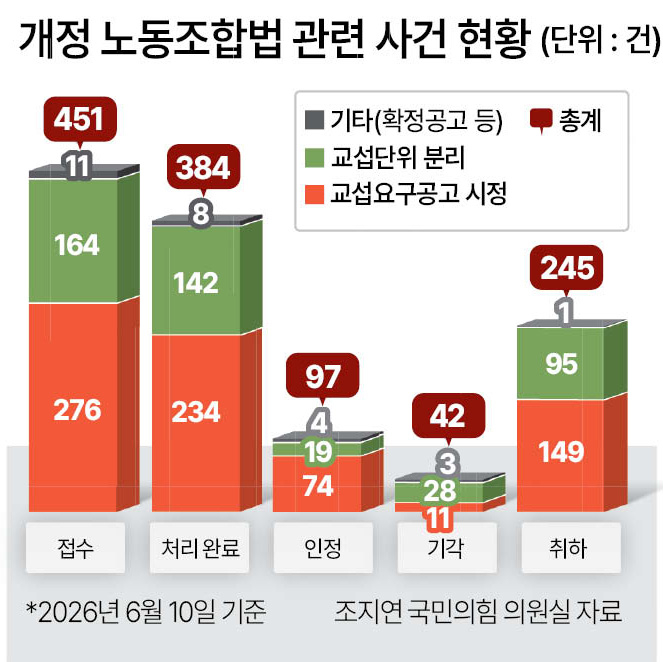
Amid this standoff, the total volume of disputes under the revised Trade Union Act — including cases still at the regional commission stage — has already reached striking levels. A total of 451 cases had been filed with labor commissions as of Wednesday. The largest category, at 276 cases (61.2 percent), involved subcontractor unions demanding that prime contractors post bargaining notices that the prime contractors had failed to issue. Requests to separate bargaining units accounted for 164 cases (36.4 percent).
Of the 384 cases that have been resolved, 97 resulted in rulings recognizing the prime contractor's employer status — more than twice the 42 cases in which such claims were rejected. Because regional commissions have repeatedly recognized prime contractors as employers, large companies now feel compelled to pursue National Labor Relations Commission appeals and prepare for a wave of litigation as a defensive measure.
If cases ultimately reach the administrative court system, the legal battles could drag on for years before the Supreme Court issues a final ruling. Last year, the average time for a labor commission case to work through all three tiers of administrative court review stood at 1,137 days.
Once litigation begins, determining who the "real employer" is could take a minimum of several years.
"Cases under the revised Trade Union Act have no precedent and involve complex legal questions, so given the burden on the courts, a final Supreme Court ruling could take as long as five years," said Park Ji-soon, a professor at Korea University School of Law. "From a prime contractor's perspective, even if a court eventually rules that it is not an employer, agreeing to bargain now under union pressure would set a binding precedent — so companies will have no choice but to hold out to the end, even at the cost of prolonged litigation."
There are also concerns that worksites could descend into a strike climate while the legal battles drag on. Under Article 27 of the Labor Relations Commission Act, filing an administrative lawsuit against a National Labor Relations Commission ruling does not suspend its effect, meaning subcontractor unions could demand immediate bargaining. If a prime contractor refuses on the grounds that the case is still being litigated, the union could file an unfair labor practice complaint and, after going through mediation procedures, call a strike.
"The Yellow Envelope Law has created a safety net that sharply reduces or eliminates liability for damages from illegal industrial action, so unions will reach for the strike card easily," Park said. "This summer could see a surge of strikes aimed at maximum impact at minimum cost — where halting just one subcontracted process paralyzes the entire prime contractor's operation — amplifying labor-management conflict."
"From June onward, as National Labor Relations Commission outcomes from the first three months of the law's operation become visible, the typhoon unleashed by the Yellow Envelope Law will begin to show its full force," he added.
By Ko Eun-gyeol
keg@heraldcorp.com