US bars foreign nationals from Anthropic's latest models; China to restrict tech, talent and data outflows from July; nations race to secure AI as strategic asset; Korea's sovereign AI project faces critical window
![The logo of Claude Mythos, developed by Anthropic. [Getty Images]](https://wimg.heraldcorp.com/news/cms/2026/06/15/news-p.v1.20260612.f457afd07343408a9071669983c6169d_P1.jpg)
The race for AI supremacy among South Korea, the United States and China has entered a new and more intense phase.
As AI emerges as a strategic asset capable of determining national security and industrial leadership, an "AI border" is taking shape — one that locks AI technology and talent inside national boundaries.
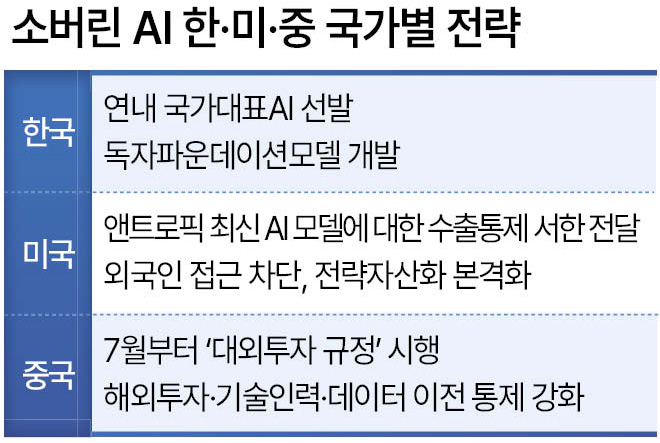
The United States has cut off foreign nationals' access to its most advanced AI models, while China is raising barriers against the overseas transfer of technical personnel and data.
The urgency of securing "sovereign AI" is growing, and South Korea faces mounting pressure to accelerate development of its own AI models and assert control over its data.
Anthropic announced Friday on its website that, in compliance with US government export control guidelines, it would block foreign nationals from accessing its latest AI models, Fable 5 and Mythos 5.
The restrictions extend beyond overseas users. Foreign nationals residing in the United States — including non-American employees at Anthropic itself — are covered, effectively bringing non-US citizens' access to the models to a halt.
The move carries significant implications because it signals that the United States has begun treating cutting-edge AI models not as ordinary commercial services but as strategic assets directly tied to national security. Fable 5 and Mythos 5 are reported to perform strongly in the cybersecurity domain.
South Korea was immediately caught in the fallout. Anthropic had earlier expanded participation in Project Glasswing — a global cybersecurity collaboration built on Mythos — to include Samsung Electronics, SK Hynix, SK Telecom and the Korea Internet & Security Agency. The export control measures have now thrown those domestic institutions' plans to use Mythos into doubt.
The South Korean government is treading carefully as it assesses how the access restrictions affect domestic participants. A Ministry of Science and ICT official said only that the ministry was "in the process of verifying the facts."
The US move shows that the front lines of the AI supremacy contest have expanded to include model access itself. China is no different. While Beijing publicly champions open-source models and open ecosystems, it is internally tightening controls to keep core AI assets within its borders — blocking the overseas transfer of technical personnel and data.
As part of that effort, China's State Council will enforce new "Regulations on Outbound Investment" starting July 1. The rules prohibit companies and individuals from transferring overseas — without government approval — any products, technologies, services or data that the state has designated as restricted, in the course of making foreign investments.
The ban also covers the transfer of restricted technologies and related data through overseas-dispatched personnel providing technical guidance or workforce training. Analysts say the rules could make it significantly harder for China's top AI talent to move abroad or engage in technical cooperation with foreign firms.
The saga surrounding Chinese AI agent startup Manus offers a stark illustration of Beijing's determination to keep key AI assets at home.
Manus, which grew out of mainland China, relocated its headquarters to Singapore and pursued a sale to Meta — but Chinese authorities blocked the foreign acquisition and ordered the deal canceled, effectively shutting down any attempt to circumvent Chinese regulations through an overseas move and sale.
South Korea is now on alert. Building its own sovereign AI has become an urgent task that allows no delay.
Calls are growing for the government to push its "independent AI foundation model" project — known as Dokpamo — with greater urgency. Experts say completing the project to a high standard during what may be the last "golden window" is essential if South Korea is to avoid falling completely behind in the global AI leadership race.
Because access to AI models can be cut off with a single notification, experts say South Korea needs a multi-track strategy — evaluating domestic models alongside closed US models and open-source models from China and Europe — rather than depending on any single foreign model.
"China is controlling talent and data, and the United States is moving toward restricting services outright," said Choi Byung-ho, a professor at Korea University's AI Research Institute. "The era when allied status alone opened many doors is already over." He added that sovereign AI "is no longer optional — it is essential," and that while South Korea should make use of American, Chinese and European models, "in areas related to national infrastructure and defense, we must ultimately have our own."
Ha Jung-woo, former presidential AI secretary for future planning at Cheong Wa Dae, described the Anthropic restrictions as "what happens when you become technologically dependent on AI" and said that "because incidents like this will keep occurring, securing independent AI capabilities — sovereign AI — is critical."
rim@heraldcorp.com