Microsoft's 2026 Work Trend Index shows 54% of Koreans producing better work with AI, but only 16% say their organization has a clear AI strategy

About half of Koreans are using AI agents to produce higher-quality work than before, but organizational systems are struggling to keep pace — leaving roughly eight in 10 workers worried about falling behind on AI adoption, according to a new survey.
Microsoft released the findings Monday at a media briefing at its Korea headquarters in Jongno-gu, Seoul, presenting the 2026 Work Trend Index.
The report draws on a survey of 20,000 knowledge workers across 10 markets, anonymized productivity data from Microsoft 365, and insights from experts in AI, workplace dynamics and organizational psychology.
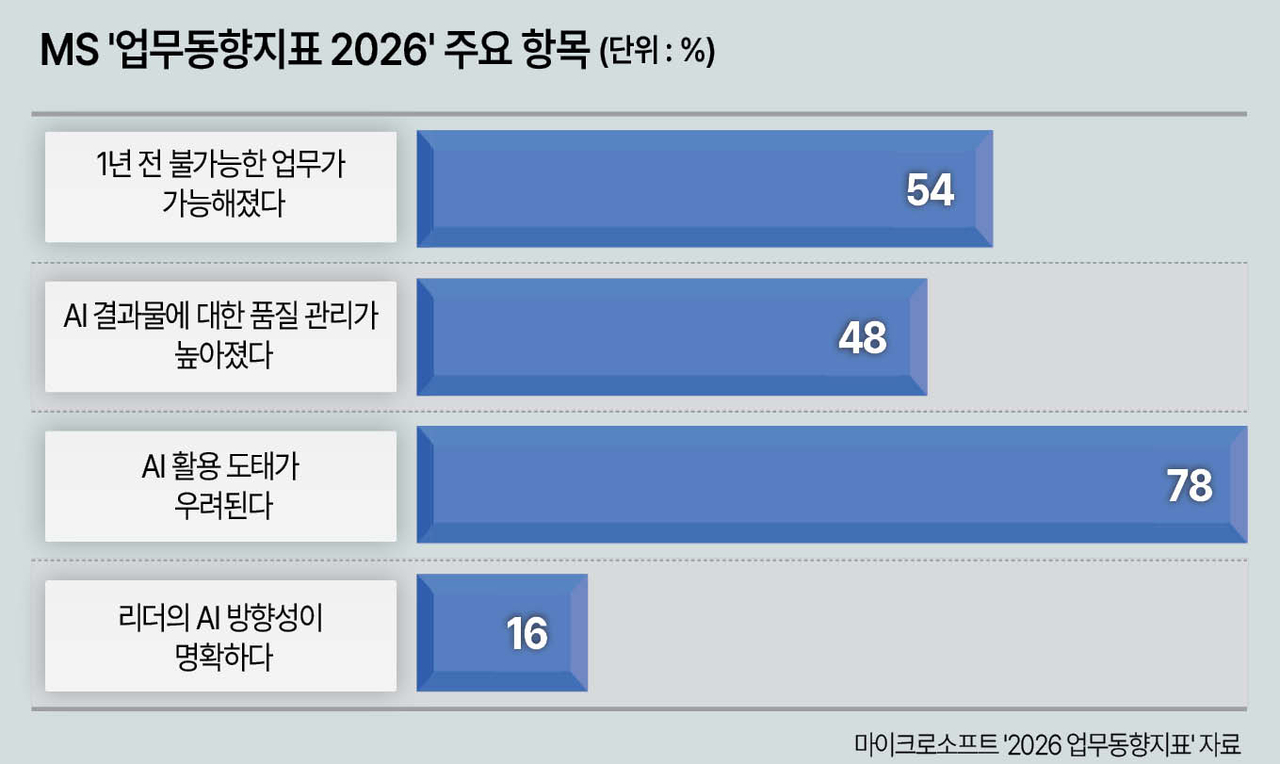
According to the report, 54 percent of Koreans said they are producing better work than a year ago thanks to AI agents.
At the same time, 78 percent said they fear being left behind in AI adoption, while only 16 percent said their organization's AI strategy is clear — a sharp gap pointing to misaligned expectations between individuals and their employers.
The report said that as AI becomes directly embedded in workflows, the way people work is shifting toward a model that combines humans, AI agents and systems.
The data also confirmed AI's role in redirecting workers toward higher-value tasks. Globally, 66 percent of AI users said they now spend more time on high-value work because of AI, and 58 percent said they are producing results that would have been difficult to achieve a year ago.
In Korea, 54 percent of respondents said they are producing better work than before — a figure that climbed to 75 percent among what the report calls "frontier workers," a segment that accounts for 12 percent of the Korean workforce.
The report also found that many organizations are still failing to keep up with the pace at which individuals are adopting AI. Globally, 65 percent of respondents said they fear being left behind if they cannot adapt quickly, yet only 26 percent said their leadership provides a clear and consistent AI direction.
That gap was even wider in Korea, where 78 percent of employees expressed concern about falling behind, while only 16 percent said they were satisfied with their organization's AI strategy.
The report said organizations will only sharpen their competitive edge by rapidly absorbing signals from the front lines, sharing them across the organization and translating them into operations quickly — in other words, by embedding AI deeply into how the business runs.
Microsoft also used the briefing to announce the latest product updates designed to help organizations embed AI more deeply.
Copilot Cowork connects people and agents within a single workflow, extending individual AI tasks into coordinated, organization-wide operations. Microsoft said the product also supports the development of custom plugins tailored to each organization's workflow.
The company also highlighted Microsoft 365 Agents, which provides the management and governance capabilities required in enterprise environments, enabling organizations to deploy and scale AI agents safely across core business functions including sales, service and operations.
chami@heraldcorp.com