Plunging catches leave 'gold squid' nearly absent from wholesale markets as rising sea temperatures and soaring fuel costs deepen the supply crunch
"No squid? None came in."
At 10:30 p.m. Monday at Seoul's Garak Agricultural and Marine Products Wholesale Market in Songpa-gu, traders were bustling ahead of an auction set to begin at 11 p.m. Styrofoam crates packed with hairtail, mackerel and pomfret filled the auction floor. Squid — whose fishing ban had just been lifted — was nowhere to be seen. A middleman dealer surnamed Jeong, 58, led a reporter to a corner of the hall, where only three or four crates of squid sat stacked.
"A few boxes came in Friday, but the quantity was so small they were already gone," Jeong said. "There isn't even enough to hold an auction." No squid appeared on the auction block that night. He added that the limited supply partly reflected the timing: immediately after the fishing ban was lifted, only squid caught by jigging — a method using multiple hooks rather than nets — had been brought in.
Starting with the auction on Wednesday, squid caught by set-net fishing off the east coast — from Gangneung, Mukho and other ports along the East Sea — began arriving at the market. A squid auctioneer at the wholesale market said the first 1,300 crates to arrive after net fishing was authorized sold for between 40,000 and 48,000 won (about $32) per crate. "Still, the volume is smaller than last year," the auctioneer said, adding that persistently high sea temperatures cast a shadow over the outlook.
Squid was a staple banchan — a side dish — on Korean dinner tables just a decade ago. Now it has earned the nickname "gold squid," so scarce and expensive has it become. Climate-driven rises in sea temperature, combined with reduced fishing activity, have pushed prices consistently higher.
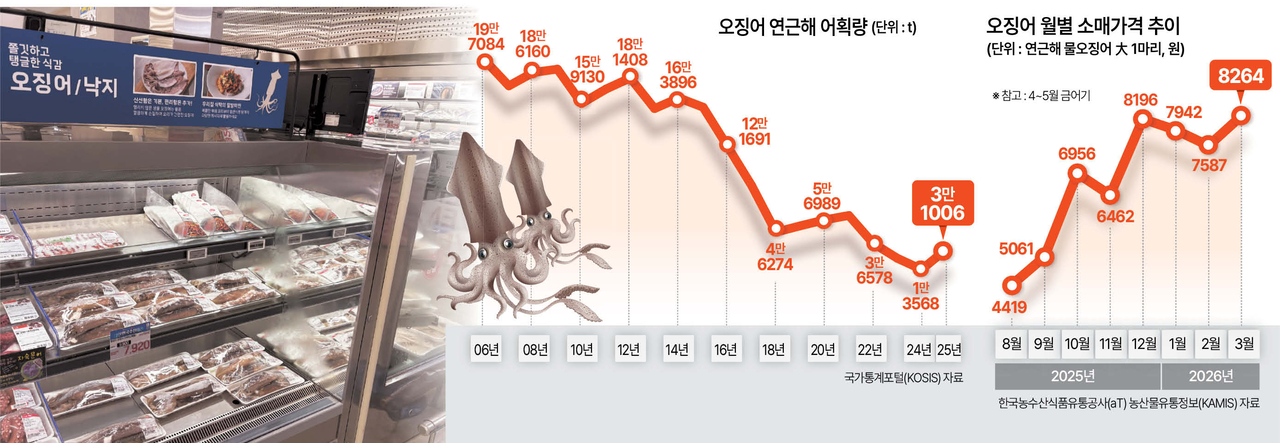
Coastal squid catches have been declining since they first fell below 100,000 metric tons in 2017. According to the Korean Statistical Information Service, the haul dropped to 36,578 metric tons in 2022, 23,375 metric tons in 2023 and 13,568 metric tons in 2024. Last year brought a brief rebound to 31,006 metric tons, but the slump has returned this year. Squid catches in May totaled just 11 metric tons — down 85 percent from 77 metric tons in the same month last year and 93 percent below the historical average. Wholesale trading volume at Garak Market also fell 62.5 percent, from 480,000 crates in 2020 to 180,000 crates last year.
Rising sea temperatures are widely cited as the primary cause. The National Institute of Fisheries Science said East Sea coastal water temperatures from Sunday through next Thursday are forecast at 17 degrees Celsius — about 3 degrees higher than a year ago. The South Sea and West Sea are also running 1.7 degrees and 1.2 degrees above last year's levels, respectively.
Surging oil prices tied to Middle East tensions have compounded the problem. The price of tax-exempt fuel for fishing vessels jumped 57 percent in a single month, from 175,940 won per 200 liters in March to 276,180 won in April. Yang, a 67-year-old market official, said putting to sea had become economically unviable. "With fuel costs this high, there's nothing left after a trip," he said. "Fishing boats are cutting back on voyages, and squid supply is taking the hit."
Shrinking supply has driven prices higher. According to the Korea Agro-Fisheries and Food Trade Corporation's agricultural price information system, the retail price of a large squid rose from 4,419 won in August last year to 8,264 won in March this year. Annual average prices have climbed steadily as well — 6,928 won in 2024, 7,104 won in 2025 and 7,932 won so far this year.
Fresh squid has also become hard to find at hypermarkets. As of May, the wholesale price of fresh domestic squid was up 10 to 20 percent from a year earlier. A hypermarket official said fresh domestic squid had been available only on a limited basis since mid-May, with frozen squid from Argentina making up the bulk of supply. "We're hoping domestic volumes pick up now that the fishing ban has been lifted," the official said.
siuu@heraldcorp.com