First prime minister candidate to come from SMEs and Startups ministry
Unusual for a junior cabinet ministry to produce a PM nominee
Policy weight for small businesses and self-employed expected to grow
Leadership vacuum at affiliated agencies likely to deepen
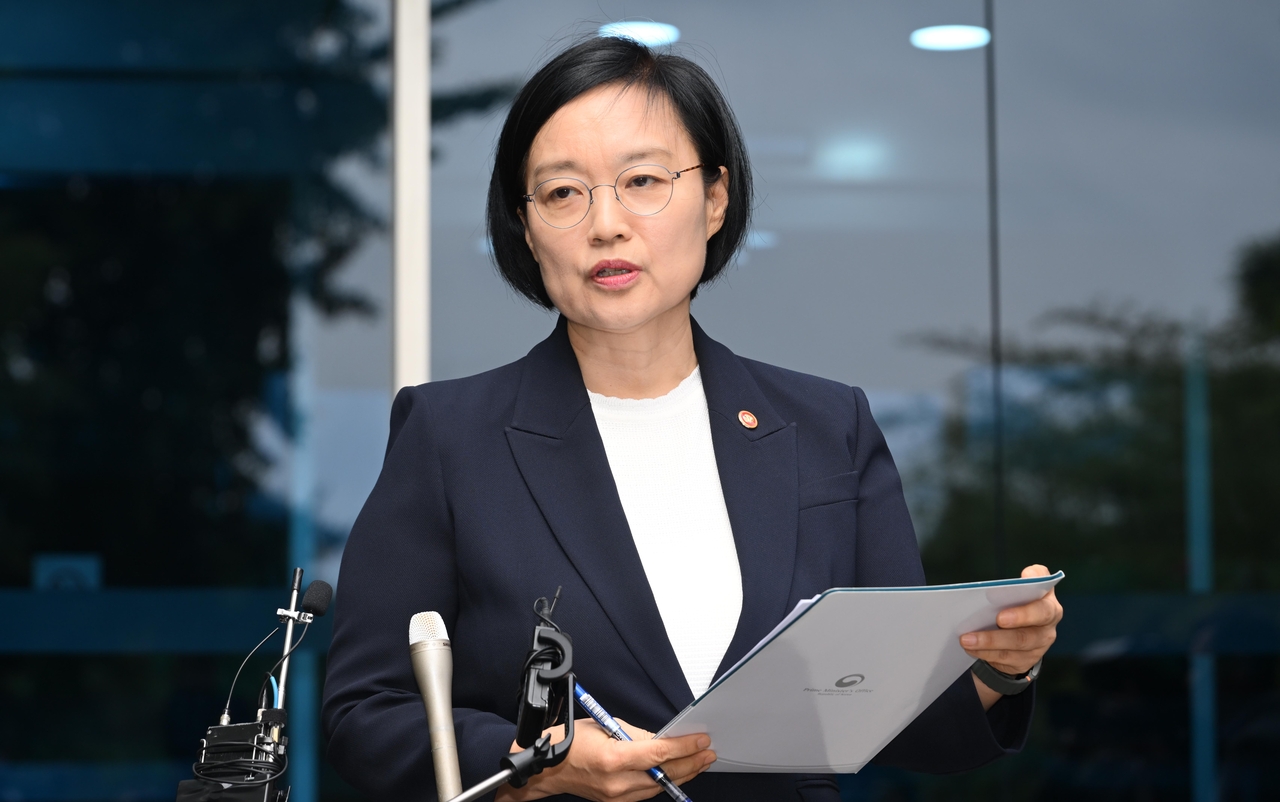
The nomination of Minister of SMEs and Startups Han Sung-sook as prime minister candidate has sent ripples through her ministry. The selection of a female business executive and former Naver chief carries its own significance, but inside and outside the ministry, the reaction centers on a different point: that the Ministry of SMEs and Startups has produced a prime minister candidate at all.
Han arrived Monday at her confirmation hearing preparation office at the Financial Supervisory Service training center in Jongno-gu, Seoul, where she told reporters that "the people's livelihoods are in a state of emergency" and pledged to "make every effort toward an economic recovery that citizens can feel."
Han, who served as chief executive of Naver before becoming minister of SMEs and Startups, is widely regarded as someone who combines hands-on corporate management experience with policy execution. Once she clears the National Assembly confirmation hearing and the appointment consent motion passes, she will take office as the first prime minister of the Lee Jae Myung administration.
Her nomination carries particular weight within the ministry. The Ministry of SMEs and Startups was elevated from the Small and Medium Business Administration to a full cabinet ministry in July 2017, shortly after the Moon Jae-in government took office. Compared with traditional powerhouse ministries — the Ministry of Economy and Finance, Ministry of Foreign Affairs, Ministry of Justice, Ministry of Interior and Safety and Ministry of Trade, Industry and Energy — it has a short history. In the official ordering of government ministries, it sits after the Ministry of Oceans and Fisheries, near the bottom of the list. That is why the ministry has long been known in government circles as the "youngest ministry."
That same ministry has now produced a nominee for the position often described as second only to the president. If Han clears the confirmation hearing and the approval process, she will become the first prime minister to have served as minister of SMEs and Startups. Inside the ministry, the reaction is that "this is a symbolic signal that small business, venture and self-employed policy has moved to the center of national governance."
Past prime ministers have often come from ministerial backgrounds, but those backgrounds have typically been concentrated in traditional departments — Interior and Safety, Foreign Affairs, Justice and Trade. Former Prime Minister Kim Boo-kyum served as minister of interior and safety; former Prime Minister Han Seung-soo as foreign minister; former Prime Minister Hwang Kyo-ahn as justice minister; and former Prime Minister Chung Sye-kyun as minister of commerce, industry and energy. No prime minister has ever come from the SMEs and Startups ministry. Even looking back to the days of the Small and Medium Business Administration, there is no precedent for a direct path to the premiership.
The ministry's growth in size has also been notable. Since its elevation to full ministry status, it has expanded its organization and budget and now operates with both a first and second vice minister — whereas the Ministry of Trade, Industry and Energy, which once housed the small business administration within it, operates with only one vice minister. The ministry's remit now covers SME policy, venture and startup policy, self-employed business policy, technology protection, the supply-price linkage system and traditional market policy.
The presidential office cited "ability" as the reason behind Han's selection. Presidential Chief of Staff Kang Hoon-sik, responding to a question about why a woman was chosen, said at the nomination announcement: "Our administration's personnel philosophy is strictly centered on competence and ability. If you're asking why a woman — I'm not sure that's the right question to be asking in 2026."
By the presidential office's account, the appointment reflects Han's policy track record as minister rather than her symbolic value as a woman or a business figure. Since taking office as minister, Han has championed a "startup for all" initiative to broaden the entrepreneurship base and has maintained an active presence on the ground in areas including the supply-price linkage system, responses to technology theft, and policies for the self-employed and traditional markets. In government circles, a moment from March — when President Lee Jae Myung publicly applauded Han at a "Dialogue with SME Leaders" event, saying "You're doing well, aren't you?" — has been read as a clear sign of presidential confidence.
Expectations are running high inside the ministry. "Small business and self-employed policy has often been pushed to the back of the queue even within economic ministries," one SME industry official said. "If a prime minister comes from the SMEs and Startups ministry, the policy weight in budget and regulatory coordination could be very different." Another official said the symbolism was considerable "given that the ministry started out as a subordinate agency-level body."
The nomination also creates a leadership vacuum risk for the ministry. Once Han enters the confirmation hearing process, her ability to carry out her ministerial duties will inevitably be constrained. Ministerial schedules set for this week have already been reassigned to the vice minister. The ministry said in a statement issued through its spokesperson that "all coverage of the nominee, including by the press, will be handled by the prime minister's office following the nomination."
Personnel appointments at affiliated agencies add another layer of uncertainty. At the Korea Technology Finance Corporation, the term of Chairman Kim Jong-ho ended in November 2024, but the process to select a successor has collapsed twice, leaving him in place. The agency launched a second open recruitment for the next chairman last month. Appointment processes at other agencies under the ministry — including the Korea Intellectual Property Strategy Agency, Korea Venture Investment, the Korea Startup Agency and the Korea Federation of Small and Medium Business — could also slow depending on when a new minister is named and how quickly the presidential office completes its vetting.
The term of Lee Tae-sik, head of Hanyuwon, expired in April, but with no successor named, the organization is being run in an acting capacity. The standard process for appointing heads of public institutions involves forming a candidate recommendation committee, opening a public recruitment, conducting document and interview reviews, a formal recommendation by the supervising ministry and vetting by the presidential office. If the ministry's decision-making chain is disrupted as the minister transitions to the prime minister nomination process, appointment timelines will naturally slip.
By Hong Seok-hee
hong@heraldcorp.com