Pest response mobile units deployed; professional disinfection services expanded across the district
221 love bug traps installed in high-density zones; water-spray control and public guidance underway
Gwangjin-gu, led by District Mayor Kim Gyeong-ho, has stepped up its pest control efforts ahead of the summer season.
Average temperatures this summer are forecast to run above normal, which is expected to accelerate the onset of pest activity and extend the season.
In response, the district is activating a preemptive and systematic pest management framework tailored to local climate conditions and area-specific infestation patterns.
The district's public health center has deployed pest response mobile units to conduct rotating control operations across four zones — Junggok, Jayang, Guui and Gwangjang. When complaints are received, teams are dispatched to the scene to treat both larvae and adult insects and report back to residents in a one-stop process designed to minimize inconvenience.
The district has also contracted professional pest control companies to install and manage sanitary insect traps, carry out larval and adult pest treatment in high-complaint and hygiene-vulnerable areas, and conduct rotating disinfection across all 15 dong.
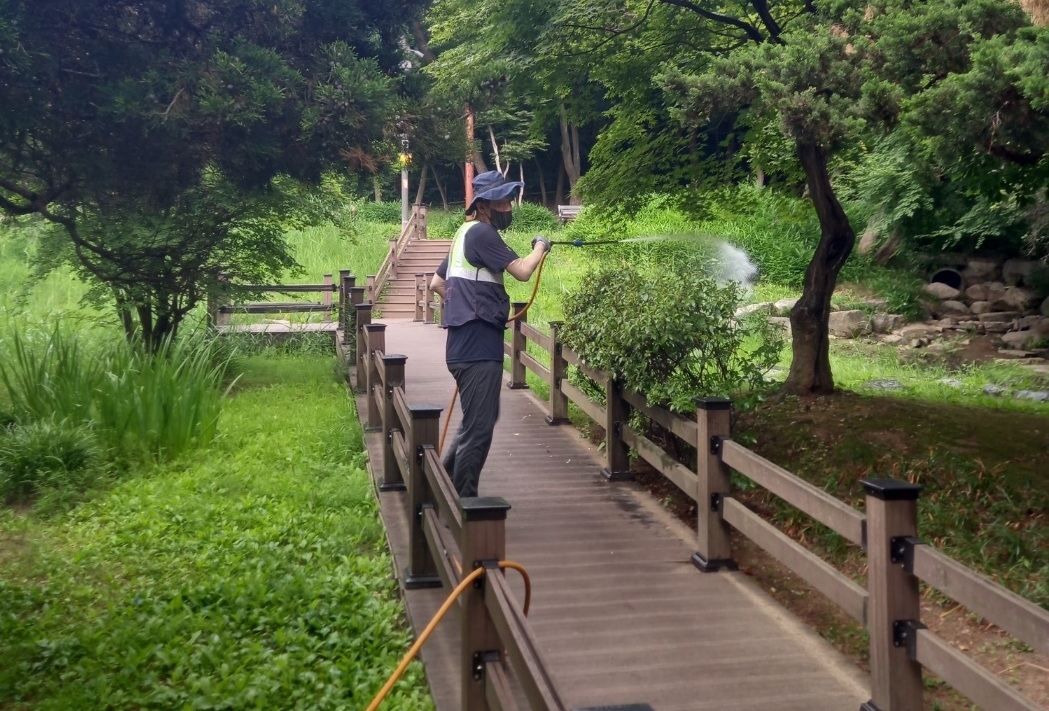
Complaints about love bugs have been rising, and the district has strengthened its rapid on-site response to coincide with peak infestation periods. A total of 221 attractant-based traps are now in operation in high-complaint areas, and four mobile response teams are handling complaints using water-spray control techniques. The district is also coordinating with saemaul pest control volunteer teams in each dong for supplementary treatment, and has requested on-site control from professional contractors to bolster overall capacity.
The district is also using online channels — including its official website and blog — to share guidance on dealing with love bugs. Tips include minimizing outdoor lighting at night and checking door gaps and window screens, wearing dark-colored clothing, and removing the insects with tissue rather than insecticide, helping residents manage the problem in their daily lives.
Alongside this, the district is reinforcing management of disease-carrying insects. Light traps have been installed at two locations — behind the storage area of the former district office building and beside the Jayang 1-dong community center — while digital mosquito monitors are operating at six sites, including the Jungnangcheon riverside path, Junggok 3-dong neighborhood park and the Jayang retention basin public parking lot, to track infestation trends and inform preemptive control efforts.
Three insect-repellent spray dispensers are in operation at the entrance pavilion to Achasan, in front of Eoulim Garden and at the entrance to the forest playground, with two more units set to be added. An additional 126 insect repellers have been installed along walking paths and in parks to reduce outdoor exposure to insects.
"Seasonal insects like love bugs that appear intensively over a short period can cause real inconvenience to residents, so we are responding quickly with a field-centered approach," District Mayor Kim said. "We will continue to do our best on summer pest control to create a comfortable living environment that residents can actually feel."
seouldream01@heraldcorp.com