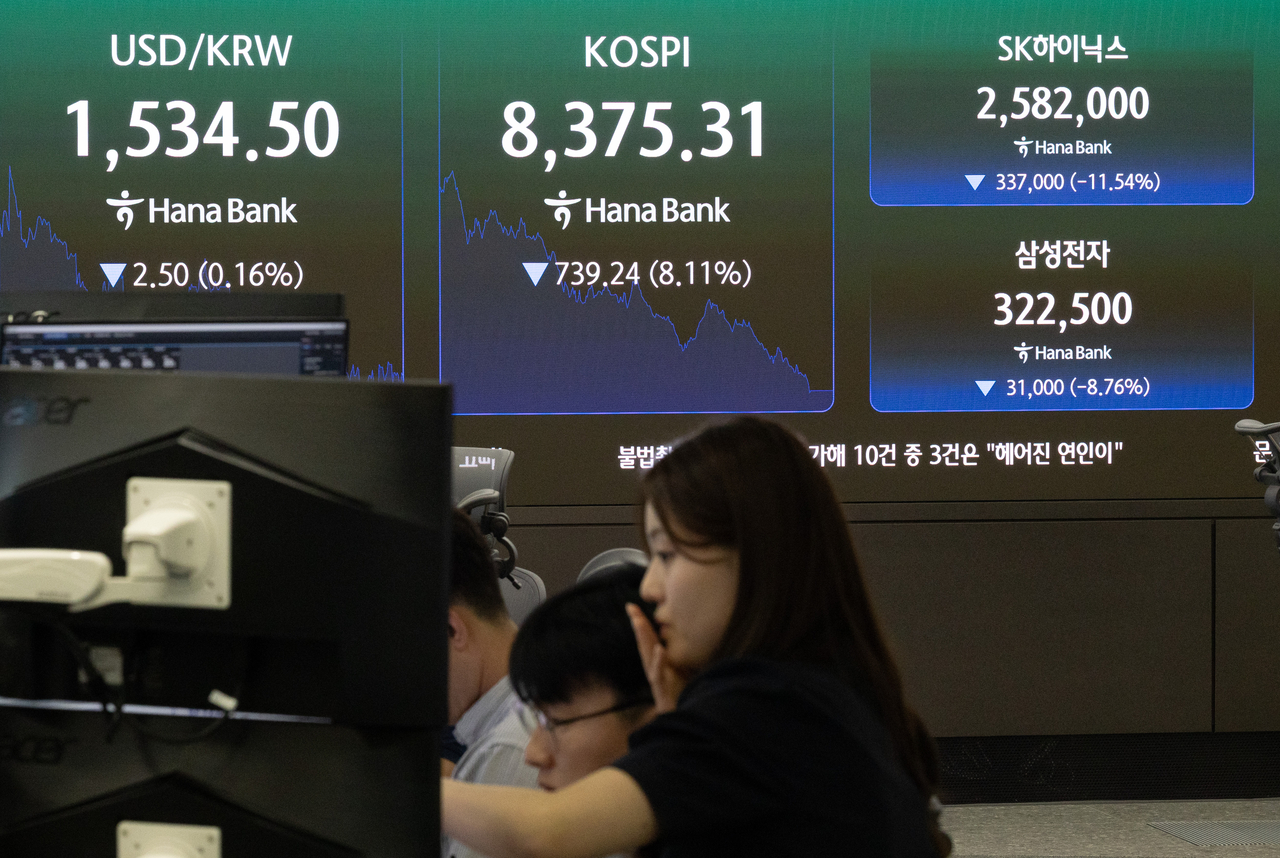
Amid an unprecedented market collapse that sent domestic stocks into a panic, retail investors poured more than 10 trillion won ($6.51 billion) into the market in a single day, marking a record-breaking buying spree.
The Kospi broke below the 9,000 level during trading Tuesday before sliding further into the 8,200 range, according to Korea Exchange. As losses deepened to more than 9 percent in the afternoon, a circuit breaker was triggered, temporarily halting market operations.
Korea Exchange said the circuit breaker was activated on the main bourse at 2:33 p.m. after the Kospi remained more than 8 percent below the previous session's closing price for one consecutive minute. At the time of activation, the index had fallen 736.30 points, or 8.07 percent, to 8,378.25. It was the fourth circuit breaker triggered on the Kospi this year and the 10th in the index's history.
Extreme volatility gripped the market from the opening bell, with sidecar measures — temporary suspensions of program sell orders — activated simultaneously on both the Kospi and Kosdaq markets in the morning.
The selloff was driven by heavy selling from both foreign and institutional investors. As of 3:15 p.m., combining Korea Exchange and Nextrade data, foreign investors posted net selling of 6.58 trillion won while institutions recorded net selling of 3.85 trillion won, together dragging the market lower.
Retail investors absorbed the historic volume of shares being offloaded. During the same period, individual investors recorded net purchases of 10.26 trillion won — the first time daily retail net buying has surpassed 10 trillion won. The surge in buying reflects what analysts described as retail investors, or "ants," treating the market's peak fear as a bargain-hunting opportunity.
Major semiconductor stocks, which had been pillars of the market, also crumbled. Samsung Electronics and SK Hynix, the two heavyweights of the domestic market, each fell more than 11 percent, delivering a severe blow to the market. The crash pushed Samsung Electronics down to the 310,000 won range and SK Hynix to the 2.5 million won range.
Lee Gyeong-min, an analyst at Daishin Securities, said discussions in political circles over taxing unrealized gains — including profits from stock and real estate investments — had weighed on investor sentiment and added downward pressure on the market, citing a recent forum where lawmakers debated treating such gains as taxable income under a comprehensive levy.
Lee added that ahead of Micron's earnings release, domestic semiconductor stocks faced profit-taking pressure after a period of short-term overheating and accumulated gains, with large-cap semiconductor names that had seen outsized rallies due to crowding leading the index lower.

jiyun@heraldcorp.com