
Economic value of grandchild care by seniors reaches 5.362 trillion won ($3.49 billion), with women shouldering 2.4 times the burden of men
Gender gap in caregiving that begins during child-rearing years extends into old age, data show
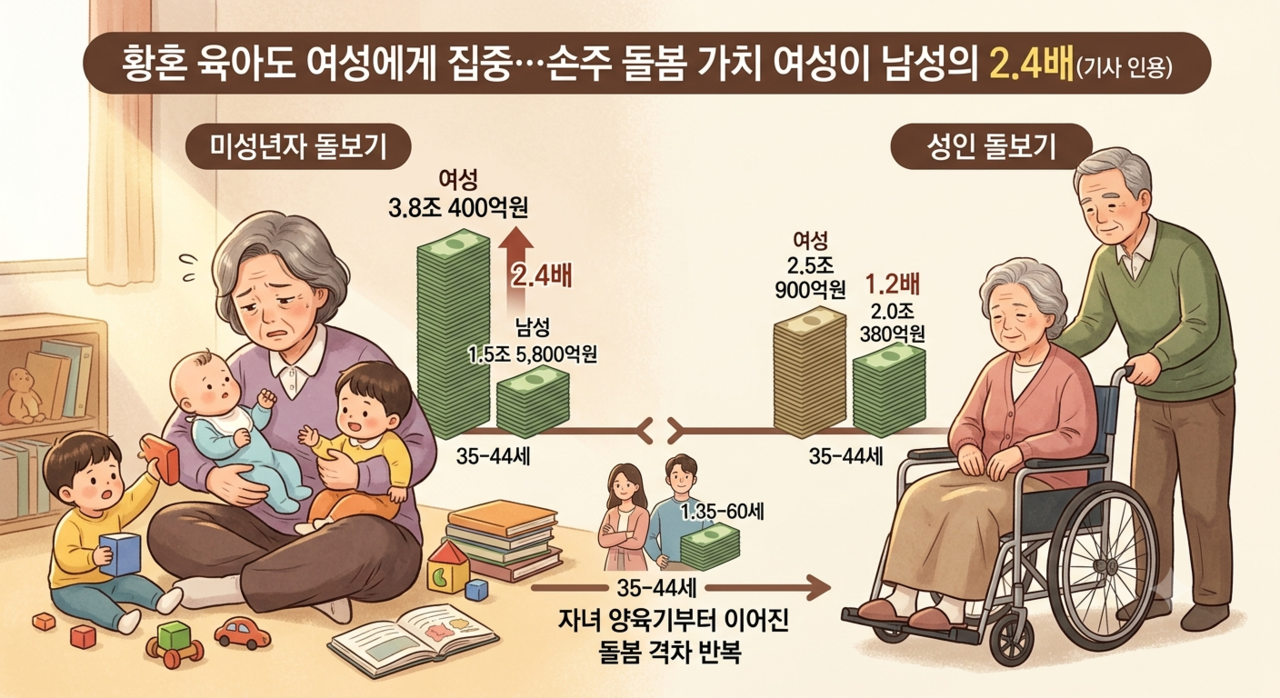
The burden of grandchild care among older Koreans still falls disproportionately on women, new government data show. Women aged 65 and older provided grandchild care at 2.4 times the rate of men in the same age group, suggesting that the gender gap in caregiving formed during child-rearing years persists well into old age.
According to the Ministry of Statistics' 2024 National Time Transfer Accounts released Wednesday, the economic value of "minor care" produced by Koreans aged 65 and older last year totaled 5.362 trillion won ($3.49 billion). The figure represents the monetary value of care that older adults provide for grandchildren, often stepping in for dual-income households.
Of that total, women accounted for 3.804 trillion won, roughly 2.4 times the 1.558 trillion won attributed to men. The gap has widened since 2019, when women's contribution was about 2.2 times that of men, pointing to an entrenched tendency for grandchild care to be treated as a woman's role even in old age.
By contrast, the gender gap was considerably narrower in "adult care" — the category covering care of spouses or other elderly individuals. Women aged 65 and older produced 2.509 trillion won in adult care, compared with 2.038 trillion won for men, a ratio of about 1.2 to 1.
The data suggest that while men participate actively in spousal or elder care, women still carry a heavier load when it comes to looking after children.
Analysts say the disparity reflects a caregiving structure that takes root during the prime child-rearing years and carries forward into retirement. Among 35- to 44-year-olds — the age group most actively raising children — women's minor-care output reached 37.934 trillion won last year, 2.5 times the 15.124 trillion won recorded for men. The gap remained wide in the 45-to-54 age bracket, where women's output of 9.506 trillion won was 1.8 times the 5.164 trillion won for men.
Men's participation in childcare is gradually expanding, however. The total economic value of minor care produced by men nationwide rose 11.7 percent, from 24.728 trillion won in 2019 to 27.616 trillion won last year. Men aged 35 to 44 posted a 20.2 percent increase over the same period, while men aged 65 and older recorded an 11.1 percent gain.
fact0514@heraldcorp.com





