![[Generated with ChatGPT]](https://wimg.heraldcorp.com/news/cms/2026/06/24/news-p.v1.20260623.78ec35663c9246bba4fc548a17177a2e_P1.png)
The Kospi's 9.99 percent plunge on Tuesday sent the cumulative returns of single-stock leveraged products tumbling in a single session. SK Hynix leveraged exchange-traded products (ETPs) that had posted cumulative returns of around 80 percent the previous day fell to the 30 to 40 percent range, while Samsung Electronics leveraged products swung into negative territory. With the products approaching their first full month of trading — they launched May 27 — the sharp reversal has renewed attention to the volatility and risks inherent in leveraged instruments.
According to Koscom data released Wednesday, SK Hynix single-stock leveraged ETPs — covering both ETFs and ETNs — recorded cumulative returns of 29 to 41 percent from their May 27 launch through Tuesday. That marked a steep drop from the 75 to 89 percent range posted at Monday's close. The KODEX SK Hynix Single-Stock Leverage product saw the sharpest individual decline, with its cumulative return falling from 87.63 percent to 39.82 percent — a contraction of 47.81 percentage points. SK Hynix leveraged products had occupied eight of the top 10 spots by return on the main bourse on Monday; by Tuesday, none remained in the top 10.
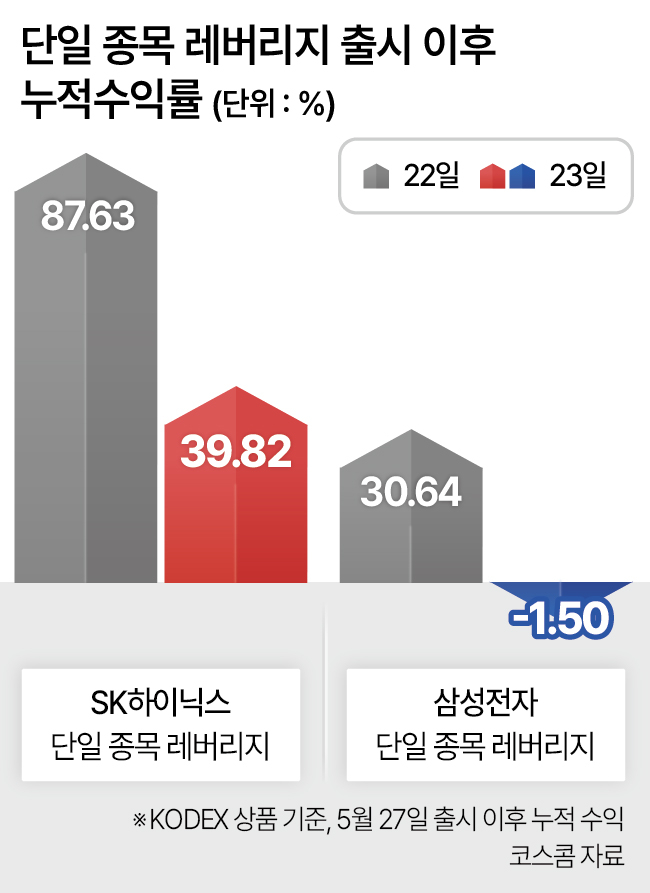
The underlying shares also lost ground over the same period. SK Hynix common stock saw its cumulative return since May 27 fall from 42.25 percent to 24.51 percent, while Samsung Electronics common stock dropped from 15.15 percent to 0.98 percent, after both shares shed roughly 12 percent on Tuesday. Both stocks held onto positive returns relative to the May 27 baseline, but the drawdown in the leveraged products — which target twice the daily return — was considerably steeper.
Among SK Hynix leveraged ETPs, the Mirae Asset Leverage SK Hynix Single-Stock ETN, which had posted the highest cumulative return through Monday at 89.03 percent, fell to 41.95 percent. TIGER and KODEX products dropped from the high-80 percent range to around 40 percent, while RISE, ACE and SOL products slid from the mid-80 percent range to the high-30 percent range. Futures-based KIWOOM and 1Q products fell from 81.12 percent and 75.69 percent to 33.97 percent and 29.22 percent, respectively.
The near-halving of cumulative returns in a single day stems from the structure of leveraged products, which track twice the daily return rather than twice the return over a given holding period. Tuesday's single-day decline was in the 20 percent range. But applying that drop to a price that had already risen more than 80 percent produced a far larger contraction in cumulative returns relative to the original base price.
Samsung Electronics leveraged products, which had benefited from a comparatively smaller share price gain, swung into negative territory. PLUS, TIGER, KODEX and RISE Samsung Electronics single-stock leveraged products that had recorded cumulative returns of 29 to 30 percent at Monday's close turned negative, falling to minus 1 to 2 percent by Tuesday. Repeated cycles of daily gains and losses have caused the leveraged products' cumulative performance to lag behind the underlying shares — a mathematical consequence of the daily-doubling structure.
Kang So-hyun, a senior research fellow at the Korea Capital Market Institute, said the divergence in cumulative performance is an inherent feature of the daily-multiplier structure. "Because leveraged products track a multiple of the daily return, the cumulative return may not equal the simple multiple of the underlying asset's return that investors expect," Kang said. "When prices repeatedly rise and fall, a negative compounding effect emerges from the calculation method, meaning actual performance can fall short of expectations."
Financial regulators have also begun reviewing investor safeguards for single-stock leveraged products. The Financial Services Commission and the Financial Supervisory Service are monitoring the concentration of flows into single-stock leveraged ETFs and the broadening volatility, and are identifying necessary measures. FSS Governor Lee Chan-jin said at a press briefing on Monday that he was considering separate safety measures for the products, noting that "most investors are middle-class and ordinary citizens, and a surge in market volatility could deal a serious blow to household finances." Market participants have floated several possible steps, including raising minimum deposit requirements, strengthening investor education, increasing fees on related products and restricting additional listings.

kacew@heraldcorp.com