
Data from Counterpoint Research
Chinese firms rapidly fill supply gaps left by memory shortage
Samsung Electronics leads DRAM and NAND in Q1 this year
Samsung Electronics held the top position in the global DRAM and NAND flash markets in the first quarter of this year, while SK Hynix led the HBM market. But as South Korean memory chip makers focused on commodity DRAM and HBM, Chinese rivals seized on the gap, pushing up their market share in NAND and lower-end DRAM. CXMT ranked fourth in DRAM — behind Samsung, SK Hynix and Micron — while YMTC ranked fourth in NAND, behind Samsung, SK Hynix and Kioxia.
According to Counterpoint Research's memory market tracker and outlook, Samsung Electronics held a 38% revenue share in the global DRAM market in the first quarter of this year. SK Hynix accounted for 29% and Micron for 22%. Chinese firm CXMT came in at 8%, with Nanya at 2%.
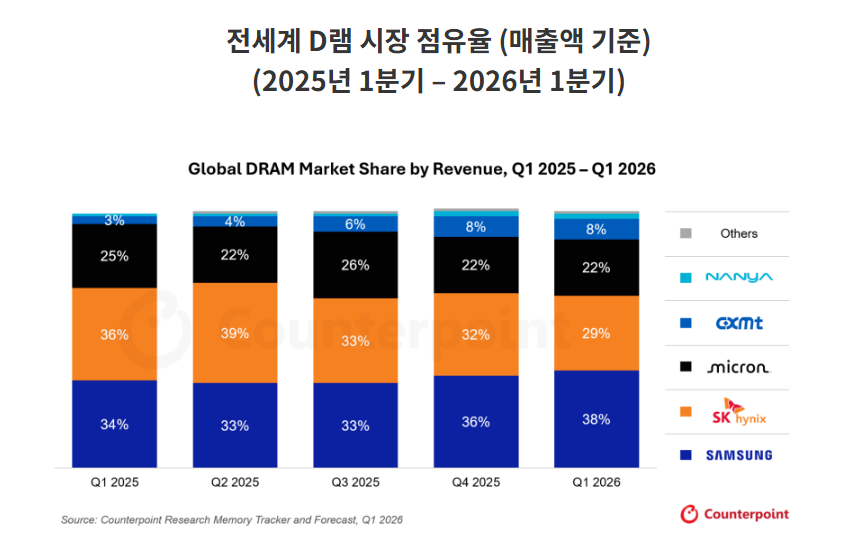
Samsung Electronics expanded its DRAM share from 36% in the fourth quarter of last year to 38% in the first quarter of this year, while SK Hynix slipped from 32% to 29% over the same period. The gap between the two widened from 4 percentage points in the fourth quarter of last year to 9 percentage points in the first quarter of this year.
SK Hynix had led the DRAM market through the second quarter of last year, posting shares of 36% in the first quarter and 39% in the second quarter — both ahead of Samsung. The two companies were tied at 33% each in the third quarter, before Samsung pulled ahead in the fourth quarter.
Samsung's larger production capacity relative to SK Hynix allowed it to flood the market with volume as the DRAM market expanded rapidly. Counterpoint Research said the global DRAM market grew 80% quarter-on-quarter and 260% year-on-year in the first quarter of this year, driven by rising investment in AI servers and growing demand for high-performance memory chips.
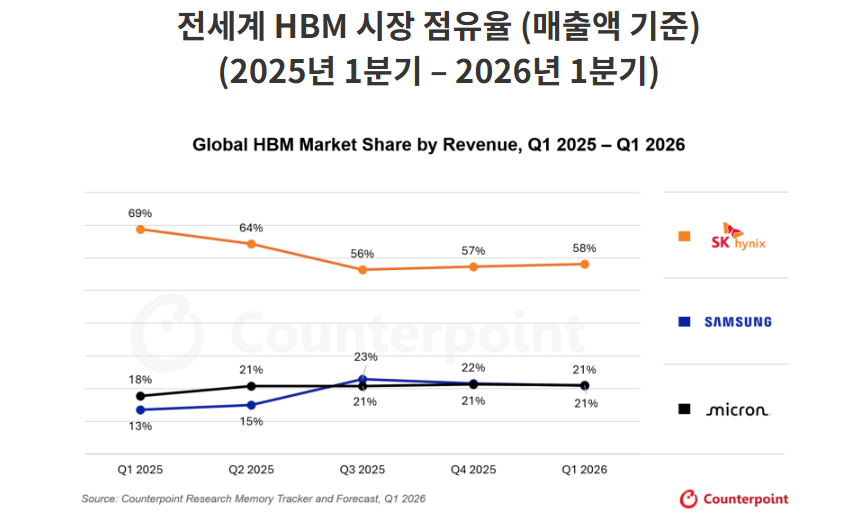
In the HBM market — a three-way contest among Samsung, SK Hynix and Micron — SK Hynix has consistently held a commanding lead. The company maintained its top position with a 58% share in the first quarter of this year, though that was a sharp decline from 69% in the same period last year.
Samsung, meanwhile, managed to claw back some ground. Its HBM share climbed from 13% in the first quarter of last year to 21% in the first quarter of this year. Micron's share grew by 3 percentage points over the same period, from 18% to 21%.
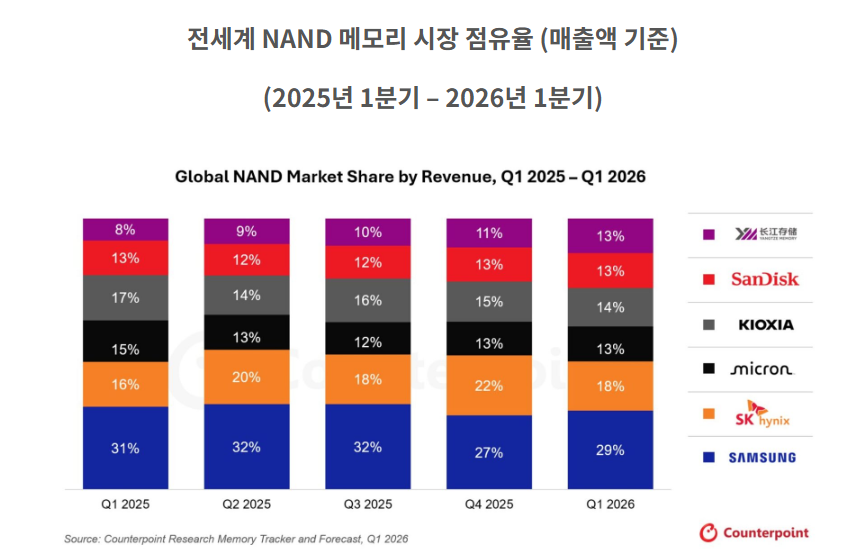
In the global NAND market, Samsung and SK Hynix ranked first and second with shares of 29% and 18%, respectively. Japan's Kioxia held 14%, while Micron, SanDisk and China's YMTC each recorded 13%. The NAND market grew 90% quarter-on-quarter in the first quarter of this year, buoyed by rising prices.
The concern is that as the DRAM and NAND markets have expanded rapidly, Chinese companies have moved quickly to fill the supply shortages that South Korean firms left unaddressed. CXMT, which held just a 3% share in the DRAM market in the first quarter of last year, solidified its fourth-place position with an 8% share in the first quarter of this year — trailing only Samsung, SK Hynix and Micron.
YMTC's rise in the NAND market has been equally striking. While Samsung's share edged slightly lower over the past year, YMTC more than doubled its position, jumping from 8% in the first quarter of last year to 13% in the first quarter of this year — putting it on par with Micron and SanDisk.
South Korean memory chip makers are watching Chinese firms' faster advance in NAND more closely than in DRAM. "In the case of CXMT, there is roughly a three-year technology gap with domestic companies in HBM, but the technology barrier in NAND is relatively lower than in DRAM," an industry official said. "At this point, YMTC is ahead of CXMT in both technology and production capacity."
go@heraldcorp.com





