Credit loans unchecked, leaving reduction goal 688.3 billion won short
Mortgage cuts exceed target, but other loans triple their limit
Banks shift lending room from mortgages to other credit
Mortgage insurance curbed, preferential rates trimmed

South Korea's four major commercial banks trimmed their mortgage loan balances by nearly 350 billion won ($226 million) beyond their targets through May, yet surging credit loans left total household lending about 690 billion won short of the reduction goal for the period. Banks effectively redirected the room freed up by mortgage cuts into other lending categories — chiefly credit loans. Analysts warn the resulting tightening could bring on a "transaction cliff" — the sharp drop in loan availability that normally appears at year-end — as early as the second half of this year.
Data the Financial Supervisory Service submitted to the office of People Power Party lawmaker Lee Yang-su, a member of the National Assembly's Political Affairs Committee, showed that the four major banks — KB Kookmin Bank, Shinhan Bank, Hana Bank and Woori Bank — had set a combined target of reducing household loans by 3.8539 trillion won from their end-of-last-year balances through May, but the actual reduction came to only 3.1656 trillion won. The shortfall against the original target stood at 688.3 billion won.
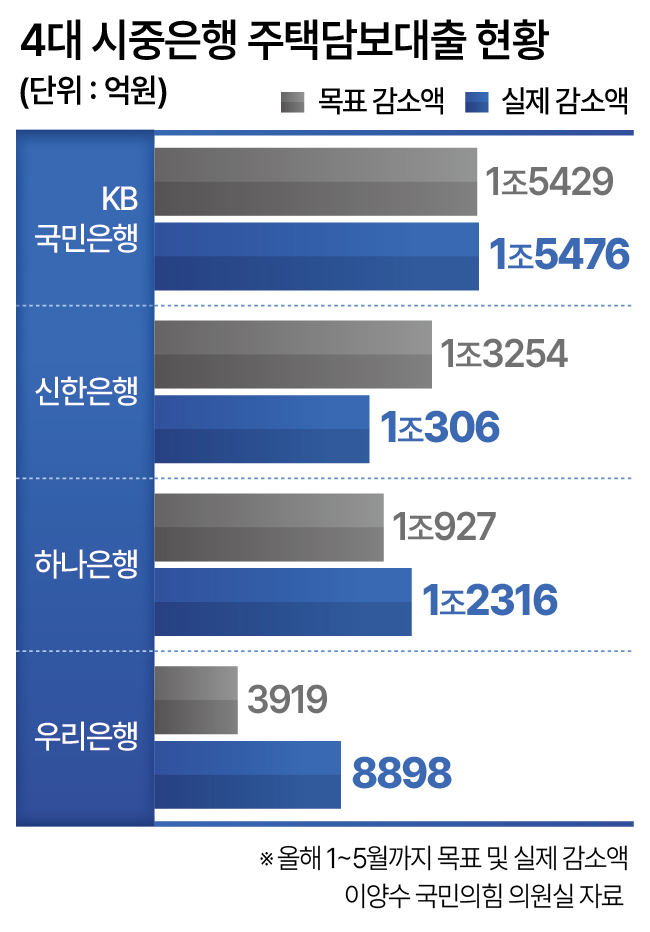
Mortgage loans broadly met the reduction targets agreed with financial regulators, but the banks failed to rein in other loans, led by credit lending. Breaking down the figures by loan type, mortgage balances fell by 4.6996 trillion won, exceeding the 4.3529 trillion won target by 346.7 billion won. Other loans, including credit loans, grew by 1.534 trillion won — more than three times the 499 billion won increase that had been planned — weighing heavily on overall household loan management.
The household loan volume management system works by assigning each bank an annual household loan growth target. This year, the four major banks received a combined ceiling of 3.4663 trillion won in permissible household loan growth. To prevent a year-end lending cliff, the banks have been managing their totals conservatively in the first half — setting tight mortgage targets — while planning to deploy remaining capacity in the second half. Other loans, by contrast, are distributed evenly throughout the year.
At the individual bank level, mortgage reductions were broadly on track with regulator-agreed targets. KB Kookmin Bank cut 1.5476 trillion won against a target of 1.5429 trillion won. Hana Bank reduced 1.2316 trillion won, surpassing its 1.0927 trillion won target. Woori Bank cut 889.8 billion won, far exceeding its 391.9 billion won target. Shinhan Bank, however, fell short: it aimed to cut 1.3254 trillion won but achieved a reduction of only 1.0306 trillion won.
A record wave of debt-fueled investing has shifted the household loan management burden from mortgages to credit loans. KB Kookmin Bank has responded by channeling virtually all of its regulator-assigned household loan growth capacity into credit lending. With a household loan growth ceiling of 909.2 billion won this year, the bank plans to cut its mortgage balance by 417.2 billion won while expanding other loans by 1.3264 trillion won.
Financial regulators have recently ordered banks to tighten monthly household loan management and are closely monitoring credit loan growth trends. Major banks have responded by cutting credit loan limits and adjusting preferential rates. Even mortgage lending, which had been managed conservatively within permitted ranges in the first half, is now being proactively tightened ahead of a potential surge in the second half.
Mortgage borrowing conditions are already tightening. Hana Bank will suspend new subscriptions to mortgage credit insurance (MCI and MCG) starting July 1. When MCI and MCG coverage is unavailable, borrowers can only receive loans net of the small-tenant deposit protection amount, reducing the maximum loan available by about 55 million won in Seoul and about 48 million won in Gyeonggi Province. NH NongHyup Bank has already blocked new mortgage insurance subscriptions, and KB Kookmin Bank said it would suspend new sign-ups starting Friday.
Interest rates are also rising in quick succession. IBK Industrial Bank of Korea will cut its in-person mortgage loan rate discount entitlement — excluding cycle-type loans — by 0.5 percentage point starting June 30. Discount entitlements on fixed- and variable-rate jeonse loans will be trimmed by 0.2 percentage point, and the special automatic discount on its i-ONE salaried worker smart loan will be reduced by 0.3 percentage point. When discount entitlements are reduced, the actual borrowing rate paid by customers rises by the same margin. Woori Bank will also discontinue preferential rates on its "Woori Apartment Loan" mortgage product starting next month.
Stock-related debt investing surged 11.2 trillion won to a record high. The increase in securities firm borrowings for equity investment this year was the largest since records began, driven by a sharp rally in share prices. The Bank of Korea has noted that the recent "debt investing" phenomenon — borrowing to invest — is amplifying volatility in the stock market.

forest@heraldcorp.com