
NPS domestic stock weight smaller than Japan's, market share similar at around 6%
Undervaluation overstates NPS's footprint — the room needs to get bigger, not the table smaller
The National Pension Service's adjustment of its domestic stock allocation appears set to proceed in earnest from July, raising significant questions about the direction of a Kospi that has already seen sharp gains and rising volatility.
Proper asset allocation to guard against concentration risk is a reasonable requirement for any manager of the public's retirement savings. But with foreign investors already dumping rebalancing sales and the exchange rate under pressure, is it truly rational for the NPS to join the selling queue and push even more money into overseas investments?
Two questions follow. How are target allocations determined in the first place? And is the NPS's current domestic stock position actually too large relative to the size of the market?
NPS domestic stock target raised to 20.8%; Japan's GPIF already at 25%
On May 28, the NPS Fund Management Committee raised the domestic stock target allocation from 14.9% to 20.8%, a move designed to address the fact that the Kospi's surge had pushed the actual weighting well above the previous target. The committee did not disclose the revised strategic asset allocation (SAA) tolerance band, which had previously stood at plus or minus 5 percentage points. The overseas stock target was set at 34.7%. Market participants estimated that by end-May, the NPS's domestic stock holdings had grown to roughly 25% of the total stock market.
Japan's Government Pension Investment Fund (GPIF) — the model most heavily referenced when the NPS was first designed in 1986 and 1987 — currently targets a 25% domestic stock allocation, with a permitted deviation of plus or minus 6 percentage points. That is roughly in line with the NPS's estimated current holding. The GPIF's overseas stock target stands at 25%, considerably lower than the NPS's equivalent figure.
Pension funds' market share similar in Korea and Japan — no urgent need to sell heavily
Public pension funds tend to accumulate large stakes in their home markets over decades of contributions. As their share of the stock market grows, the so-called "whale in a pond" effect means their trading moves markets. Just how large a whale is the NPS?
As of Friday, the combined market capitalization of the Kospi and Kosdaq stood at approximately 7,400 trillion won ($4,790 billion). Estimating the NPS's domestic stock holdings at around 500 trillion won on the same date implies a market share of roughly 6.76%. That figure has ranged from 6.29% to a peak of 7.47% in 2020, fell to 5.79% in 2023, and recovered to 6.62% by end-2025. Is 6.76% actually high?
Japan offers a useful comparison. According to the GPIF's fiscal year 2024 operations report, the fund held a 6.42% share of the Japanese stock market as of end-March 2025. Adjusting for share price gains and net inflows through Friday, the GPIF's domestic stock holdings are estimated at up to 85 trillion yen ($525 billion), implying a market share of at most 6.4%. The gap with the NPS is not particularly wide. (※ The difference between the Korean and Japanese governments' approaches to pension sustainability will be addressed in a future column.)
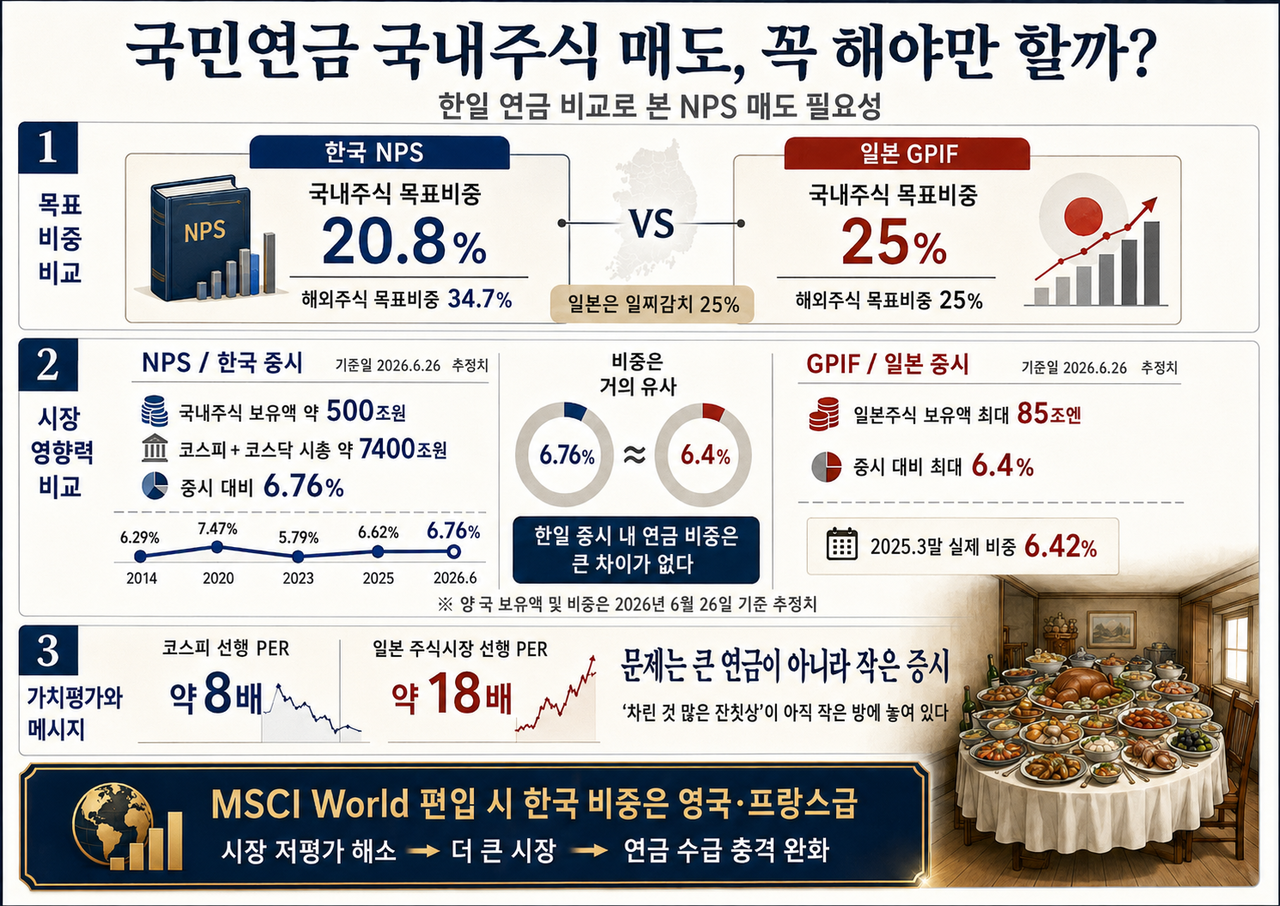
A well-laid feast in a cramped room — time to move to a bigger house
There is one more factor to examine: the valuation level of the market capitalization that forms the denominator. The Nikkei's 12-month forward price-to-earnings ratio stands at around 18 times, partly reflecting Japan's status as the second-largest market in the MSCI Developed Markets index. The Kospi's forward PER is around 8 times — below not only Taiwan and India, which trade at roughly 20 times within the MSCI Emerging Markets index, but also mainland China's CSI 300 at 13 times.
The biggest factor is the explosive, short-cycle earnings growth of chipmakers, which account for more than half of the Korean market. At the same time, despite economic fundamentals that are by any measure on par with developed nations, the capital and financial market infrastructure still falls short of the global standard expected of peer countries — a gap that has kept the Kospi out of the MSCI Developed Markets index.
It is as if a lavishly prepared banquet table has been set in a room too small to seat the guests. The right answer is to enlarge the room and welcome more visitors — not to clear away the food.
Were the Korean stock market included in the MSCI World index, its weighting would be comparable to that of the United Kingdom or France, placing it among the top markets after the United States and Japan. A larger influx of global capital would resolve the undervaluation, allowing the NPS to hold more domestic stocks while minimizing supply-demand shocks when it does need to rebalance.
If you can afford to move to a bigger house, why rearrange the furniture to fit a smaller one?
kyhong@heraldcorp.com





