Report by nonprofit Climate Solutions finds disclosure-based rules fall short of enforcement

South Korea's environmental, social and governance fund market is growing rapidly, but a structural greenwashing problem is embedded in the market because the regulatory framework lacks the tools to ensure fund names match actual investment practices, according to a new analysis.
A report published Monday by nonprofit Climate Solutions, titled "How to Address Greenwashing in ESG Funds: Overseas Regulatory Cases and Implications for Korea," found that while South Korea has entered the disclosure phase of ESG regulation, it has yet to advance to the stage of verifying actual investment structures.
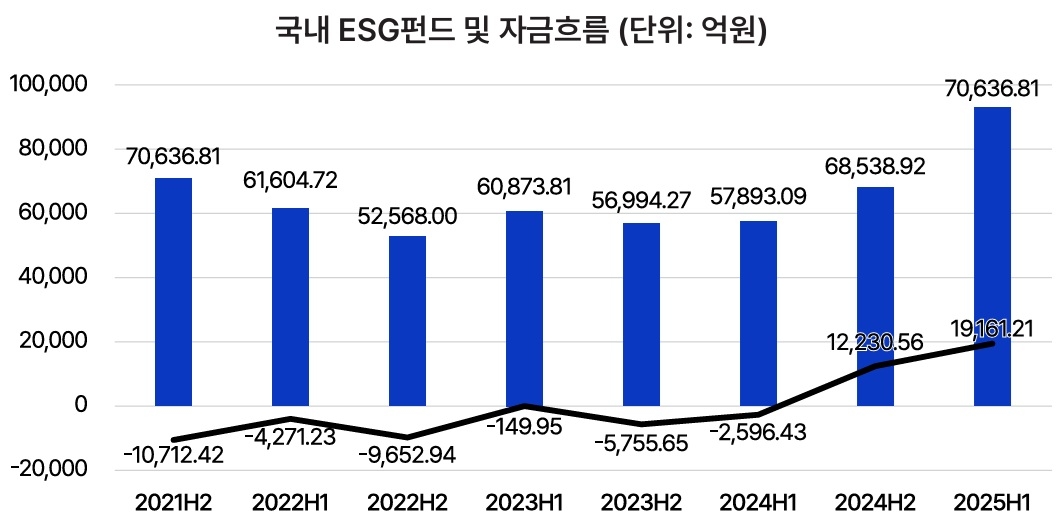
The global ESG fund market grew roughly eightfold — from about $510 billion in 2019 to about $4.13 trillion in 2025, the report said. South Korea's domestic ESG fund market expanded at a similar pace over the same period, reaching about 9.38 trillion won ($6.07 billion) by 2025, a 37 percent increase from the previous year.
An analysis of domestic ESG funds found that many bond and equity funds using names such as "green," "sustainable" or "eco-friendly" hold investments in companies listed on the Global Coal Exit List 2024, the Global Oil & Gas Exit List 2024 and the Financial Exclusions Tracker 2024.
The report said the findings reflect not individual misconduct by asset managers but a structural problem rooted in a regulatory framework that does not require consistency between a fund's name and its actual investments.
South Korea's ESG fund regulations require asset managers to disclose their ESG investment strategies and evaluation criteria, but set no quantitative standard for how closely a fund's actual asset composition must reflect those stated strategies.
The result, the report said, is an asymmetry in which regulations govern what managers say they will invest in, but not whether they actually invest accordingly.
By contrast, the US Securities and Exchange Commission requires funds using ESG-related names to invest at least 80 percent of their total assets in line with the stated investment strategy.
The EU has codified minimum investment thresholds and fossil fuel exclusion criteria through its Sustainable Finance Disclosure Regulation and fund-naming guidelines. Singapore similarly requires at least two-thirds of a fund's net assets to align with its ESG strategy.
South Korea, by comparison, has no confirmed cases of official sanctions against ESG fund greenwashing to date.
Disclosure obligations exist, but the absence of quantitative standards for verifying and penalizing actual investment practices makes it difficult to define a violation in the first place. The report frames ESG fund greenwashing as a problem of distorted capital allocation, not merely a financial product issue.
When investors commit funds intending to support green or low-carbon transitions but the money flows instead into high-carbon industries, the market suffers a double loss: investor trust is eroded, and the capital needed for climate action fails to reach the industries that require it.
The regulatory gap in ESG funds ultimately risks leaving South Korea behind in its capacity to mobilize climate transition finance, the report said.
![[123RF]](https://wimg.heraldcorp.com/news/cms/2026/06/29/news-p.v1.20260629.3cc6c26b0d2642c0bb526ca78d4aecc7_P1.jpg)
To close the gap, the report proposed introducing a minimum investment threshold of 70 to 80 percent alongside explicit fossil fuel exclusion criteria, and using existing provisions under the Capital Markets Act on false or misleading disclosures to sanction misuse of ESG fund names even before formal regulatory reforms are in place.
Choi Yun-jae, a legal researcher on Climate Solutions' legal team and the report's author, said the current ESG fund market operates under a structure in which fund names and actual investment content cannot be considered consistent. "We need to move away from a simple disclosure-centered system toward regulation that combines portfolio standards with enforcement," Choi said.
Choi added that ESG greenwashing is not merely a matter of labeling but a structural market problem that determines where capital flows. "Clear standards and an enforcement framework must be established urgently to maintain investor trust and ensure the effectiveness of climate action," Choi said.
thlee@heraldcorp.com